
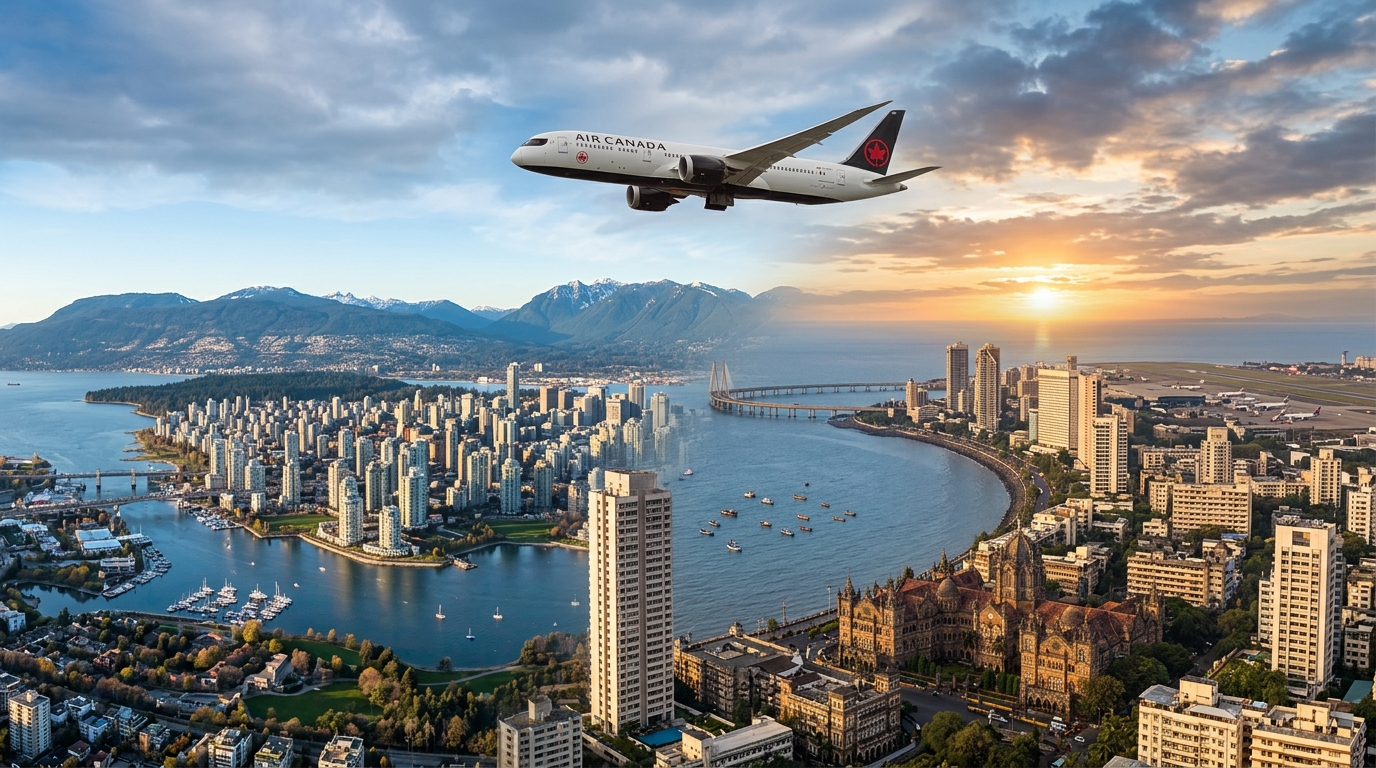
The Vancouver-Mumbai Direct: Why Air Canada’s New 2026 Route is a Game Changer for the West Coast
The first-ever non-stop link between Western Canada and India’s financial capital is finally here, cutting travel time by 10 hours.
Ten hours. That is the literal day of your life Air Canada just handed back to you. On September 3, 2026, the airline officially announced its landmark non-stop service between Vancouver (YVR) and Mumbai (BOM), finally bridging the gap between Western Canada and India’s financial powerhouse.
For years, the "West Coast Shuffle" was a rite of passage. You either braved the slog through London Heathrow, risked the tight connections in Dubai, or flew east to Toronto just to fly back west over the pole. Now, the 16-hour marathon happens in one shot. But while the headline is about the time saved, the reality of surviving a 14,000-kilometer flight requires more than just a boarding pass. If you’re planning to be on one of the inaugural flights in 2026, you need a strategy that starts long before you hit the tarmac at Chhatrapati Shivaji Maharaj International Airport.
The 787-9 Strategy: Choosing Your Battle Station
Air Canada is deploying the Boeing 787-9 Dreamliner on this route. This is good news. The Dreamliner’s higher cabin humidity and lower pressurization altitude (6,000 feet vs. the standard 8,000 feet) are the only things standing between you and feeling like a piece of dried leather upon arrival.
However, not all seats are created equal for a 16-hour haul. In Economy, avoid the last three rows (55-58). The taper of the fuselage means the floor space is slightly cramped, and the proximity to the rear galleys means you’ll be serenaded by the sound of meal carts for the duration of the flight. If you can’t swing Signature Class, aim for the "preferred" seats in the front of the Economy cabin. The extra four inches of legroom isn't just a luxury; it’s a deep-vein thrombosis prevention strategy.
Surprising Tip: Most travelers gun for the bulkhead seats for the extra legroom. On a flight this long, don't. Bulkhead seats have fixed armrests (because the tray table is tucked inside them), which reduces your seat width by about an inch. Over 16 hours, that inch matters more than the legroom. You want the ability to lift the armrest if the seat next to you is empty—the "Poor Man’s Business Class" is only possible if your armrests move.
Connectivity and the "Arrival Fog"
Mumbai is a sensory assault. Even if you’ve been there ten times, landing at 2:00 AM after 16 hours in a pressurized tube leaves you in a mental fog. The last thing you want to do is haggle with a taxi driver or stand in a 40-minute queue for a local SIM card while clutching a stack of physical documents.
Skip the airport kiosks entirely. They are notoriously slow and often require physical photos and passport copies that take hours to "activate." Instead, set up an India eSIM before you even leave Vancouver. Having data the second your wheels touch the ground means you can bypass the chaos and call a reliable Uber or Ola from the dedicated ride-share zone in Terminal 2.
While we’re on the subject of digital prep: India’s public Wi-Fi is surprisingly widespread but can be a security nightmare for the uninitiated. If you’re planning to check bank balances or work from a cafe in Bandra, using a Secure VPN isn't optional—it’s a basic requirement to keep your data from leaking onto an open network.
Navigating the BOM Arrival
Chhatrapati Shivaji Maharaj International Airport (BOM) is a literal museum—Terminal 2 houses one of the world's largest art programs. But don't get distracted yet.
Once you clear customs, you’ll be funneled toward the exit. The heat hits you first. Even at midnight, Mumbai’s humidity is a physical weight. If you haven't pre-booked a transfer, head to the "Prepaid Taxi" counter inside the arrivals hall. It’s a fixed-rate system that prevents the "scenic route" surcharge. If you prefer a more seamless experience, booking an airport transfer in advance allows you to look for a placard with your name on it, which is the ultimate stress-reducer after a trans-Pacific journey.
Beyond the Gateway: The Mumbai You’re There to See
Mumbai isn't a city of "sights" in the traditional sense; it’s a city of neighborhoods. Since you’ve saved 10 hours on the flight, spend that extra time exploring the areas that the tour buses usually gloss over.
Start with a walk down Marine Drive at sunset. It’s known as the "Queen’s Necklace" because of the way the streetlights curve around the bay. It’s where the city comes to breathe. From there, head into the heart of South Mumbai to see the Chhatrapati Shivaji Maharaj Terminus . It’s one of the most functional UNESCO World Heritage sites in the world—a Gothic-revival masterpiece that handles millions of commuters daily.
If you want to escape the tourist trail, take a taxi to Khotachiwadi . It’s a tiny heritage village of 18th-century Portuguese-style bungalows tucked away in the middle of the skyscraper-heavy Girgaon district. It feels like a glitch in the matrix—quiet, colorful, and completely at odds with the frantic pace of the surrounding city.
The "Empty Seat" Gamble
Because this is a brand-new route, the flight loads in the first few months of 2026 will be unpredictable. Use a flight tracker like PingWing to monitor the flight’s status and history. If you notice the flight is consistently under-booked on certain days of the week (usually Tuesdays or Wednesdays), that is your signal to hold off on selecting a seat until the 24-hour check-in window.
When the seat map opens, look for rows where the middle seat is empty. On a 16-hour flight, the difference between a full row and an empty middle seat is the difference between sleeping and merely hallucinating from exhaustion. If the flight looks packed, you can use the same tool to book a cheap flight on an alternative date if your schedule is flexible.
Survival Gear: What to Pack in Your Personal Item
Don't rely on the airline's amenity kit. For a flight this long, your personal bag needs to be a survival kit:
- Electrolyte Tablets: Plain water isn't enough when you're being dehydrated by airplane air for 16 hours. Drop a Nuun or Hydralyte tablet into your bottle every four hours.
- Noise-Canceling Headphones: This isn't for the movies; it’s for the "engine hum fatigue." Even if you aren't listening to anything, the active noise cancellation reduces the cognitive load on your brain.
- A Physical Book: Somewhere over the Pacific, your eyes will get "screen fatigue." Having a paper book is a necessary reset for your brain.
- Melatonin: If you’re landing in Mumbai at 2:00 AM, you need to sleep for at least 4 hours of the flight to survive the following day. Time your dose for the middle of the flight, not the beginning.
The Long Game
The YVR-BOM direct route is more than just a convenience for the Punjabi and Gujarati diaspora in BC; it’s a signal that the aviation world is finally acknowledging the West Coast as a primary gateway to South Asia. We are moving away from the era of the "hub-and-spoke" model where every long trip required a stop in a global megahub.
But direct doesn't mean easy. 16 hours is still 16 hours. The "game-changer" isn't just the route—it’s how you use the 10 hours you just got back. Don't spend them recovering from a poorly planned flight. Plan the seat, sort the data, and hit the ground running.
Mumbai is waiting. And for the first time, it’s just one long nap away.