
The Nusantara-Singapore Direct: Why You Can Finally Skip the Jakarta Layover to IKN
Travelers can now fly directly to Indonesia’s new capital, cutting travel time by 4 hours and avoiding the chaotic CGK transit.
Four hours. That is the minimum "tax" you used to pay for the privilege of visiting Indonesia’s ambitious new capital. You’d fly into Jakarta’s Soekarno-Hatta (CGK), navigate the humid sprawl of Terminal 3, clear immigration, wait for a domestic connection, and then fly another two hours to Balikpapan before enduring a bumpy car ride.
That era of transit-induced headaches is officially ending. The Indonesian Ministry of Transportation has confirmed that international flight slots for Nusantara (IKN) Airport will open on October 1, 2026, with Singapore designated as the very first international destination.
This isn't just another route on a map. It is the bypass that travelers, investors, and the "curious-about-the-future" crowd have been waiting for. If you are planning a trip to the world's most talked-about "forest city" in late 2026, here is why the direct flight from Changi (SIN) changes everything and how to navigate the logistics of a city that is still technically being built.
The Death of the CGK Layover
Jakarta is a world-class city, but CGK is often a bottleneck for international travelers heading anywhere else in the archipelago. The domestic-to-international transfer usually requires a change of buildings, a luggage re-check, and a battle with some of the most unpredictable traffic in Southeast Asia if you’re unlucky enough to have a long layover and try to leave the airport.
By flying direct from Singapore to Nusantara, you aren't just saving time; you’re saving your sanity. The flight time from SIN to the new IKN Airport is projected to be roughly 2 hours and 15 minutes. Compare that to the 7-to-9-hour ordeal of a traditional transit through Jakarta. You leave Changi after a morning laksa and arrive in the heart of East Kalimantan before lunch.
For the frequent flyer, this means the "day trip" or the "quick weekend look" at the new capital becomes a reality. It shifts Nusantara from a "major expedition" to a "regional hop."
The Airport: Not Just a VIP Strip
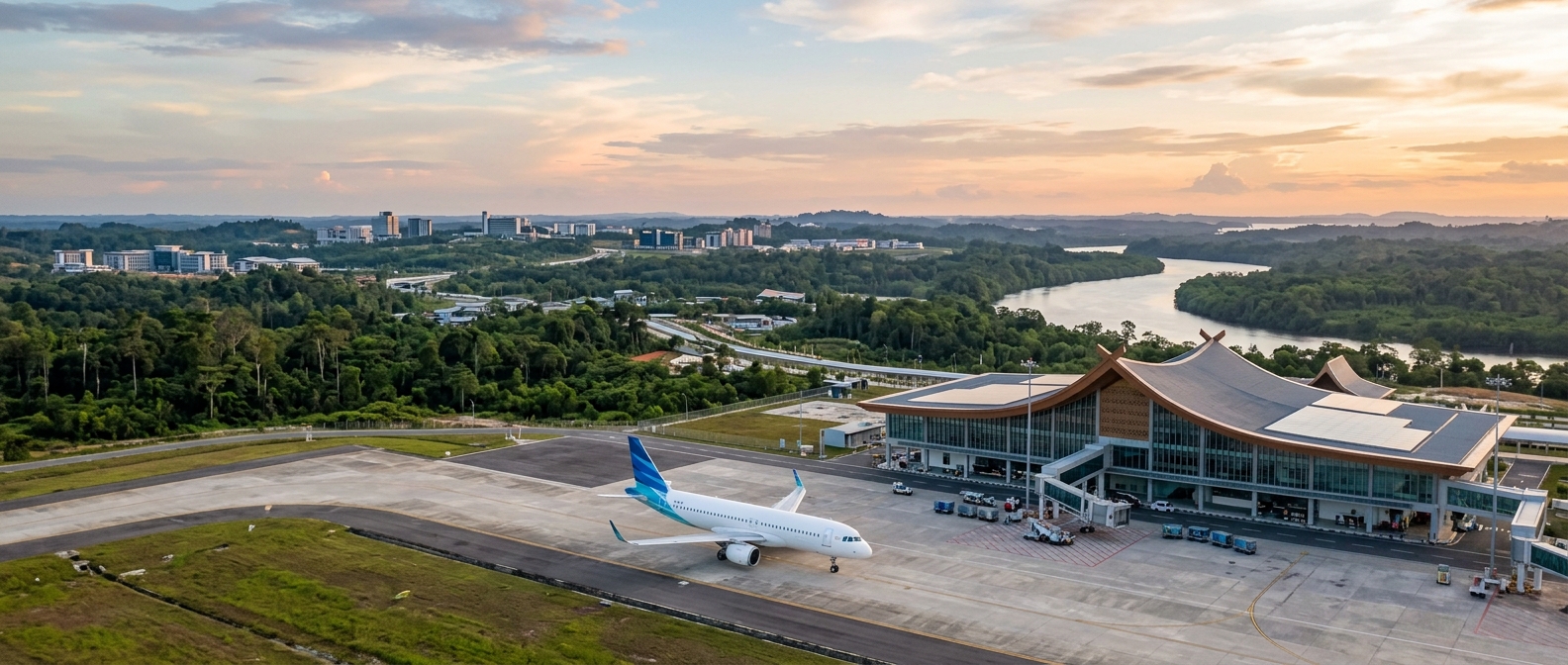
There has been a lot of chatter about the IKN Airport being a "VVIP-only" facility. That was the initial plan, but the reality of 2026 is much more democratic. The runway has been extended to 3,000 meters, specifically to accommodate wide-body aircraft like the Boeing 777 and Airbus A330.
While the VVIP terminal remains for heads of state, the commercial terminal is where the action is. When you land, don't expect the infinite shopping malls of Changi or the chaotic energy of Jakarta. Expect a terminal designed with "green" architecture—lots of natural light, airflow, and a distinct lack of the plastic-heavy aesthetic found in older regional airports.
Why Singapore First?
The choice of Singapore as the inaugural international link isn't accidental. Singapore is the primary financial hub for the IKN project. Most of the architects, urban planners, and green-tech investors are based in the Little Red Dot.
While Garuda Indonesia will likely lead the charge, keep an eye on Scoot and Singapore Airlines. Scoot, in particular, has a history of pioneering "secondary" Indonesian routes (like their successful runs to Manado and Makassar), making them the likely candidate for the budget-conscious traveler looking to see the capital without a corporate expense account.
The Surprising Tip: The "Digital Ghost" Problem
Here is something most travel blogs won't tell you: Nusantara is being built as a "Smart City," but the digital infrastructure is currently a patchwork. Because the city is a massive construction site, cell towers are frequently moved, and signal dead zones are common near the peripheral construction sectors.
Even though the city aims for 5G ubiquity, the transition period in late 2026 will be messy. Don't rely on the "smart" features of the city to navigate or pay for things in the early days. You will want a robust data plan the second you touch down to avoid being stranded in a city that is still learning its own layout. Getting an Indonesia eSIM before you board at Changi is the smartest move you can make; it ensures you have local network access for ride-hailing apps that are essential for getting from the airport to the Government Core Area.
What to Actually See in October 2026
If you’re on those first flights, you aren't visiting a finished museum. You’re visiting a living laboratory.
- The Garuda Palace: The iconic eagle-shaped presidential palace is the center of the city. It’s breathtaking from the air, but the scale is only truly felt from the ground.
- Plaza Seremoni : This is the heart of the "civic" experience. It’s where the major public gatherings happen and offers the best views of the surrounding "Sumbu Kebangsaan" (National Axis).
- The Sumbu Kebangsaan : A massive, landscaped parkland that connects the various government buildings. It’s designed for walking—a rarity in Indonesian urban planning.
- Mentawir Mangrove Forest : Just a short drive from the city center, this is a reminder of why this location was chosen. It’s a glimpse into the raw, prehistoric beauty of Borneo that the city is trying to coexist with.
Logistics: The "New Capital" Tax
Nusantara is not a budget destination—yet. Because almost everything (from bottled water to cement) has to be brought in, prices for mid-to-high-end accommodation are currently higher than in Bali or Jakarta.
Most travelers in 2026 will likely stay in "Glamping" setups or newly opened business hotels in the Sepaku District . If you are looking for a more traditional luxury experience, you might still find yourself staying in Balikpapan and commuting, though the new toll road has cut that drive down to about 45 minutes.
Given the fluctuating nature of a city under construction, things can go wrong. Flights might be diverted if the tropical rains are particularly heavy, or your "smart" hotel might have a power glitch. This is one of those rare times where I’d actually suggest that Travel Insurance is a non-negotiable part of the budget. It’s a "frontier" capital; treat it with the same caution you’d give any high-growth, high-activity zone.
Planning Your Itinerary
Since the city is being built in phases, your itinerary needs to be flexible. You don't want to spend three days looking at scaffolding. A 48-hour trip is usually enough to see the architectural highlights and the surrounding nature preserves.
To make sense of the rapidly changing landscape, you can use an AI Trip Planner to map out your route. It can help you balance the "official" government sites with the natural escapes like the Bangkirai Hill Canopy Bridge, which is a bit further out but essential for understanding the Borneo landscape.
The "Nusantara Shift"
The Singapore-IKN direct flight is more than just a convenience; it’s a symbol. For decades, Indonesia was a "monocentric" country—everything flowed through Jakarta. By establishing a direct international link from Singapore to the heart of Borneo, Indonesia is effectively decentralizing its future.
When you land at Nusantara Airport in October 2026, you won't feel the history of the place—there isn't much yet. Instead, you'll feel the friction of the new. The smell of freshly poured concrete mixed with tropical rain. The sight of electric buses gliding past ancient trees.
It’s not often we get to see a capital city born in real-time. Skipping the Jakarta layover isn't just about saving four hours; it’s about arriving at the future with enough energy left to actually see it. Bookmark the route, set your flight alerts, and prepare for a version of Indonesia that looks nothing like the one you know.