
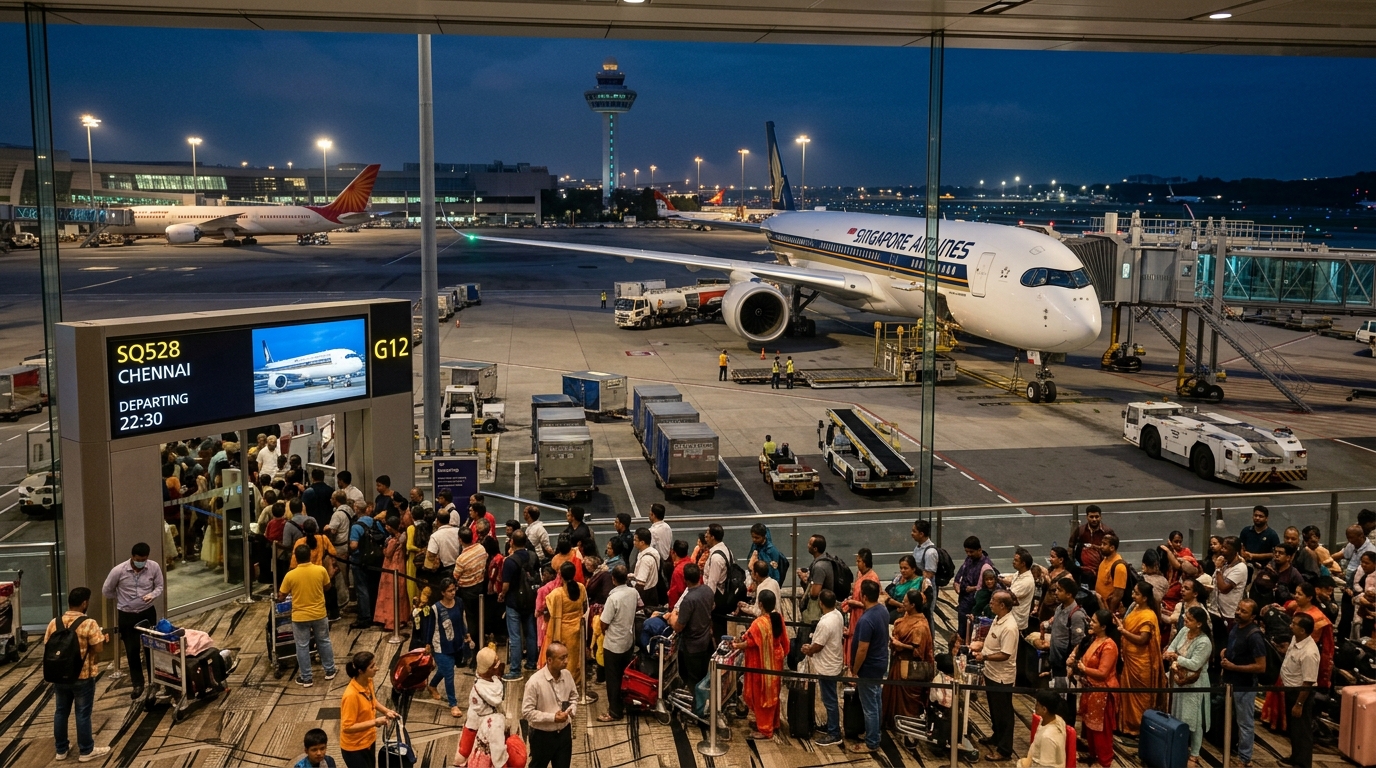
The October 20th Deepavali Crunch: Why Singapore-India Fares Just Tripled
With Deepavali falling on a Tuesday this year, the "long weekend" exodus is causing a massive price spike on routes to Chennai and Delhi.
A direct flight from Singapore (SIN) to Chennai (MAA) usually hovers around the $350 mark. If you look at the calendars for October 16, 2026, that same seat is currently quoted at $1,100—and it’s only going up.
Deepavali 2026 falls on Tuesday, October 20, creating a massive peak travel window from October 16–21 as travelers bridge the Monday holiday to secure a five-day escape. For the Singapore-India corridor, this isn't just a busy weekend; it is a mathematical certainty that demand will outstrip supply by a factor of three. If you are planning to head home or visit family, the "wait and see" approach is a financial death sentence for your budget.
The "Tuesday Trap" and the Monday Bridge
In the world of aviation scheduling, a Tuesday public holiday is the ultimate catalyst for price surges. When a holiday falls on a Thursday, people split their leave. When it falls on a Tuesday, the entire workforce moves as a single, monolithic block.
By taking Monday, October 19 off, thousands of professionals in Singapore's tech, finance, and construction sectors create a "super-weekend." The exodus starts the moment the clock hits 6:00 PM on Friday, October 16. Because everyone is targeting the same Friday night and Saturday morning departures, the algorithms used by Singapore Airlines, IndiGo, and Air India respond with aggressive price hikes.
It’s not just the departure that’s the problem. The return leg on Wednesday, October 21, is seeing a similar vertical climb. You aren't just competing with tourists; you’re competing with the 650,000-strong Indian diaspora in Singapore, all trying to squeeze into a finite number of metal tubes.
The Chennai vs. Delhi Divide
The "Deepavali Crunch" hits different routes with varying intensity. Chennai (MAA) and Tiruchirappalli (TRZ) are the hardest hit due to the high volume of South Indian families living in the Little India precinct and surrounding areas.
Delhi (DEL) and Mumbai (BOM) fares are also spiking, but because these hubs handle more international transit traffic, there’s occasionally a "ghost seat" available on a long-haul flight that hasn't been filled by a London-bound passenger. Chennai, however, is largely a destination-specific route from Singapore. When those seats are gone, they are gone.
Strategy 1: The "Secondary Gate" Maneuver
If you are looking at $1,200 for a direct flight to Chennai, stop looking at Chennai.
Consider flying into Tiruchirappalli (TRZ) or even Coimbatore (CJB). While these airports also experience spikes, they often lag 24–48 hours behind the primary hubs in their pricing updates. Better yet, look at the "Bus + Flight" combo. A flight to Bangalore (BLR) followed by a luxury sleeper bus or a short domestic connection can often save you $400.
Another "stealth" option is flying via Kuala Lumpur (KUL). AirAsia and Malaysia Airlines often run aggressive promotions for the India sector to undercut Changi-based carriers. Even with the added layover, the savings for a family of four can easily cover the cost of the entire trip's gifts and sweets.
Strategy 2: The Sacrificial Tuesday
The most counterintuitive way to save money during Deepavali is to fly on the day itself.
While everyone wants to be home by Monday night to start the celebrations, flights departing on Tuesday morning (October 20) are significantly cheaper. You might miss the morning prayers, but you’ll arrive in time for the evening festivities with an extra $600 in your pocket. In 2026, the price delta between a Saturday departure and a Tuesday departure is expected to be the widest we've seen in five years.
Connectivity and Logistics
Once you land, the last thing you want to deal with is a non-functional SIM card while trying to coordinate a pickup in the chaotic arrivals hall of Delhi or Chennai. Local SIM registration in India can be a bureaucratic nightmare involving physical photos and local references.
I highly recommend sorting your data before you touch down. Grabbing an India eSIM allows you to bypass the airport kiosks entirely. You’ll have 4G or 5G connectivity the moment the wheels touch the tarmac, which is essential for booking an Ola or Uber—often the only way to get a fair price out of MAA or DEL during the holiday rush.
The Surprise Hack: The "Reverse" Booking
Here is a tip most travelers miss: Look at the pricing for "Point of Origin" shifts. Occasionally, if you book a flight as part of a larger itinerary—say, Jakarta to Chennai via Singapore—the system allocates "budget buckets" differently than it does for a simple SIN-MAA point-to-point.
Additionally, check the prices in Indian Rupees (INR) on the airline’s local Indian site versus the Singapore Dollar (SGD) site. While currency conversion usually levels the playing field, some LCCs (Low-Cost Carriers) offer "domestic-only" promotions that occasionally leak into the regional international routes if you book through the right portal.
Avoid the "Ghost Capacity" Trap
Be wary of booking with smaller, struggling carriers that suddenly announce "seasonal charters" for the Deepavali period. Every year, a few fly-by-night operations promise low fares and then cancel the flights two weeks before the holiday due to "operational reasons," leaving travelers stranded with no affordable alternatives. Stick to the majors:
- Singapore Airlines: High price, high reliability.
- IndiGo: The workhorse. T4 at Changi is efficient, but watch the baggage fees.
- Air India / Vistara: Post-merger, their service levels are stabilizing, and they often have the best meal options for the 4-hour hop.
Timing Your Purchase
If you are reading this and haven't booked for October 2026, you are in the "Yellow Zone."
- The Green Zone (10-12 months out): Prices are at their baseline. This is when the smart money moves.
- The Yellow Zone (6-9 months out): Algorithms start detecting the holiday search volume. Prices begin to creep.
- The Red Zone (Less than 4 months out): You are no longer buying a ticket; you are paying a "convenience tax."
If you find a fare under $550 for the October 16–21 window, book it immediately. Don't wait for a "Friday sale" or a credit card promotion. The demand for this specific Tuesday-holiday bridge is so high that airlines have zero incentive to discount.
Final Thoughts on the Ground
If you do make it home, remember that the chaos doesn't end at the airport. Markets like T. Nagar in Chennai or Chandni Chowk in Delhi will be at a standstill.
The goal isn't just to save money on the flight; it's to save your sanity. By choosing an alternative airport or a slightly "off" travel day, you avoid the worst of the Changi crowds and the bottlenecked Indian immigration queues.
The 2026 Deepavali crunch is a classic supply-and-demand puzzle. You can't change the supply, so you have to be smarter about how you demand your seat. Book the mid-week flight, get your data roaming sorted early, and leave the $1,100 economy seats to the people who didn't check the calendar.