
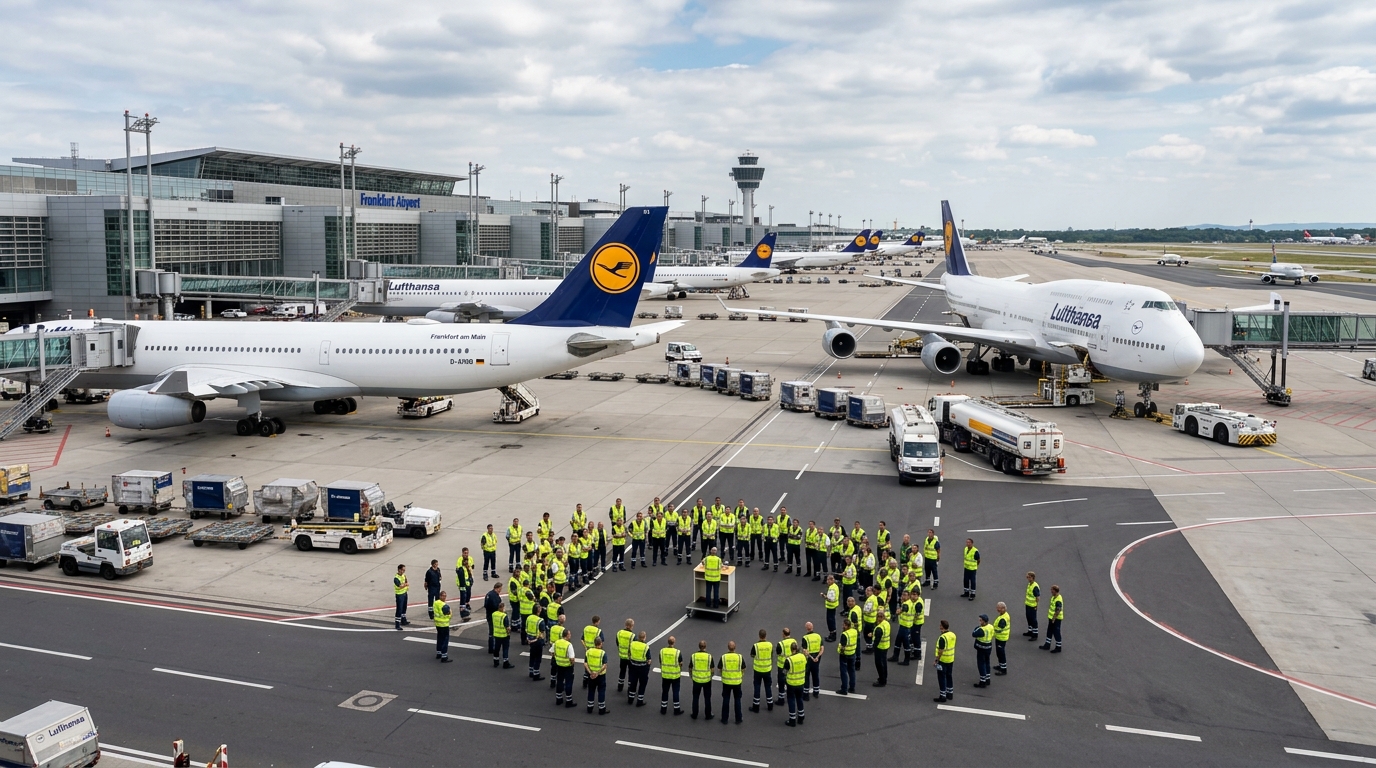
The September 22nd Lufthansa Ground Crew Strike: Which Hubs are Most at Risk?
A major labor dispute is set to ground hundreds of flights across Germany later this month, and travelers need a backup plan now.
A strike is a math problem where the traveler always loses. When the Ver.di union announced a 48-hour "warning strike" for Lufthansa ground crew on September 22-23, 2026, they weren't just signaling a labor dispute; they were effectively deleting thousands of flight hours from the European sky. If you are scheduled to touch down or take off in Frankfurt or Munich during those 48 hours, your itinerary is currently a theoretical concept.
This isn't a "wait and see" situation. Ground crew strikes are particularly lethal to schedules because they involve the people who push the planes back, load the bags, and fuel the engines. Without them, the most advanced Airbus in the fleet is just a very expensive piece of stationary metal.
The Hub Heat Map: Where the Damage Hits Hardest
The strike is surgically targeted at Lufthansa’s two primary arteries: Frankfurt (FRA) and Munich (MUC).
Frankfurt (FRA) is the behemoth. It is the core of the Star Alliance network. If you are flying from New York (JFK) to Delhi (DEL) or London (LHR) to Johannesburg (JNB) with a layover, you are likely passing through here. When FRA ground crews walk out, the ripple effect is global. Terminal 1 becomes a parking lot for frustrated passengers. If you have a connection under three hours in Frankfurt on the 22nd, assume you will miss it.
Munich (MUC) is often touted as the "stress-free" alternative to Frankfurt, but during a strike, that reputation vanishes. Munich handles a massive volume of Lufthansa’s premium and business traffic. Because Munich is a secondary hub, the airline often prioritizes keeping Frankfurt moving, meaning Munich flights are frequently the first to be sacrificed on the altar of "operational necessity."
If your flight involves a smaller German airport—like Stuttgart or Berlin—you aren't safe either. Most of those flights are "spokes" feeding into the Frankfurt and Munich "hubs." If the hub is closed, the spoke has nowhere to go.
The Counterintuitive Move: Don't Wait for the Email
Most travelers wait for the "Flight Cancelled" notification before they act. That is a mistake. By the time that automated email hits your inbox, 50,000 other people have already received it, and the race for the few remaining seats on Swiss, Austrian, or Eurowings has already been won.
Here is the move: If you see your flight is "At Risk" or if the airline has issued a general travel waiver, use it immediately. Lufthansa typically opens up free rebooking windows 48 to 72 hours before a scheduled strike. You don't need a cancellation to move your flight to the 20th or the 26th. Do it now, while the inventory still exists.
If you’re stuck in the middle of a trip, don't waste four hours standing in a "Service Center" line that stretches into the next terminal. Use the PingWing app to track your specific tail number. Often, the tail-tracking data will show a plane hasn't even left its origin point long before the airport departure boards admit the flight is delayed or cancelled.
The "Secret" German Escape Hatch: Deutsche Bahn
Germany has a massive advantage over the US or Australia when aviation fails: the ICE (InterCity Express) train network.
If your domestic German flight or short-haul European flight is cancelled, Lufthansa will often convert your ticket into a "Good for Trains" voucher. You can do this at the automated check-in machines or via the app. Instead of fighting for a seat on a flight three days from now, take the train. A high-speed rail journey from Frankfurt to Munich takes about three hours—roughly the same time you’d spend sitting in a terminal eating an overpriced pretzel.
If you find yourself stuck in Munich for an extra day and want to escape the airport gloom, hop on the S-Bahn to the city center and walk through the Englischer Garten . It’s a better way to spend a "strike day" than staring at a departure board that refuses to change.
The Insurance Trap and the "Extraordinary" Lie
Airlines love the phrase "extraordinary circumstances." They use it to avoid paying compensation under EU 261/2004 regulations. Here is the reality: A strike by the airline's own staff (like Lufthansa ground crew) is generally not considered an extraordinary circumstance. It is considered within the airline's control.
If your flight is cancelled or delayed by more than three hours due to this strike, you are likely entitled to between €250 and €600 in compensation, regardless of whether the airline provides you with food or a hotel. Don't let a gate agent tell you otherwise. If the airline plays hardball, services like AirHelp can handle the legal heavy lifting to get your money back.
Beyond government-mandated compensation, check your private travel insurance. Most "standard" policies have a specific clause for labor disputes, but many require you to have purchased the policy before the strike was officially announced. If you’re planning future travel during the volatile autumn months, getting a robust policy from a provider like Ekta is the only way to sleep soundly.
Survival Logistics: Data and Security
When 20,000 people are all trying to use the same airport Wi-Fi to rebook flights, the network will crash. Or worse, it becomes a playground for data interceptors.
I never travel through FRA without a backup data plan. Instead of hunting for a local SIM kiosk that’s likely closed due to the strike, I use a Germany-specific eSIM to stay connected the second I land. It allows you to bypass the overloaded airport "Free Wi-Fi" and keep your rebooking apps running at full speed.
If you do have to use the airport network to access your banking or airline loyalty accounts, please, for the love of your credit score, use a VPN. Public networks during a crisis are high-traffic areas for "Man-in-the-Middle" attacks. A quick connection via NordVPN ensures that while you’re fighting for a seat, you’re not also giving away your login credentials.
The Ground Crew Reality Check
Why is this strike happening now? Ver.di is pushing for higher wages to combat inflation, and the ground crew—the people who actually make the airport function—feel left behind by the post-pandemic travel surge.
When you’re at the counter, remember that the person in front of you didn't call the strike. They are likely working a double shift to deal with the fallout. Being the person who stays calm and has their "Plan B" already pulled up on their phone usually gets you a lot further than being the person screaming about a missed wedding.
If you are forced into an overnight stay in Frankfurt, don't stay in the terminal. If the airport hotels are booked, look for anything near "The Squaire" . It’s technically attached to the airport but feels worlds away from the chaos of the gates.
Summary Checklist for September 22-23:
- Check your connection: If you are transiting through FRA or MUC, look for alternative hubs like Zurich (ZRH) or Vienna (VIE) now.
- Monitor the tail number: Use PingWing to see if your actual plane is moving, not just what the board says.
- Download your airline’s app: Ensure your contact details are updated so you get the rebooking links first.
- Know your rights: EU 261 applies to airline-staff strikes. Take photos of your boarding pass and any "delay" notices.
- Have a "Land" backup: Bookmark the Deutsche Bahn (DB) website. Sometimes the fastest way to fly is to take the train.
Modern aviation is a miracle of logistics held together by a very thin thread of labor peace. On September 22nd, that thread snaps. You can either be the traveler caught in the tangle, or the one who saw it coming and moved their pieces across the board early.
The biggest mistake you can make right now? Assuming the strike will be "called off" at the last minute. In German labor relations, a "warning strike" is rarely a bluff. It’s a demonstration of power. Plan accordingly.