
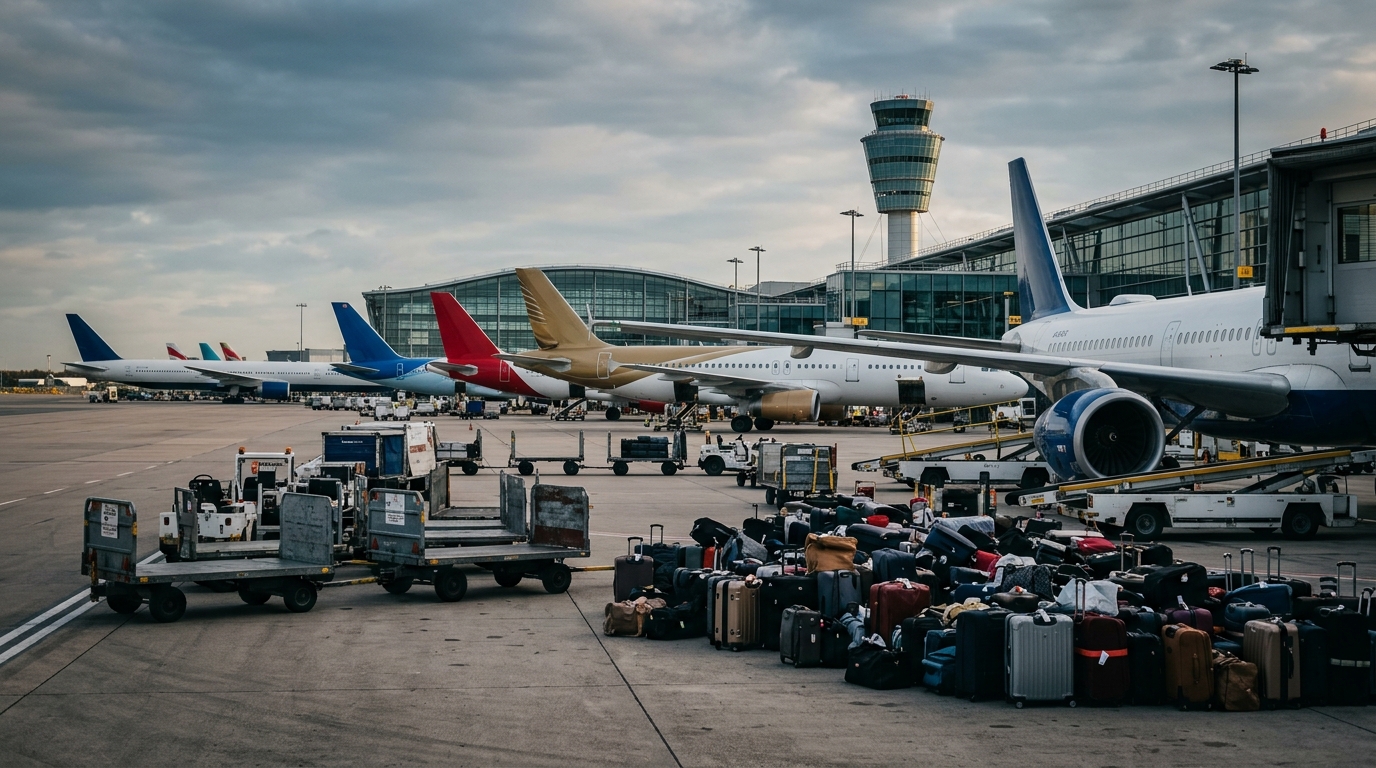
The Heathrow Ground Handler Walkout: Why Your October 5th Connection is at Risk
A sudden 72-hour strike announcement means thousands of bags may not make their connections at LHR next month.
The Heathrow Ground Handler Walkout: Why Your October 5th Connection is at Risk
Three days. That is all it takes to turn Europe’s busiest aviation hub into a glorified luggage warehouse.
On September 18, 2026, Unite the Union announced a 72-hour walkout for Heathrow ground handlers starting October 5, 2026, following a breakdown in pay negotiations with dnata. If you are flying through LHR during that window, the "business as usual" emails from your airline are, quite frankly, optimistic.
When ground handlers strike, the visible parts of the airport—the check-in kiosks, the Duty-Free shops, the lounges—keep humming. But beneath the terminals, the "below-wing" operations freeze. Planes can’t be loaded, bags can’t be transferred, and the precision-engineered chaos of a Heathrow connection falls apart.
Here is what you need to know to protect your trip before the first picket line forms.
The dnata Factor: Is Your Airline Affected?
Not every airline at Heathrow uses dnata for ground handling, but the list of those that do is a "who’s who" of long-haul giants. If you are flying with Emirates, Qatar Airways, Etihad, or Singapore Airlines, you are in the splash zone. These carriers rely on dnata for everything from baggage ramping to aircraft pushback.
British Airways (Terminal 5) generally uses its own ground staff, but don't assume you’re safe. When Terminal 2, 3, and 4 descend into a backlog of "short-shipped" luggage, the congestion bleeds into the entire airport ecosystem. Security queues swell. Air traffic control slots get missed. The ripple effect is real.
The Baggage Black Hole
If you have a connection at Heathrow between October 5th and October 8th, checking a bag is a high-stakes gamble. During a strike, the skeleton crews remaining are prioritized for "point-to-point" luggage—bags belonging to people ending their journey in London.
Transfer bags? They are the first to be sidelined.
If you must check a bag, now is the time to ensure your travel insurance policy specifically covers "baggage delay" and "missed connection" due to industrial action. Many basic policies exclude strikes if they were "foreseeable," but since the 14-day notice period only started on September 18, policies bought prior to that date should hold firm.
The Counterintuitive Tip: The "Short Connection" Paradox Common travel wisdom says a longer layover is safer. During a ground handler strike, the opposite can be true. If you have a 5-hour layover, your bag is sent to a holding area. In a strike scenario, that holding area becomes a graveyard where bags are buried under thousands of others. A "tight" 90-minute connection often forces the skeleton crew to keep the bag on the move, ironically increasing the chance it actually makes the flight.
That said, if you can travel with a carry-on only, do it. Use the vacuum-seal bags. Leave the extra pair of boots. The peace of mind of knowing your belongings are in the overhead bin above your head is worth the laundry bill at your destination.
Navigating the Terminal Chaos
If your flight is delayed or you miss your connection, do not join the 400-person deep line at the customer service desk. It is a soul-crushing waste of time.
Instead, find a quiet corner with a charging port—like the seating area near The Perfectionists' Café —and get on the phone. You will almost always reach a phone agent faster than the person at the desk can process the hundred people in front of you.
While you're waiting, keep a hawk-eye on your flight’s status. Apps like PingWing can give you the "real" story—showing you exactly where your incoming aircraft is and whether it’s actually departed its previous gate. Often, the gate agents at LHR won't announce a cancellation until an hour after the tracking data shows the plane hasn't even left Dubai or New York.
Connectivity is Your Only Weapon
When the screens at LHR start turning red with "Delayed" and "Cancelled" notices, the airport Wi-Fi usually buckles under the weight of ten thousand people trying to rebook simultaneously.
Don't rely on the "Free Heathrow Wi-Fi" that requires a marketing sign-up every 20 minutes. If you’re transiting, grab a United Kingdom eSIM before you land. Having your own dedicated data stream allows you to bypass the local network congestion and stay on top of airline app notifications, which are often the first place rebooking options appear.
Your Legal Rights (UK261)
Because this strike involves a third-party contractor (dnata) rather than the airline’s own staff, many carriers will try to claim "extraordinary circumstances" to avoid paying out compensation.
Don't accept that at face value.
Under UK261 regulations, airlines have a "duty of care" regardless of the cause of the delay. If you are stuck overnight, they must provide:
- Food and drink vouchers.
- Hotel accommodation.
- Transport between the airport and the hotel.
If they refuse, book it yourself and keep every single receipt. If you're looking for a place to crash that doesn't require a bus journey, the Sofitel London Heathrow is directly connected to Terminal 5, though it fills up within minutes of a major disruption.
If the airline drags its feet on a refund or compensation for a multi-day delay, services like AirHelp can navigate the legal loopholes that airlines use to deflect blame onto the ground handlers.
The Pivot: Can You Reroute?
If your flight is on October 5th, 6th, or 7th, check your airline’s "Travel Alerts" page now. Often, when a strike is confirmed, airlines offer a limited window for free changes.
If you see an option to reroute through Paris (CDG), Amsterdam (AMS), or Frankfurt (FRA), take it—even if it adds three hours to your total travel time. A three-hour longer flight is infinitely better than a 24-hour stint on a terminal floor because a ground crew wasn't there to push your plane back from the gate.
A Final Reality Check
Strikes are designed to be disruptive; that is the union's only leverage. The workers at dnata aren't trying to ruin your vacation—they're trying to pay their rent in one of the most expensive cities on earth.
However, their leverage is your headache.
If you are flying through Heathrow in early October, the "Gold Standard" of travel prep is no longer just checking your gate. It’s having a backup eSIM, an AirTag in your bag (if you’re brave enough to check one), and the mental flexibility to know that "Plan A" might evaporate the moment you touch down on the runway.
Stay sharp, keep your data roaming on, and maybe—just maybe—pack an extra change of clothes in your backpack. You might be seeing more of Heathrow than you planned.