
The October 19th Loophole: Why Your Next Delay Might Not Come with a Meal Voucher
A major federal rule change is about to strip away your right to free hotels and meals for 10 specific types of flight disruptions.
The October 19th Loophole: Why Your Next Delay Might Not Come with a Meal Voucher
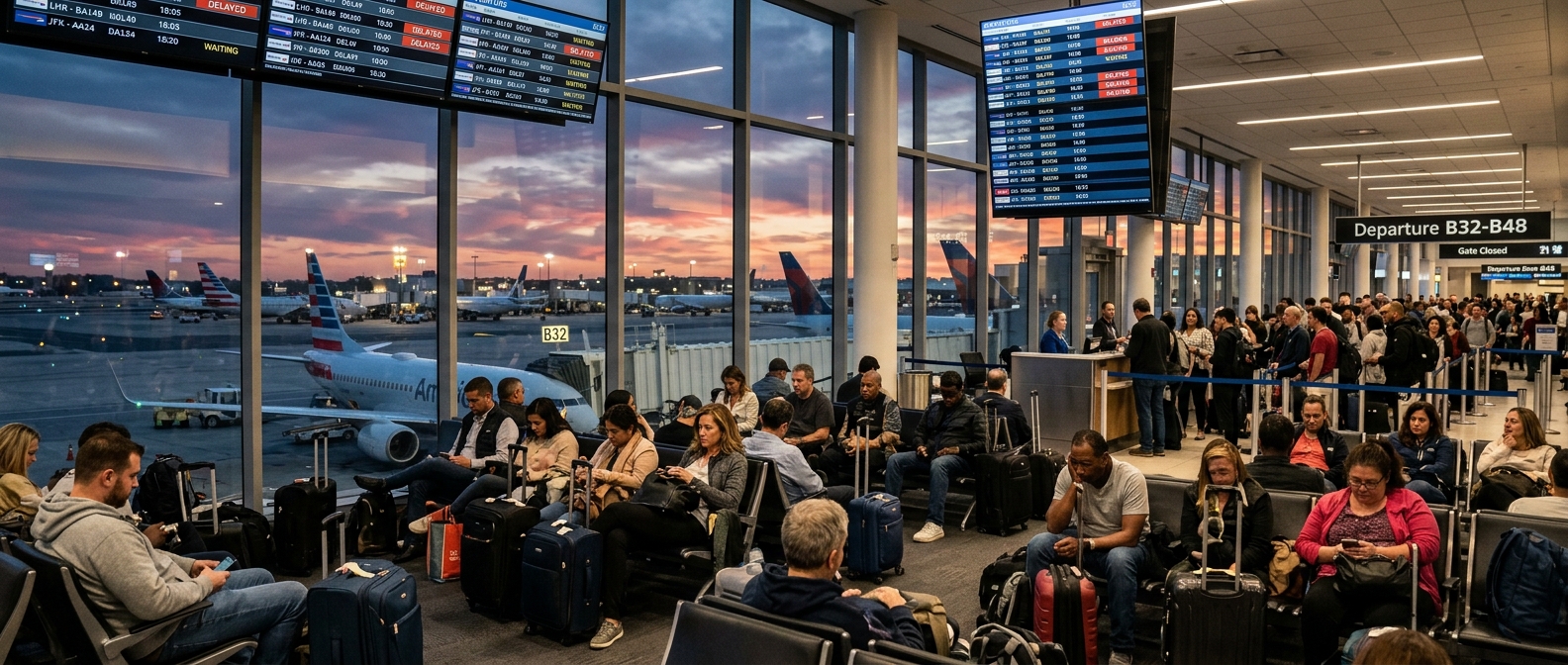
October 19, 2026, is the day the "customer service" facade in the American skies finally cracks. On this date, the U.S. Department of Transportation is implementing a new rule that reclassifies 10 common causes of flight disruptions as "outside the airline’s control," effectively stripping away your leverage for free hotel rooms, meal vouchers, and ground transportation.
For years, the line between an airline’s fault and "an act of God" was blurry enough that a persistent traveler could usually squeeze a $15 Chick-fil-A coupon out of a gate agent at JFK or ORD. Not anymore. This federal shift codifies the excuses airlines have been using for decades, giving them a legal shield to leave you sleeping on a terminal floor.
If you’re flying after the 19th, the "it's not our fault" script isn't just a tactic—it's the law. Here is what is changing, why the "Dirty Ten" list matters, and how you can actually protect your wallet when the departure board turns red.
The Dirty Ten: What You’re Losing
Previously, if a flight was delayed due to "operational issues," airlines were often on the hook for your subsistence. The new DOT rule draws a hard line. If your delay is caused by any of these 10 factors, the airline owes you exactly zero in terms of "amenities" (hotels/meals):
- Air Traffic Control (ATC) Delays: The classic "the sky is too full" excuse.
- Weather: Not just at your departure, but anywhere in the aircraft’s route.
- Bird Strikes: Nature’s way of ruining your vacation.
- Medical Emergencies: A passenger falls ill, the plane diverts, and you lose your connection.
- Security Issues: A terminal evacuation or a "suspicious package" delay.
- Government-Ordered Groundings: Think the FAA’s NOTAM failure or Boeing-specific groundings.
- Airport Infrastructure Failure: A power outage at Hartsfield-Jackson or a broken fuel hydrant at LAX.
- Labor Strikes (Non-Airline): If the TSA or ATC goes on strike, the airline isn't responsible.
- Civil Unrest or War: Sudden geopolitical shifts that close airspace.
- Natural Disasters: Volcanic ash clouds, earthquakes, or wildfires.
While these sound reasonable on paper, the "loophole" lies in the interpretation. Airlines are notorious for blaming "ATC" when the real reason is that their crew timed out. After October 19th, proving the true cause of a delay becomes the passenger’s burden, and the airline’s default answer will be one of the ten.
The Semantic Game: Maintenance vs. Safety
Here is where it gets cynical. Under the new rules, "mechanical issues" are still considered within the airline’s control. This means if a bolt is loose on a Boeing 737 Max at Seattle-Tacoma (SEA), they still owe you a hotel.
However, expect to see a surge in airlines re-categorizing mechanical issues as "Safety Directives" or "Government Mandated Inspections." If the FAA issues an emergency directive to check an engine component, that moves the delay from "Maintenance" (Airlines pay) to "Government Order" (You pay).
I recently sat through a four-hour delay at Newark (EWR) where the pilot initially blamed a "broken sensor," but the official app notification later updated to "ATC weather restrictions." That subtle shift in wording just saved the airline $4,000 in meal vouchers for the 200 people on board.
The "Interline Agreement" Trick: Your Secret Weapon
When the gate agent tells you they won’t give you a hotel because the delay is "uncontrollable," don't argue about the sandwich. Argue about the rebooking.
Most travelers don't realize that even if an airline doesn't owe you a meal, they still have a duty to get you to your destination. Many major carriers (Delta, United, American) have "interline agreements." This means if they can’t get you out for 12 hours due to an "uncontrollable" ATC delay, they can technically book you on a competitor’s flight that is leaving sooner.
They will never volunteer this. It costs them cash. You have to walk up to the desk and say: "Since this is an uncontrollable delay and your next flight isn't for 14 hours, I’d like you to check the interline availability for the JetBlue flight departing in two hours." It’s the "Open Sesame" of the aviation world.
Why You Must Stop Relying on the Airline for Protection
If the October 19th rule proves anything, it’s that the government is no longer in the business of forcing airlines to be "hospitable." You are now your own travel agent and your own insurer.
First, stop checking the airport monitors. They are often the last to know. Use a real-time flight tracker like PingWing to see where your incoming aircraft actually is. If the plane you’re supposed to board is still sitting at Dallas-Fort Worth (DFW) while you’re waiting at LaGuardia (LGA), and the weather is clear in both places, you know the "weather delay" the agent is claiming is likely a crew-scheduling issue in disguise.
Second, if you’re traveling without comprehensive travel insurance, you’re essentially gambling that none of those 10 "uncontrollable" events will happen. A good policy doesn't care if it was a bird strike or a broken wing; it pays out based on the length of the delay, not the cause.
The Surprising Counter-Move: The Credit Card "Trip Delay" Shadow
Most people in the 25-45 demographic have a credit card with some form of travel protection (Chase Sapphire, Amex Platinum, etc.), but 90% of them use it wrong.
Here is the "surprising" reality: Your credit card's trip delay insurance is often superior to the airline’s voucher. If you’re delayed more than 6 or 12 hours (depending on the card), they will reimburse up to $500 for a hotel and meals.
The trick? You don’t need the airline’s permission to use it. If the line at the customer service desk is 200 people deep because of a "security issue" at Chicago O'Hare (ORD), don't stand in it. Walk out, book a room at the Hilton Chicago O'Hare Airport , eat a steak, and save your receipts. As long as you paid for a portion of the original fare with that card, you’re covered—regardless of the DOT's new 10-point loophole.
Staying Connected and Moving Fast
When a mass delay hits, the airport Wi-Fi usually chokes under the pressure of 5,000 angry people trying to rebook at once. I’ve seen it happen at London Heathrow (LHR) and Tokyo Narita (NRT); the moment the "Cancelled" signs go up, the bandwidth goes down.
If you’re flying internationally and a "civil unrest" or "infrastructure" delay hits, you need independent data. Don't rely on roaming or airport hotspots. Grab a local eSIM for the United States or your specific destination before you land. Being the first person to load the rebooking app while everyone else is staring at a loading screen is the difference between the last seat on the 6:00 PM flight and a night on a terminal bench.
The Final Reality Check
The U.S. Department of Transportation’s move on October 19, 2026, signals a shift toward a "European-lite" model, but without the robust passenger compensation (EU261) that actually protects travelers in the UK and Europe. We are getting the "uncontrollable" definitions of the European system without the mandatory cash payouts for everything else.
If you are stuck, and you suspect the airline is lying about the cause of the delay to avoid paying up, don't just tweet at them. Document everything. Take a screenshot of the weather map showing clear skies. Take a photo of the "Mechanical" notice on the gate screen before they change it to "ATC." Then, use a service like AirHelp to let the professionals fight the legal battle for you.
The days of the "sympathy voucher" are over. The October 19th loophole is a reminder that in the modern aviation industry, the airline isn't your host—they’re just a bus driver with better marketing. If the bus breaks down because of a bird, you’re on your own. Pack an extra battery, keep your insurance card handy, and never trust a gate agent who says, "There's nothing we can do."
There is always something you can do; it just usually involves knowing the rules better than they do.