
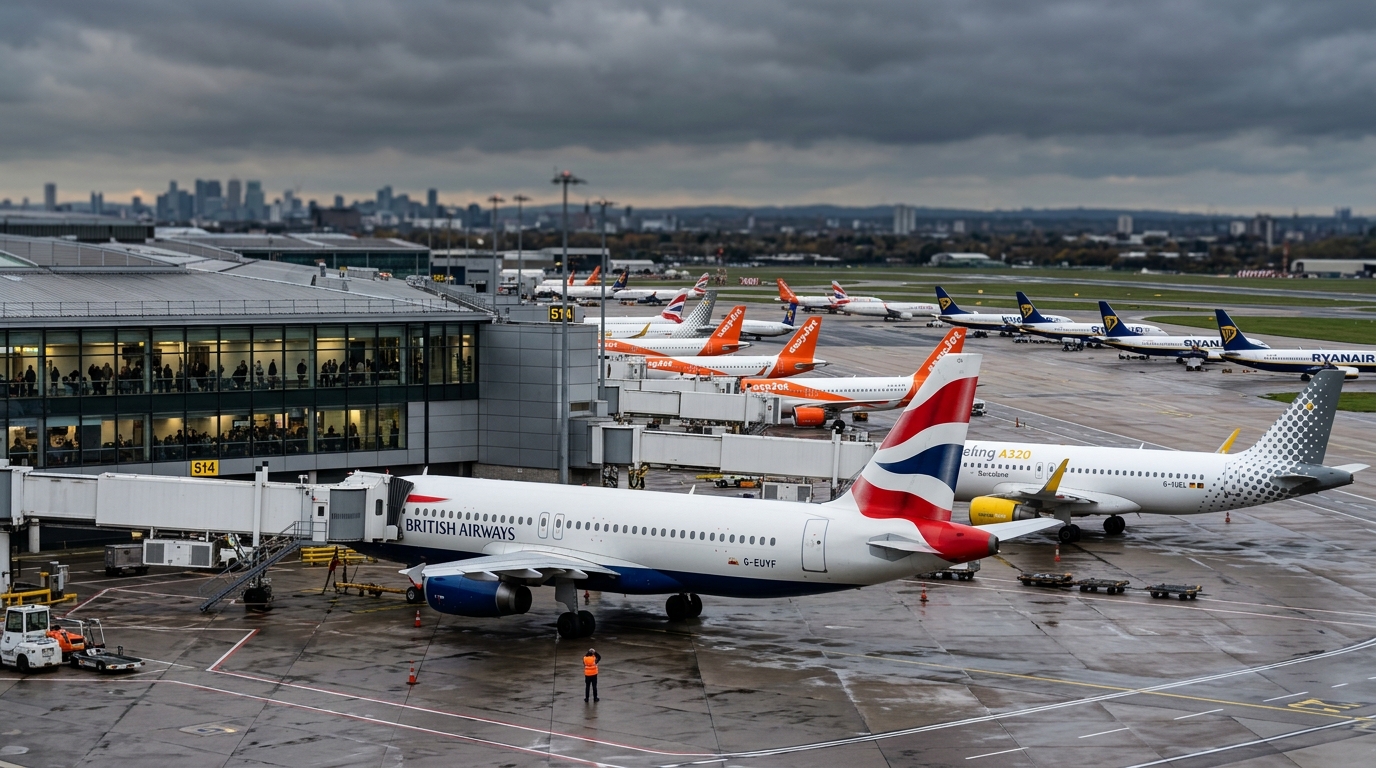
The October 27th French Air Traffic Control Walkout: Why Your Flight Over France is at Risk
It is not just flights to Paris—ATC strikes in France can ground any flight crossing French airspace, from London to Spain.
On October 27th, a significant portion of European aviation will effectively hit a brick wall. The SNCTA, France’s largest air traffic control union, has called for a nationwide strike over staffing levels and recruitment concerns, a move recently highlighted by Le Parisien as a major threat to autumn travel.
If you think this doesn’t affect you because you aren’t flying to Paris, you are dangerously mistaken.
France is the geographical "funnel" of Europe. Its airspace—the busiest on the continent—doesn't just serve Charles de Gaulle (CDG) or Orly (ORY). It serves as the primary corridor for almost every flight moving between Northern Europe and the Mediterranean. When French Air Traffic Controllers (ATC) walk out, the impact ripples from Dublin to Dubai, and London to Lisbon.
Here is what you need to know to navigate the chaos of the October 27th walkout.
The Overflight Trap: Why You’re At Risk
Most travelers assume that if their departure and arrival airports are outside of France, they are safe from French industrial action. This is the "Overflight Trap."
Europe’s sky is divided into Functional Airspace Blocks. France manages a massive section of this. If you are flying from London Heathrow (LHR) to Malaga (AGP), or from Amsterdam (AMS) to Faro (FAO), your pilot must talk to French controllers to cross their territory. When those controllers go on strike, the number of "slots" available for planes to enter French airspace drops by 50% to 70%.
The result? Your flight from the UK to Spain might be canceled or delayed by five hours, even though you never planned to touch French soil. Airlines like Ryanair and EasyJet are particularly vulnerable because their business models rely on quick turnarounds and high-frequency routes through these exact corridors.
The "Loi Diard" Loophole
There is a common misconception that French law requires a "minimum service" that keeps the skies open. This is only partially true.
The "Loi Diard" requires individual strikers to declare their intent to walk out 48 hours in advance. This allows the French Civil Aviation Authority (DGAC) to tell airlines to reduce their flight programs. However, these protections prioritize domestic French flights and "public service" routes to overseas territories. International overflights are often the first to be sacrificed to keep the internal French network moving.
If you are booked on a flight on October 27th, do not wait for the airline to email you. Use PingWing to monitor your flight's status and, more importantly, look at the "incoming" flight. If the plane that is supposed to pick you up is currently stuck on a tarmac in Marseille, you aren’t going anywhere.
Actionable Advice: What to Do Right Now
If you have a booking for the 27th, your window for stress-free adjustment is closing.
1. The 48-Hour Rule Airlines usually receive formal notice of how many flights they must cut 48 hours before the strike begins. This is your "Go" time. If your airline offers a "voluntary rebooking" window (often for free during major strikes), take it. Shift your flight to the 25th or the 29th. The 28th will be a "recovery day" and will likely be just as congested as the strike day itself.
2. Check Your Travel Insurance Policy Not all policies cover "industrial action" if the strike was "threatened" or "known" at the time you bought the policy. Since the SNCTA has already made this call public, buying insurance today specifically for this strike might be too late. However, if you already have a policy, verify the "Travel Delay" and "Abandonment" clauses. If the chaos looks permanent, Travel Insurance can be the difference between a €400 out-of-pocket hotel bill and a covered stay.
3. The "Swiss-German" Detour If you absolutely must fly on the 27th, look for routes that bypass French airspace entirely. This is the counterintuitive play: instead of a direct flight from London to Italy, look for a connection through Frankfurt (FRA) or Zurich (ZRH). These flights head east and then south, avoiding the French "funnel" altogether. It adds two hours to your journey, but it beats a twelve-hour cancellation.
The Surprising Reality of Flight Compensation
Here is something your airline won't tell you: A strike by airport staff is usually considered an "extraordinary circumstance" (meaning no compensation), but a strike by the airline's own staff is often compensable.
Where does an ATC strike fall? Typically, French ATC strikes are ruled as extraordinary circumstances because the airline has no control over the DGAC. However, if your flight is canceled three days after the strike because the airline failed to get their planes back in position, you may have a claim. The "knock-on" effect is a legal gray area that often favors the passenger. If you’re stuck for more than three hours, it’s worth checking your eligibility through Flight Compensation services rather than taking the airline's "no" at face value.
Connectivity is Your Only Weapon
When a strike hits, the airport information screens are the last to know. The "Delayed" sign usually flips to "Canceled" only after the gate agents have already been overwhelmed.
If you find yourself stranded at a hub like Paris-Charles de Gaulle and need to rebook via your phone, don't rely on the spotty airport Wi-Fi. It will fail the moment 10,000 people try to load the same rebooking page. Ensure you have a reliable data connection. For those actually landing or transiting in France, grabbing a France eSIM beforehand ensures you can jump on a rebooking app while everyone else is still hunting for a Wi-Fi password.
If you end up with an unplanned overnight stay and want to escape the terminal, the Sheraton Paris Charles de Gaulle Airport Hotel is the only hotel located directly inside Terminal 2, making it the "golden ticket" for stranded travelers. It will sell out within minutes of the first major wave of cancellations.
The "Hidden" Survival Tip: The 12-Hour Buffer
Most travelers look at their flight time and plan their day around it. On a French strike day, you must plan around the buffer.
If you have a connecting flight in a different country (e.g., flying Manchester to Paris, then Paris to New York), the strike in France can kill your entire trip. If the first leg is delayed by just 45 minutes due to "air traffic congestion," you miss your transatlantic connection. On October 27th, a 45-minute delay is the best-case scenario. If you have a high-stakes connection, move it. Now.
Final Thoughts
Air traffic control strikes are a structural reality of European travel. They aren't a sign of a "broken" system, but rather a highly leveraged one. France knows its power as the gateway to the continent, and the SNCTA uses that leverage effectively.
The travelers who suffer most are those who assume the "system" will fix itself. It won't. The system will prioritize the most profitable routes and the most vocal domestic interests. As an international traveler, you are an afterthought in their negotiations.
Don't be an afterthought. Bookmark your flight on PingWing, keep your data roaming ready, and have a "Plan B" route through the Alps or the North Sea. The sky is big, but on October 27th, the gates through France are going to be very, very narrow.
The best way to handle a strike isn't to hope for the best—it's to be the person who already booked the last seat on the train while everyone else is still staring at the "Delayed" board.