
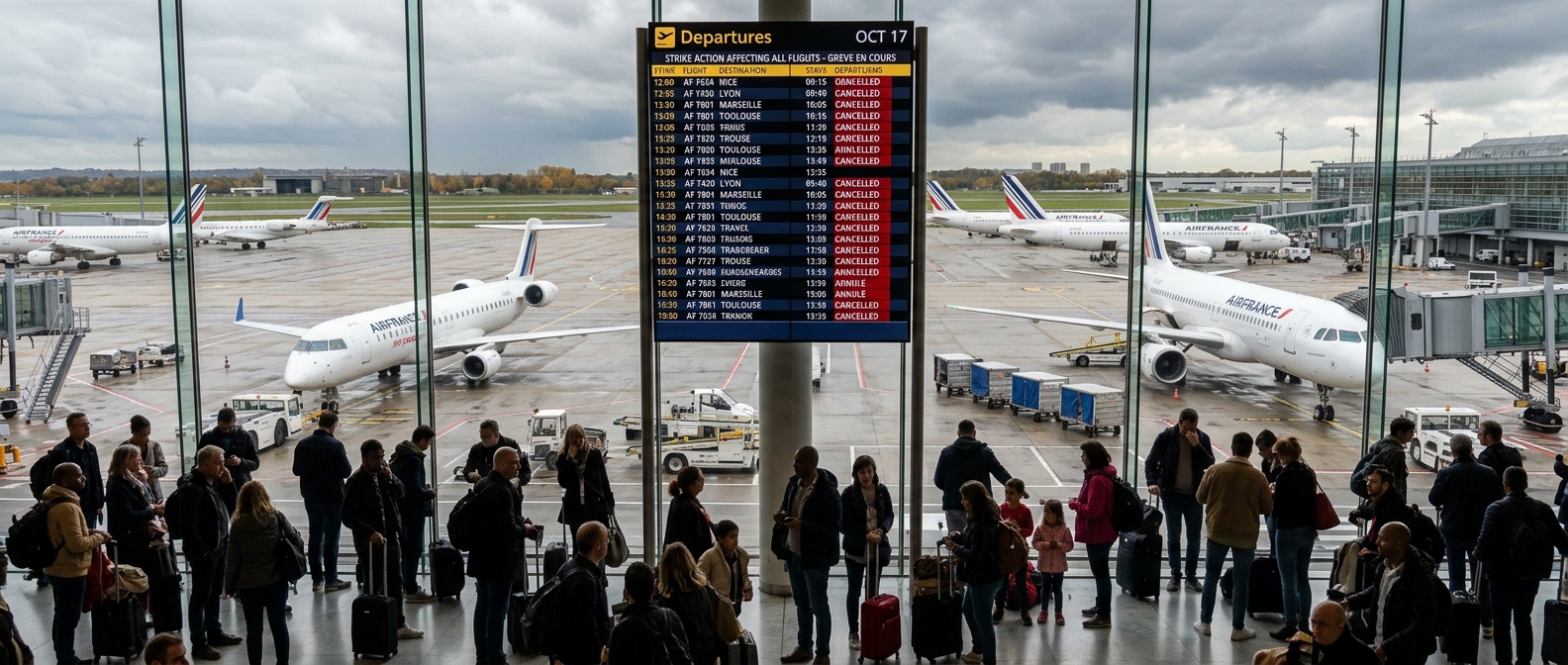
The October 17th Crew Walkout: Why Your French Holiday Flight Just Hit a Wall
A 5-day strike by French pilots and cabin crew is set to paralyze regional travel right as the autumn school holidays begin.
Aviation unions including SNPL and UNSA PNC have officially filed a strike notice for French-contracted crews from October 17 to 21, 2026. If you have a ticket to Paris, Nice, or Lyon during that five-day window, your itinerary just became a gamble.
This isn’t just a minor operational hiccup. The timing is surgical. By striking from the 17th to the 21st, the unions are hitting the exact moment the French autumn school holidays (the Toussaint) begin. This is one of the busiest domestic and regional travel periods in Europe. When the pilots and cabin crew walk out, the ripple effect won’t just stay in France; it will clog the arteries of European airspace, leading to groundings at Heathrow (LHR), Schiphol (AMS), and Frankfurt (FRA) as planes and crews end up out of position.
The "French Contract" Trap
You might think you’re safe because you didn’t book with Air France. That is a dangerous assumption. The strike notice targets "French-contracted crews." In the modern aviation world, that includes crews working for low-cost carriers like Vueling, EasyJet, and even Transavia who are based in French hubs.
If your flight is operated by a crew based out of Charles de Gaulle or Orly, you are in the splash zone. Conversely, an Air France flight originating from New York (JFK) or Singapore (SIN) might actually fly because those crews are often on different rotation schedules or may be less affected by the regional base walkouts. The uncertainty is the point. The unions want to create a vacuum of information that forces airlines to preemptively cancel flights.
The Immediate Survival Plan
Stop checking your email for a "Flight Cancelled" notification. By the time that lands in your inbox, every alternative seat on every train and rival airline will be gone. You need to be proactive.
First, identify if your flight is "at risk." Check the flight number on a real-time tracker. If that specific tail number has been bouncing between French regional airports (like TLS to NCE) for the last three days, it’s likely a French-based crew. If it’s a long-haul flight coming in from outside the EU, your odds are better.
Second, look at the TGV. The French rail network is the only viable backup when the skies close. If you are traveling between London and Paris, book the Eurostar now. If you are trying to get from Paris to the south, head to the Gare de Lyon and secure a seat before the masses descend on the ticket kiosks.
Why You Should Actually Want Your Flight Cancelled
Here is the counterintuitive truth about airline strikes: a cancellation is often better for you than a "delay."
Under EU Regulation 261/2004 (and its post-Brexit UK equivalent), a strike by the airline’s own staff—like the pilots and cabin crew represented by SNPL and UNSA PNC—is generally not considered an "extraordinary circumstance." This means the airline is on the hook. If they cancel your flight with less than 14 days' notice, they owe you more than just a refund; they owe you a seat on the next available flight (even on a competitor) and potentially hundreds of euros in cash compensation.
If they merely delay you for five hours, you’re stuck in a terminal eating a soggy €14 sandwich. If they cancel, you have leverage. You can demand they book you on a train or a rival carrier. If the airline's app says "no flights available," don't believe it. They are only showing you their flights. Legally, they must look at other airlines. If you find a seat on Lufthansa or British Airways, buy it, and keep the receipt.
If the airline starts playing games with your refund or rebooking, it’s time to call in the specialists. Using a service for Flight Compensation can take the sting out of a ruined holiday by ensuring you actually get the cash the law says you’re owed.
The "Hidden-City" Backup
If you absolutely must get to France and the direct flights are sold out or cancelled, look for "hidden-city" opportunities. Instead of booking London to Paris, look for London to Geneva. Geneva (GVA) sits right on the French border. From there, it’s a short train ride or a rental car across the line.
Be careful, though. If you book a flight with a layover in Paris and intend to "drop" the second leg, the airline will cancel your return journey the moment you fail to board that connecting flight. This trick only works for one-way trips or the final leg of a return journey.
Connectivity is Your Only Weapon
When a strike hits, the airport becomes a dead zone. The Wi-Fi will be throttled by 10,000 people trying to reload the same booking page. The customer service desk will have a line that stretches into the parking lot.
Do not join that line. It is a graveyard of productivity.
Instead, find a quiet corner, perhaps a café in a neighborhood like Le Marais if you're already in the city, and get on the phone. But don't call the French help line. Everyone in France is calling that number. Call the airline’s Australian, Canadian, or American help desk. You’ll pay for the international call, but you’ll get an agent in five minutes instead of five hours.
To do this without coming home to a $400 roaming bill, make sure you have a local data solution ready to go. Grab a France eSIM before you even leave for the airport. It allows you to bypass the saturated airport Wi-Fi and keep your VOIP calls (like Skype or WhatsApp) crystal clear while you navigate the chaos.
The Ground Transport Pivot
If the strike lasts the full five days, the rental car market in France will evaporate. If you suspect your flight from CDG to Marseille is doomed, book a car at a neighborhood rental office rather than the airport. The rates at the Gare du Nord or smaller city-center offices are often lower, and they are less likely to be "cleaned out" by the first wave of stranded flyers.
Also, consider the "bus of last resort." Companies like FlixBus or BlaBlaCar Bus aren't glamorous, but they don't strike. When the planes are grounded and the TGVs are full, a six-hour bus ride is infinitely better than spending the night on a terminal floor.
Don't Trust the "Flight Status" Board
Airport screens are notoriously slow to update during a strike. They often show "On Time" right up until the moment the crew fails to show up, at which point it flips to "Cancelled."
Use an independent tracker to follow the incoming aircraft. If the plane that is supposed to take you from Nice to London hasn't even left its previous destination, it’s not going to be "On Time." Use that 45-minute head start to jump the queue for rebooking.
The October 17th walkout is a power move by the unions, designed to cause maximum friction. You can’t stop the strike, but you can refuse to be the person sleeping on a suitcase. The moment you see that SNPL logo in the news, stop hoping for the best and start planning for the worst. In the world of French aviation, hope is not a strategy. Movement is.