
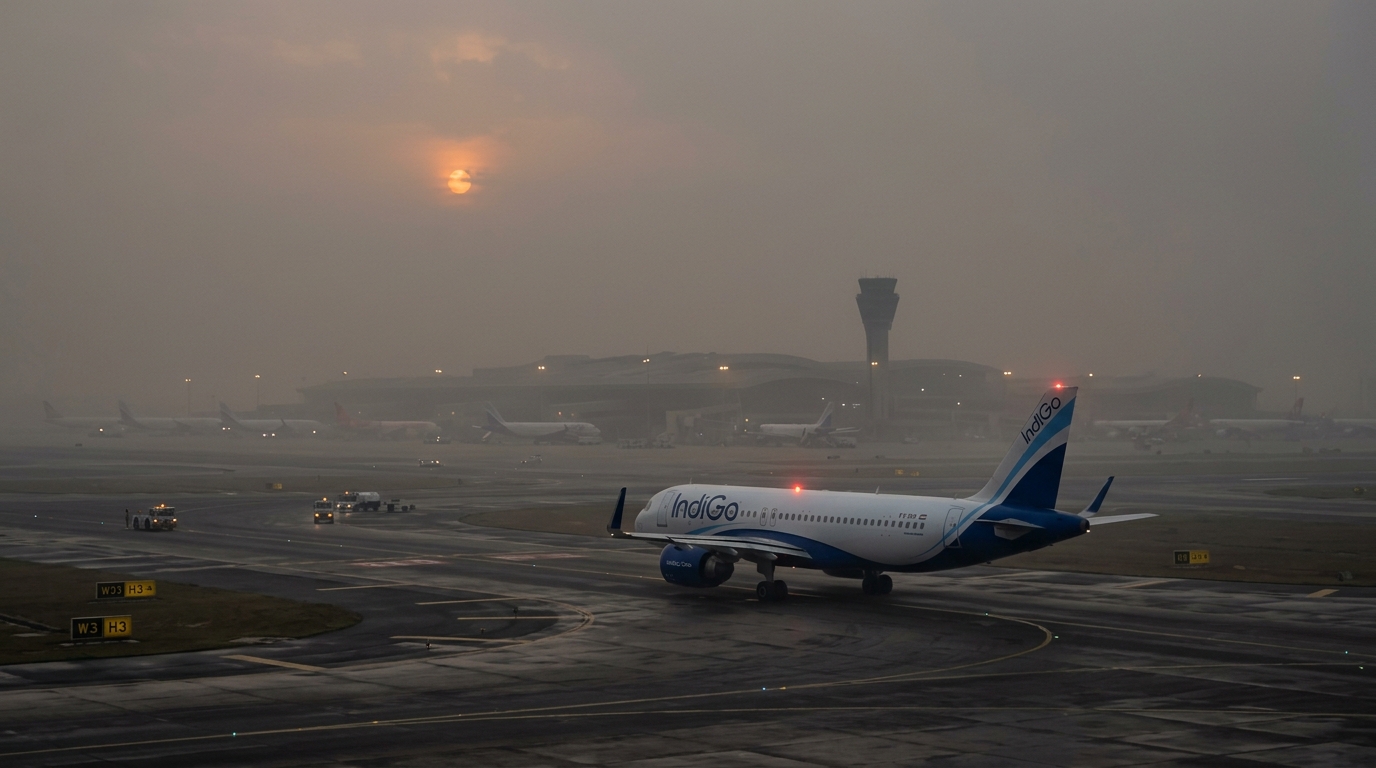
The Delhi Smog Divert: Why Your 8 AM Flight Might Land in Jaipur Next Week
As air quality drops in mid-October, travelers need to know which morning flights are most likely to be rerouted due to CAT III visibility issues at DEL.
The wheels are down, the flaps are set, and you’re bracing for that familiar thud on the tarmac at Indira Gandhi International (DEL). But instead of the sprawling grey expanse of the Delhi suburbs, you see the pink sandstone of Rajasthan or the flat plains of Uttar Pradesh. The pilot’s voice, usually a sedative drone, carries a note of apology: "Ladies and gentlemen, due to zero-visibility conditions at IGI, we have been diverted. Welcome to Jaipur."
This isn't a hypothetical nightmare. The DGCA has just issued its annual winter fog advisory for Delhi IGI Airport, effective October 15, 2026, warning of early-morning visibility disruptions that will likely plague the flight schedule for the next four months.
If you are booked on an 8 AM flight into or out of Delhi next week, you aren't just a passenger; you are a gambler. And the house—in this case, the dense, particulate-heavy smog that blankets the National Capital Region (NCR) every mid-October—usually wins.
The Science of the "Soup"
In mid-October, the Delhi atmosphere undergoes a violent shift. As temperatures dip, the wind speeds drop to a crawl. Combine this with the seasonal stubble burning in neighboring states and the city’s own industrial output, and you get a meteorological trap. This isn't the romantic, rolling mist of the Scottish Highlands. This is "smog-fog," a thick, yellowish soup that sticks to the runways and refuses to budge until the sun is high in the sky.
For aviation, the magic number is the Runway Visual Range (RVR). Delhi’s runways are equipped with CAT III-B Instrument Landing Systems (ILS), which theoretically allow planes to land with as little as 50 meters of visibility. However, theory and practice diverge sharply at 8:00 AM on a Tuesday. Even if the runway is CAT III compliant, the pilot might not be. Or the aircraft might not be. Or, more likely, the sheer volume of planes waiting for a "window" creates a backlog that makes a diversion to Jaipur (JAI) or Lucknow (LKO) the only viable option for a fuel-heavy jet.
Why the 8 AM Slot is a Trap
Most travelers aim for the 8 AM flight to "save the day." In any other month, it’s a brilliant move. In late October, it’s a tactical error.
The peak density for Delhi fog typically hits between 3:00 AM and 9:00 AM. By booking an 8 AM arrival, you are positioned exactly at the tail end of the worst visibility. If the flights scheduled for 5:00 AM, 6:00 AM, and 7:00 AM are all circling or diverted, your 8 AM flight won't even be allowed to take off from its origin.
If you must travel during this window, you need to be prepared for the "Technical Hold." This is when your airline keeps you on the plane at the departure gate in Mumbai (BOM) or Bengaluru (BLR) for three hours because Delhi simply cannot accept more arrivals. It is much cheaper for an airline to keep you on the ground in a clear city than to have you circling over a fogged-out Delhi burning expensive ATF.
The Counterintuitive Survival Guide
Most people check their flight status and call it a day. If you want to actually reach your meeting on time, you need to go deeper.
1. The "Incoming Aircraft" Hack Your flight status might say "On Time," but that is a lie. Use a real-time tracker like PingWing to look up the tail number of the aircraft assigned to your flight. Trace where that specific plane is coming from. If your 8 AM flight to Delhi is being serviced by a plane that is currently stuck in a fog-bound Amritsar (ATQ), your flight is delayed regardless of what the departure board says.
2. The Crew Certification Secret Not all pilots are equal. To land in CAT III-B conditions, both the captain and the first officer must have specific low-visibility training and current certifications. If an airline has a scheduling snafu and puts a non-CAT III certified crew on your morning Delhi rotation, they cannot land in the fog, even if the plane is capable of it. Major carriers like Air India and IndiGo generally have high numbers of certified pilots, but smaller regional players or newer crew rotations might not.
3. The "Bus of Shame" Prevention If you are diverted to Jaipur, the airline is technically obligated to get you to Delhi. Often, this results in the "Bus of Shame"—a six-hour coach ride from Jaipur to Delhi because the airline doesn't want to wait for the fog to clear to fly a 30-minute leg. If you see the diversion coming, check your travel insurance policy immediately. Many premium policies cover "trip interruption" or "alternative transport," allowing you to book a private car from Jaipur instead of waiting for the airline’s crowded bus.
When to Book Instead
If your schedule allows for any flexibility, stop booking the morning slot. Between October 15 and the end of January, the "Golden Window" for Delhi arrivals is between 1:00 PM and 4:00 PM. By this time, the sun has usually warmed the ground enough to disperse the surface-level fog, and the morning backlog of diverted flights has been cleared.
If you are coming in from an international destination like London (LHR) or New York (JFK), try to time your arrival for the late afternoon. Arriving at 2:00 AM might seem like a way to beat the traffic, but you are landing exactly when the "soup" is thickening.
Connectivity in the Chaos
If you do find yourself diverted to a secondary airport like Jaipur or Ahmedabad, don't rely on the airport Wi-Fi. Indian airports often require an active Indian mobile number to receive an OTP for Wi-Fi access—a catch-22 if you’ve just landed and haven't sorted a local SIM. I highly recommend grabbing an India eSIM before you even board your flight. Having 4G/5G data the second you touch down in a "surprise" city allows you to book a hotel or a car while everyone else is still arguing at the transfer desk.
If You Get Stuck in Jaipur
If the diversion turns into an overnight stay, don't spend it in the terminal. Jaipur is a world-class destination. If you have a few hours to kill before a rescheduled flight, take a quick cab to the Patrika Gate . It’s close to the airport, stunningly beautiful, and a much better backdrop for your "I’m late for my meeting" selfie than a crowded boarding gate.
The Reality Check
We often treat flight schedules as promises. In the winter of 2026, they are merely suggestions. The DGCA’s advisory is a reminder that despite all our technology—the billion-dollar runways, the automated landing systems, the AI-driven scheduling—we are still fundamentally at the mercy of a few billion suspended water droplets and carbon particles.
Check the RVR. Check your pilot’s certification if you can. But mostly, check your expectations. If you're flying to Delhi next week, pack a book, charge your power bank, and maybe keep a map of Jaipur handy. You might be seeing the Pink City sooner than you thought.
The best tool you have isn't the airline's app—it's your own data. Watch the trends, see which flights are consistently being rerouted, and don't be afraid to change your booking to a 2 PM departure. A three-hour delay in your living room is always better than a six-hour diversion on a tarmac in Lucknow.