
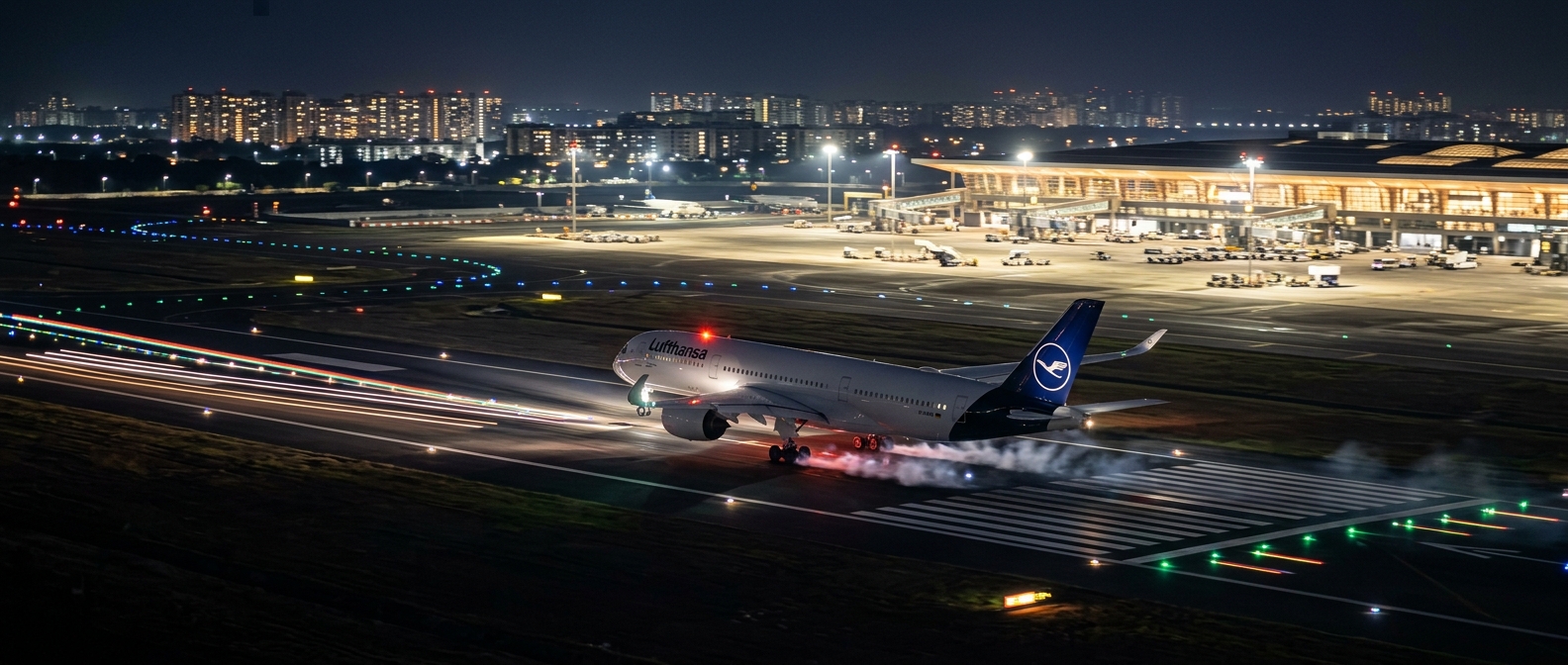
The Navi Mumbai Night Trial: Why Your 2 AM Flight Just Moved to NMI
Travelers booking late-night flights to Mumbai need to know that night landing trials at the new airport are causing last-minute diversions from BOM.
The Navi Mumbai Night Trial: Why Your 2 AM Flight Just Moved to NMI
You’re drifting in that half-asleep haze that only exists in a pressurized cabin at 35,000 feet. The cabin lights dim, the engines pitch down, and the captain’s voice crackles over the intercom. You expect the usual "Welcome to Mumbai, the local time is..." but instead, you hear something different. "Ladies and gentlemen, due to scheduled landing trials, we will be diverting our arrival tonight to the new Navi Mumbai International Airport."
Suddenly, you’re wide awake. You booked a ticket to BOM, not NMI.
On September 22, 2026, Navi Mumbai International Airport (officially the DB Patil International Airport) launched its critical night-flight calibration and landing trials. While this is a massive milestone for India’s aviation infrastructure, it has created a temporary logistical headache for anyone flying into the city during the "red-eye" window. If you have a flight scheduled to land in Mumbai between 11:00 PM and 5:00 AM this month, there is a high probability your flight plan just got a Navi Mumbai makeover.
The Midnight Switch: What’s Actually Happening?
Chhatrapati Shivaji Maharaj International Airport (BOM) has been operating at its absolute breaking point for years. It is the most constrained single-runway operation in the world. To ease this, the DGCA and MIAL (Mumbai International Airport Limited) are fast-tracking the integration of the new Navi Mumbai site.
The trials starting this September aren't just "practice." They are legal requirements for the airport to receive its final aerodrome license. For these trials to be accurate, they need real aircraft, real pilots, and real-time night visibility conditions. To facilitate this, the Ministry of Civil Aviation has authorized a series of "scheduled diversions."
Airlines like IndiGo, Air India, and Akasa Air are rotating specific flight numbers to land at NMI instead of BOM. These aren't emergency diversions; they are pre-planned but often communicated to passengers with very little lead time—sometimes only via a text message sent while you’re standing in the check-in line at LHR or DXB.
The Logistics of a "Wrong" Airport Landing
Navi Mumbai is not "just across the bridge." If your home or hotel is in Bandra or Juhu, landing at NMI adds a significant layer of travel time.
However, the opening of the Atal Setu , also known as the Mumbai Trans Harbour Link (MTHL), has changed the math. Before the MTHL, a diversion to Navi Mumbai would have meant a two-hour crawl through the traffic of Vashi and Chembur. Now, if your driver takes the MTHL, you can reach South Mumbai in about 40 to 50 minutes.
The catch? The ride-sharing ecosystem at NMI is still in its "trial" phase too. Uber and Ola are operating, but the wait times at 2:30 AM can be unpredictable because drivers are still figuring out the demand patterns of the new terminal.
Pro Tip: If you see your flight is diverted to NMI, don't wait until you clear customs to book your ride. Use the airport's free Wi-Fi (if you have a local SIM) or a pre-activated India eSIM to book your car the moment you touch the tarmac. This puts you at the front of the virtual queue while everyone else is still wrestling with their overhead luggage.
The Surprising Reality of "Ghost" Terminals
One thing you’ll notice immediately at NMI during these trials is the silence. Unlike the organized chaos of BOM’s Terminal 2, NMI feels like a "ghost" terminal. Most of the retail and dining outlets aren't fully operational yet.
If you were planning on grabbing a late-night snack or a bottle of water before heading into the city, do it on the plane. The vending machines at NMI are currently the most popular "dining" option.
There is, however, a weird upside: Immigration and Customs. Because the airport is only handling a handful of trial flights, you can often clear the entire arrival process in under 15 minutes. At BOM, that same process at 2 AM—the peak hour for international arrivals—can easily take an hour.
How to Tell if Your Flight is Part of the Trial
Airlines are notorious for burying diversion notices in the fine print of "Flight Status" emails. Don't rely on the airline's app alone, as they often don't update the destination airport code until the flight is actually airborne.
Instead, look at the historical flight data for your specific flight number over the last three days. If you see "Diverted to NMI" or "Landed at NMI" appearing consistently, you’re likely on a trial route.
The most effective way to stay ahead of this is to keep a real-time flight tracker active on your phone. These apps pull data directly from ATC transponders rather than waiting for an airline’s PR department to update a database. If the flight path on the map starts banking toward the mainland instead of the coast, you know exactly where you’re heading.
Ground Transport: The NMI Survival Guide
If you find yourself at NMI, you have three real options to get into Mumbai proper:
- The MTHL (Atal Setu): This is the fastest route to South and Central Mumbai. Ensure your cab driver knows you are willing to pay the toll (it’s around ₹250, but worth every penny to save an hour of your life).
- The Sion-Panvel Highway: Use this only if you are heading to the northern suburbs like Thane or Mulund.
- The "Pre-Booked" Private Car: This is the smartest move. Since NMI is in the Ulwe/Panvel region, many local drivers aren't yet "hanging out" there looking for fares.
If you’re worried about the uncertainty of a new airport, you can pre-book an airport transfer to have a driver waiting with a sign. It removes the 3 AM stress of trying to explain to a confused Uber driver why you’re standing at an airport that "doesn't exist" on some older GPS maps.
The Counterintuitive Benefit: The "Quiet Landing"
Here is something most travelers don't realize: Landing at NMI is actually a much smoother experience for the nervous flyer.
BOM is famous (or infamous) for its "holding patterns." Because the runways are so congested, it’s common for flights to circle over the Arabian Sea for 20 to 30 minutes before getting a landing slot. This leads to turbulence and anxiety.
At NMI, there is no traffic. You get a "straight-in" approach. No circling, no waiting, no sudden altitude drops to fit into a gap in the sequence. It is the most "VIP" landing experience you will ever get for the price of an economy ticket.
Connectivity and Safety
A new airport means new dead zones. While the NMI terminal has excellent infrastructure, the surrounding roads in the Navi Mumbai periphery are still being developed. Cell towers are being added, but there are spots where your GPS might flicker.
This is why having a secure connection is vital. If you’re a frequent traveler, you’re likely jumping on any open Wi-Fi you find to check your location. Don't do that without protection. A secure VPN is non-negotiable when you’re navigating the digital infrastructure of a brand-new transit hub. It keeps your data private while you’re trying to figure out if your hotel in CBD Belapur is five minutes or fifty minutes away.
Looking Ahead: Is This the New Normal?
The night trials are scheduled to run through the end of September 2026, but aviation insiders suggest they may be extended into October to account for the monsoon's impact on visibility sensors.
By early 2027, the "diversion" phase will end, and NMI will begin scheduled commercial operations. But for now, we are in a transition period. You are effectively a test passenger in the birth of a mega-airport.
It’s easy to get frustrated when your 2 AM landing doesn't go as planned. But look at it this way: you’re among the first few thousand people to ever land at an airport that will eventually handle 60 million passengers a year. Take a photo of the empty terminal. It won't look like this for long.
The next time you’re booking a red-eye into Mumbai, check the destination code one last time. If it says NMI, don't groan. Just make sure you’ve got your MTHL toll money ready and your tracker open. You're not just flying; you're witnessing the city's map being redrawn in real-time.
Navigating the shift from BOM to NMI is a reminder that in travel, the destination is never as fixed as the ticket suggests. The most prepared travelers aren't the ones who never face diversions—they’re the ones who already have the backup app downloaded before the pilot even makes the announcement.