
Charleroi’s 24-Night Strike: Why Your Morning Flight Just Got Cancelled
A massive nighttime walkout by Belgian air traffic controllers starts tonight, threatening to ground 832 flights and strand 300,000 passengers through October.
300,000 people are about to have their autumn travel plans shredded by a group of people they will never actually see. Starting tonight, September 16, 2026, air traffic controllers at Brussels South Charleroi Airport (CRL) are walking off the job every night through October 10.
As reported by Anadolu Agency on September 15, this isn't a total shutdown, but a targeted nighttime strike. On paper, it sounds manageable. In reality, it’s a logistical landmine that will ground 832 flights and leave passengers stranded across Europe. If you have a flight booked to or from Belgium’s low-cost hub in the next three weeks, the "wait and see" approach is a recipe for sleeping on a terminal floor.
The "First Wave" Trap: Why Night Strikes Kill Morning Flights
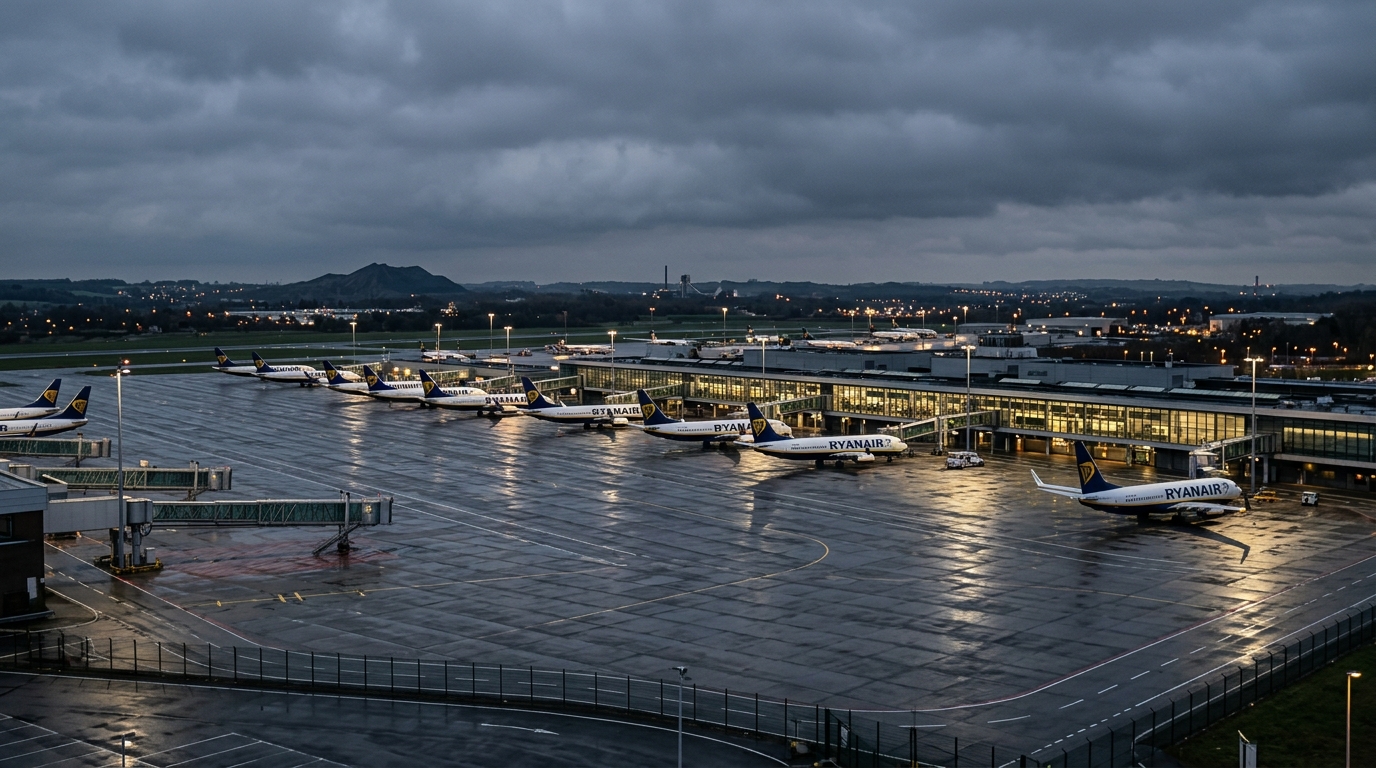
There is a common misconception that a strike from 10:00 PM to 6:00 AM only affects red-eye flights. At an airport like Charleroi, which serves as a massive base for Ryanair and Wizz Air, the opposite is true.
Aviation operates on a "first wave" principle. For a 6:30 AM flight to depart for Barcelona or Warsaw, the aircraft must already be on the tarmac, the crew must have arrived the night before, and the ground handlers must be cleared to work. When air traffic controllers walk out at night, the "inbound" flights—the ones arriving late in the evening to "sleep" at the airport—get diverted or cancelled.
If the plane isn't at CRL by midnight, it isn't there to take you to your meeting at 7:00 AM. This creates a cascading delay that can take 48 hours to resolve. If you are booked on the first flight of the day, you are actually at higher risk than someone flying at noon.
Don’t Wait for the "Cancelled" Email
Airlines are notoriously slow at updating their internal systems during rolling strikes. They hope for a last-minute resolution that rarely comes. By the time you get the automated "We’re sorry" email, the seats on the next available flight—or the trains out of Brussels-South Railway Station —will already be gone.
The Proactive Play: Check the status of the inbound flight. If you’re flying CRL to Marseille at 7:00 AM, find out where that tail number is coming from the night before. If that plane is diverted to Brussels Airport (BRU) or Lille (LIL) because of the nighttime strike, your morning flight is effectively dead.
If you see the disruption starting, use a Belgium eSIM to stay connected without hunting for spotty airport Wi-Fi, and start looking at the "Manage Booking" section of the airline app immediately. You want to be the first person to hit the 'rebook' button, not the 180th person in a physical queue at the check-in desk.
The Plan B Strategy: Alternative Hubs and Logistics
Charleroi is about 46 kilometers south of Brussels. It is not well-connected by train; most people rely on the "Flibco" shuttle buses. If the strike grounds your flight, don't just sit in the terminal. The airport is small, and the facilities at CRL are... let's say "functional" at best.
If you’re stranded, head into the city. Charleroi itself has a gritty reputation, but the area around Place de la Digue has seen a recent revival with decent cafes where you can regroup.
Your Alternative Routes:
- Brussels Airport (BRU/Zaventem): This is the main international hub. It’s managed by different sets of controllers and often remains unaffected by local CRL disputes. If Ryanair cancels your flight, check Brussels Airlines or Vueling out of BRU.
- Lille (LIL): Just across the French border. It’s a 1.5-hour drive or bus ride from Charleroi. Many low-cost carriers use Lille as a diversion point.
- The Eurostar/Thalys: If you’re trying to get to London, Paris, or Amsterdam, give up on the air. Go straight to the Brussels-South station and buy a train ticket. It will be expensive, but it will actually move.
The Compensation Myth: Know Your Rights (and the Loopholes)
This is where it gets frustrating. Under EU261 regulations, passengers are entitled to cash compensation for cancellations—unless the disruption is caused by "extraordinary circumstances."
Air traffic control (ATC) strikes are almost always classified as extraordinary circumstances because they are outside the airline's control. This means Ryanair or Wizz Air likely won't owe you that €250 or €400 payout.
However, they always owe you a "Duty of Care." If your flight is cancelled, the airline must provide:
- Food and drink vouchers.
- Hotel accommodation (if you are rebooked for the next day).
- Transport between the airport and the hotel.
If the airline staff tells you to "find your own hotel and send the receipt," get that statement in writing or via a recorded video. Keep every single receipt. If they refuse to help, you can later use a service for flight compensation to recoup those specific out-of-pocket expenses, even if the strike itself doesn't qualify for the standard lump-sum payout.
The Counterintuitive Tip: The "Hidden" Departure
Most travelers focus on getting out of the strike zone. But if you are currently abroad and trying to get to Charleroi, the strategy changes.
If your flight to CRL is cancelled, don't just rebook to the same airport for two days later. The backlog will be immense. Instead, ask the airline to rebook you to any airport within a 200km radius—Cologne (CGN), Eindhoven (EIN), or Paris Beauvais (BVA). Under EU law, the airline is responsible for the cost of your transport from that alternative airport to your original destination.
I’ve seen passengers spend €150 on a taxi from Eindhoven to Brussels and get it fully reimbursed because the airline failed to provide a flight to the original city. It’s a bold move, but for frequent flyers with meetings to attend, it’s often the only way to arrive on the right day.
Travel Insurance: The 24-Hour Rule
If you haven't bought travel insurance yet, doing it today for a flight tomorrow won't help you with this specific strike. Most policies have a "known event" clause. Once a strike is announced in the news (like the Sept 15 report), you can no longer buy a policy to cover that specific event.
However, if you already had insurance in place before the announcement, read your PDS (Product Disclosure Statement). Look for "Travel Abandonment" clauses. If the delay exceeds 12 or 24 hours, some premium policies allow you to cancel the trip entirely and claim back your non-refundable hotel and tour costs.
A Note on Charleroi Itself
If you do find yourself stuck at CRL during the day, don't expect a lounge-hopping experience. The "The Lounge" at Charleroi is often packed and offers basic snacks. If you need to get work done, your best bet is the food court area upstairs before security, which tends to have more breathing room than the gates.
If you have a long delay, consider renting a car to move toward a more stable hub. You can often find one-way car rentals that allow you to drop the vehicle at Brussels Zaventem or even Paris, though the "drop-off fee" for crossing borders can be steep.
Final Reality Check
Strikes in Belgium are a form of political theater, but the victims are always the passengers. The nighttime walkout at Charleroi is particularly cynical because it targets the airport’s most vulnerable window—the preparation for the morning rush.
Don't be the traveler standing at a closed gate at 5:00 AM wondering why there's no plane. Watch the tail numbers, watch the "inbound" status from the night before, and have your "Plan B" (the train or an alternative airport) ready to execute the moment the status changes from "On Time" to "Expected."
In the world of low-cost European travel, the airline isn't going to save you. You have to save yourself. Bookmark a reliable flight tracker, keep your phone charged, and remember that in the eyes of an airline's automated rebooking system, the fastest finger always wins.