
The EES Fingerprint Chaos: Why Your First 2026 Trip to Paris Will Take 2 Hours Longer
The EU Entry/Exit System is finally live, and travelers are reporting massive biometric bottlenecks at major hubs.
The full implementation of the EU Entry/Exit System (EES) on October 1st, 2026, has led to reported 120-minute delays at Paris Charles de Gaulle and Frankfurt airports as cited by SchengenNews. If you’re flying into the Schengen Area this month, that "quick" hop across the Atlantic or the Channel just got a lot more complicated.
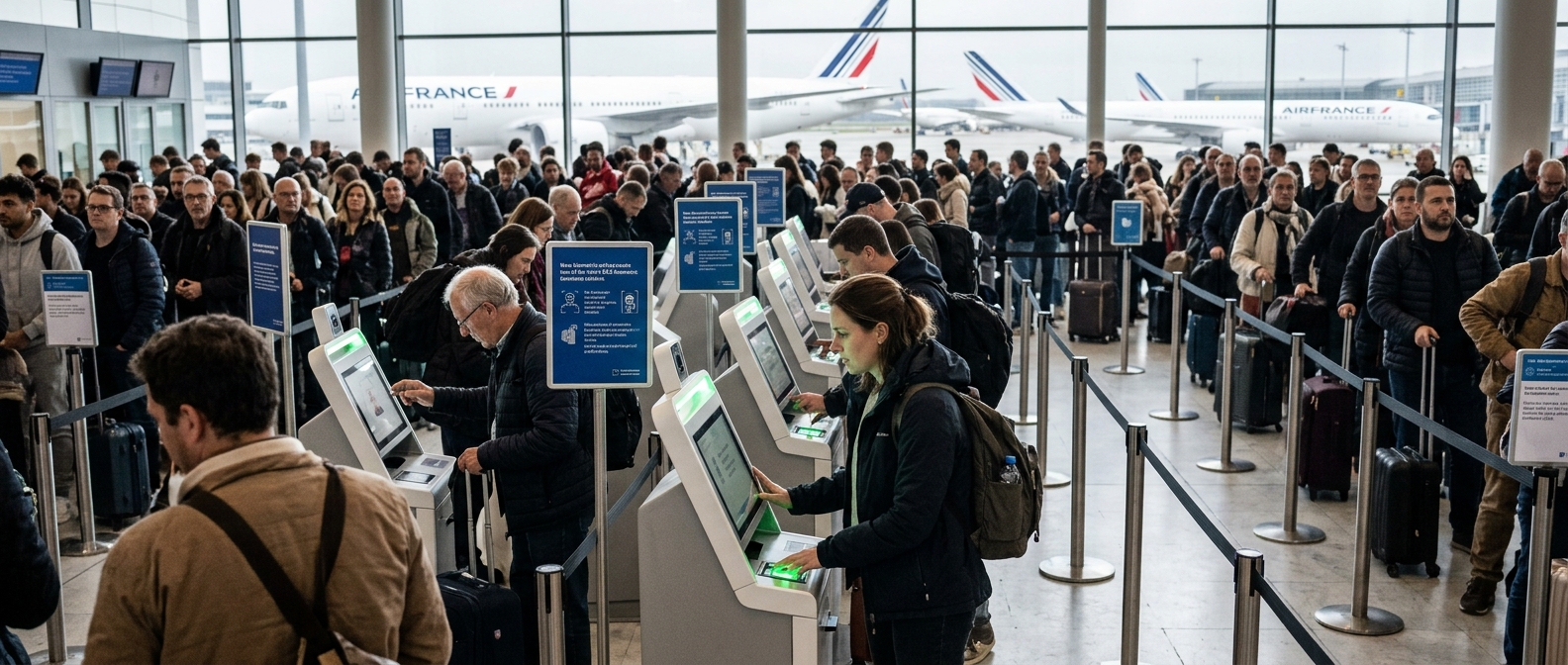
The era of the ink-stained passport stamp is over, replaced by a wall of biometric kiosks that are currently struggling to keep up with the sheer volume of travelers. This isn't just a minor administrative hiccup; it’s a fundamental shift in how you enter Europe.
Here is how to navigate the EES fingerprint chaos without losing your mind—or your connecting flight.
The 60-Second Scan That Takes Two Hours
The EES is designed to register non-EU travelers—including those from the US, UK, and Canada—via facial scans and four-fingerprint sets. In theory, it’s a streamlined digital border. In practice, the first week of October 2026 has shown that "digital" often means "technical bottleneck."
At Paris Charles de Gaulle (CDG), the queues are snaking deep into the arrival corridors. The issue isn't just the technology; it’s the human element. Each traveler is now spending an average of 90 to 120 seconds longer at the kiosk than they did under the old manual stamping system. Multiply that by a Boeing 777-300ER carrying 300+ passengers, and you have a recipe for a 2-hour standstill.
If you are landing at CDG and heading toward a hotel in Saint-Germain-des-Prés , do not expect to be there for lunch. You’ll be lucky to make it by tea time.
The Survival Strategy: Change Your Landing Logic
If you haven't booked your trip yet, the smartest move is to avoid the "Mega-Hubs." While Frankfurt (FRA) and Paris are reporting the worst delays, smaller entry points like Zurich or even Munich are currently seeing faster processing times.
The Secondary Airport Pivot Consider flying into Orly (ORY) instead of CDG if you’re heading to Paris. While ORY still implements EES, the volume of long-haul international traffic is lower, meaning fewer people are hitting the biometric kiosks simultaneously.
The Connection Cushion In 2025, a 90-minute connection in Frankfurt was tight but doable. In late 2026, it’s a gamble you will lose. If your itinerary involves clearing immigration at your first point of entry in Europe before a domestic leg, you now need a minimum of three hours.
If the kiosks are down or the lines are backed up, and you miss that connecting flight to Rome or Berlin, your airline might not be obligated to help if you booked separate tickets. This is the year to ensure your travel insurance specifically covers "missed connections due to border processing delays"—a clause that has become a lifesaver this month.
A Counterintuitive Tip: The "Moisturizer" Hack
This sounds like beauty advice, but it’s actually a border-crossing hack. One of the primary reasons for the 120-minute delays reported by SchengenNews is "fingerprint rejection."
Modern biometric scanners struggle with dry or calloused skin. After an 8-hour flight in a pressurized cabin with 10% humidity, your skin is like parchment. When the kiosk asks for your prints, the sensor fails to read the ridges. The machine tries again. And again. Then a border officer has to come over.
Do this instead: Twenty minutes before landing, use a high-quality hand cream. Hydrated skin provides a much clearer "read" for the EES sensors. You’ll be the person who breezes through the kiosk in 30 seconds while the person in front of you is still frantically rubbing their thumb on their jeans.
Tech Preparation Before You Hit the Queue
Once you’re stuck in that two-hour line, your phone is your only lifeline. However, airport Wi-Fi is notoriously spotty in the "no-man's-land" between the gate and the immigration hall.
Don't wait until you're at the luggage carousel to figure out your data situation. Before you even leave the jet bridge, ensure your France eSIM is activated and ready to go. Having a working data connection allows you to:
- Check the PingWing app for real-time updates on your connecting gate (which will likely change while you're in line).
- Message your airport transfer driver.
- Pre-load your hotel's address and map.
If you’re worried about privacy on the airport's public network while you wait, a secure VPN is no longer optional—it’s a basic travel utility for anyone handling sensitive flight data or booking last-minute trains while standing in a 500-person queue.
The "Pre-Registration" App: Fact vs. Fiction
There has been a lot of talk about the EES mobile app. The EU has promised an app that allows you to pre-register your data before you arrive at the airport.
Here is the reality: The app does not let you skip the line. You still have to visit a physical kiosk or a border guard to "verify" the data you entered. It saves you from typing your name and passport number into the kiosk, but it doesn't bypass the biometric scan. Use it to save three minutes of typing, but don't expect it to shave an hour off the wait.
Managing the "Post-Queue" Logistics
If you’ve spent two hours at a kiosk, you’ve likely missed your pre-booked train or bus. If you’re traveling from CDG into central Paris, the RER B train is your most resilient option because tickets aren't tied to a specific time.
However, if you’re exhausted and just want to get to your destination, avoid the "unofficial" taxis that haunt the arrivals hall during these periods of chaos. They prey on the "EES-exhausted" traveler. Stick to official stands or pre-booked airport transfers where the driver monitors your flight and (hopefully) the general delay status of the terminal.
What Happens If You Miss Your Flight?
If the 120-minute EES bottleneck causes you to miss a connection on a single-ticket itinerary (e.g., JFK to CDG to VCE all on Air France), the airline must rebook you. However, they are currently arguing that border delays are "extraordinary circumstances," meaning they might not pay for your hotel or meals.
If you find yourself stuck overnight in Frankfurt, don't just sit at the gate. Head into the city. A walk around the Museum Island (if you’ve made it that far) or the Altstadt in Frankfurt is better than a night on a terminal bench.
If you feel the airline was at fault—perhaps for an unrealistic "minimum connection time" in their booking engine—it’s worth checking your eligibility for flight compensation. The rules are evolving rapidly as the EES rollout continues.
The New Normal
The biometric chaos of October 2026 is a "growing pain" of a system that will eventually be faster than the old way. But for now, the burden is on the traveler.
The biggest mistake you can make right now is assuming your 2024 or 2025 travel habits still apply. The border has changed. The "quick" trip to Europe now starts with a two-hour test of patience. Bring a book, hydrate your hands, and for heaven's sake, book the long layover.
The most valuable tool in your travel kit this year isn't a fancy suitcase or a lounge pass—it's an extra three hours of buffer time and the refusal to let a biometric kiosk ruin your first night in Paris.