
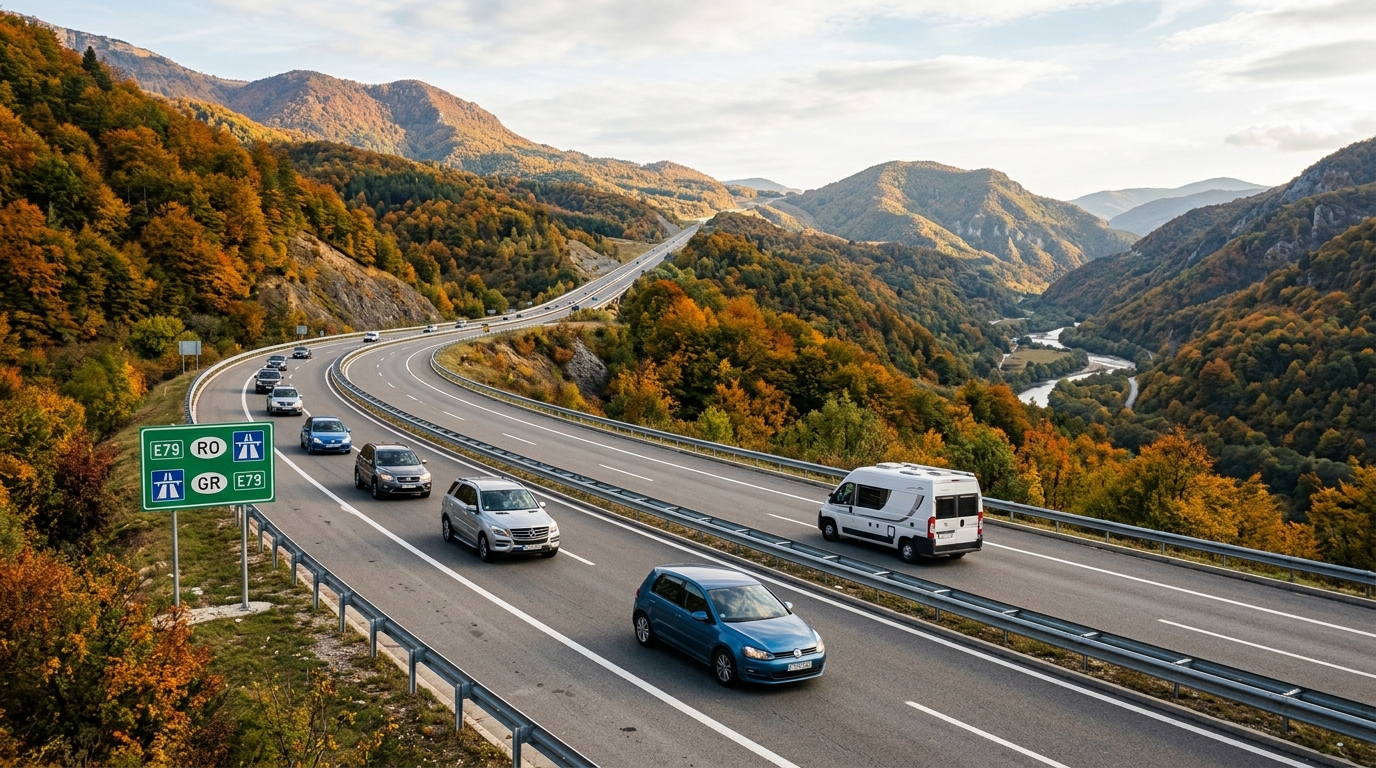
The Schengen Land Border Breakthrough: Why Your October Drive from Greece to Romania Just Got 3 Hours Shorter
After years of air-only access, the full integration of Bulgaria and Romania into the Schengen Area this month finally eliminates land border checks for travelers.
The Schengen Land Border Breakthrough: Why Your October Drive from Greece to Romania Just Got 3 Hours Shorter
The idling engines at the Kulata-Promachonas crossing used to be the soundtrack of a ruined itinerary. You’d sit there, trapped between the scorched hills of northern Greece and the Bulgarian border, watching the minutes bleed into hours while a bored official flipped through a stack of passports with the urgency of a hibernating snail. That era of bureaucratic sludge officially ended this month.
Following the European Council’s final 2026 resolution to lift land border controls for Bulgaria and Romania, the last barriers have fallen. Passport checks at the Danube Bridge and major Greek-Bulgarian crossings are gone, effectively turning a fragmented Balkan transit corridor into a seamless high-speed artery.
If you are planning to traverse the spine of the Balkans this October, you aren't just saving time; you are witnessing the birth of a new kind of European road trip. Here is how to navigate the "new" land border reality without getting caught in the residual traps that news reports won't tell you about.
The 180-Minute Dividend: Where the Time Goes
The "three hours" isn't a marketing exaggeration. On a bad Friday evening or a Sunday afternoon in autumn, the queue at the Giurgiu-Ruse bridge —the primary link between Romania and Bulgaria—could easily swallow half your day.
By eliminating the physical stop for passport verification, the "Schengen effect" does more than just save the five minutes it takes to scan your ID. It eliminates the ripple effect of heavy freight traffic. Previously, cars were often bottlenecked behind kilometers of HGVs (Heavy Goods Vehicles). Now, with dedicated lanes and no stop-and-go friction, the transit from the Greek coast to the Romanian capital has shifted from an endurance test to a scenic commute.
If you’re starting in Thessaloniki and heading for Bucharest, the drive is now a straight shot. You can realistically have breakfast by the Aegean and a late lunch in the Romanian Old Town without ever having to roll down your window for an official.
The "Vignette Trap": Don't Confuse Schengen with "Free"
Here is the counterintuitive reality of the 2026 opening: the borders are gone, but the fines are about to skyrocket.
Many travelers mistake the removal of passport checks for the removal of all transit formalities. They don't. While you no longer need to show your papers, you absolutely still need to pay for road usage. Bulgaria and Romania use electronic vignettes (e-vignettes), and their enforcement cameras are positioned exactly where the old border checkpoints used to be.
In the past, the physical border stop acted as a "safety net"—a reminder to buy your vignette at the kiosks nearby. Now, you’ll likely cruise through the old checkpoint at 50km/h and straight into the sights of an automated enforcement camera. If you haven't pre-purchased your digital pass, you’ll have a fine waiting for you before you even reach your hotel.
For the Bulgarian stretch, ensure you’ve registered your plates online the moment you cross. To keep your data secure while navigating these local government portals on public Wi-Fi, it’s worth having a secure VPN active on your phone to prevent your payment details from leaking on an unencrypted roadside network.
Rental Cars and the "Schengen Cross-Border" Fee
If you are flying into Athens (ATH) or Sofia (SOF) and planning to drive across the now-invisible borders, your logistics just got simpler, but your contract might not have.
Even though the land borders are open, many rental agencies still require "Cross Border Authorization" documents. Why? Because insurance risk doesn't follow the same rules as the European Council. Your car might be legally allowed to drive into Romania without a passport check, but if you haven't cleared it with the rental desk, your insurance is void the moment you cross the Danube.
When booking through a consolidator like Economy Bookings, always filter for "cross-border allowed" and check the specific terms for Romania and Bulgaria. The "Green Card" insurance is still a thing, and while it’s becoming more integrated, having the physical paper in your glovebox is the only way to deal with local police if you have a minor fender-bender in a rural village outside Plovdiv .
Connectivity: One Region, One Sim, No Gaps
The most underrated benefit of the full Schengen integration is the psychological shift in how we handle connectivity. October in the Balkans is prime road-trip season—the crowds are gone, the Carpathian forests are turning gold, and the temperature is perfect for hiking.
In the old days, crossing from Greece to Bulgaria meant waiting for that "Welcome to Bulgaria" SMS and hoping your roaming plan didn't have a 5-minute lag while you were trying to use Google Maps to find a gas station. Now, the transition is seamless. However, local roaming caps can still throttle your data if you’re using a SIM from outside the EU.
If you’re an international traveler coming from the US, UK, or Asia to do this trip, don't rely on "Euro-roaming" from your home carrier—it's notoriously slow in the Balkan highlands. Picking up a Bulgaria eSIM or a Romania eSIM before you land ensures that your navigation stays live even in the dead zones of the Stara Planina mountains.
The "Iron Gates" Alternative: A Pro Tip for the Scenic Route
Most people will take the E85 through Ruse. It’s the fastest. It’s also, frankly, boring.
Now that the land borders are open, you should consider the "Iron Gates" route. Instead of heading straight north through Bulgaria, swing west toward the Serbian border and then cut back into Romania at the Iron Gates gorge .
Wait, isn't Serbia outside Schengen? Yes. And that’s the trick. While the Bulgaria-Romania land border is now open, the Serbian borders still have checks. But because everyone is now flocking to the new "open" Bulgaria-Romania crossings, the secondary mountain roads are emptier than ever. The drive along the Danube where the river carves through the mountains is one of the most spectacular in Europe, and with the time you’ve saved by not being stuck at the main Greece-Bulgaria crossing, you can afford the detour.
What to Watch Out For in October
October is a transitional month in this part of the world. You can have a 25°C day in Thessaloniki and find yourself in a sleet storm in the Carpathian Mountains four hours later.
- Fog on the Danube: The morning fog near the Giurgiu-Ruse crossing can be thick enough to swallow a truck. Without the border queue to slow traffic down, speeds are higher. Be careful.
- The "Ghost" Checkpoints: Just because the booths are empty doesn't mean they are gone. Many of these border stations are narrow, concrete funnels. Don't go flying through them at 100km/h; the local police often sit just past the old booths to catch people "celebrating" the lack of checks with excessive speed.
- Currency: Romania (Leu) and Bulgaria (Lev) are still not in the Eurozone. While you won't stop for a passport, you will still need local "small" money for parking meters or local markets in places like Veliko Tarnovo .
The New Balkan Circuit
This Schengen expansion effectively creates a "Balkan Loop" that was previously a logistical nightmare. You can now fly into Bucharest, rent a car, drive down through the Bulgarian mountains, spend a few days on the Greek coast, and drive back up through the western Bulgarian spa towns like Sandanski <a href="https://www.google.com/maps/search/?api=1&query=Park%20%22St.%20Vrach%22%2C%20Sandanski" target="_blank" rel="noopener noreferrer" class="pw-blog__mapLink" title="Park "St. Vrach", Sandanski on Google Maps" aria-label="View Park "St. Vrach", Sandanski on Google Maps"> without a single passport stamp.
For those of us who track flights for a living, we usually advocate for the speed of a low-cost carrier like Wizz Air or Ryanair to jump between these capitals. But this October, the land border opening has tipped the scales. When you factor in the 2-hour early arrival at the airport, the security lines, and the baggage claim, the 6-hour drive from Sofia to Bucharest is now arguably faster and infinitely more interesting.
The barriers are down. The road is open. Just remember to buy your vignette before the cameras find you.
The Balkans have always been a region of layers—historical, cultural, and unfortunately, bureaucratic. By stripping away that final layer of border checks, the European Council hasn't just shortened a commute; they've finally let the region breathe. Grab a car, skip the flight, and see it before the rest of the world realizes the shortcut exists.