
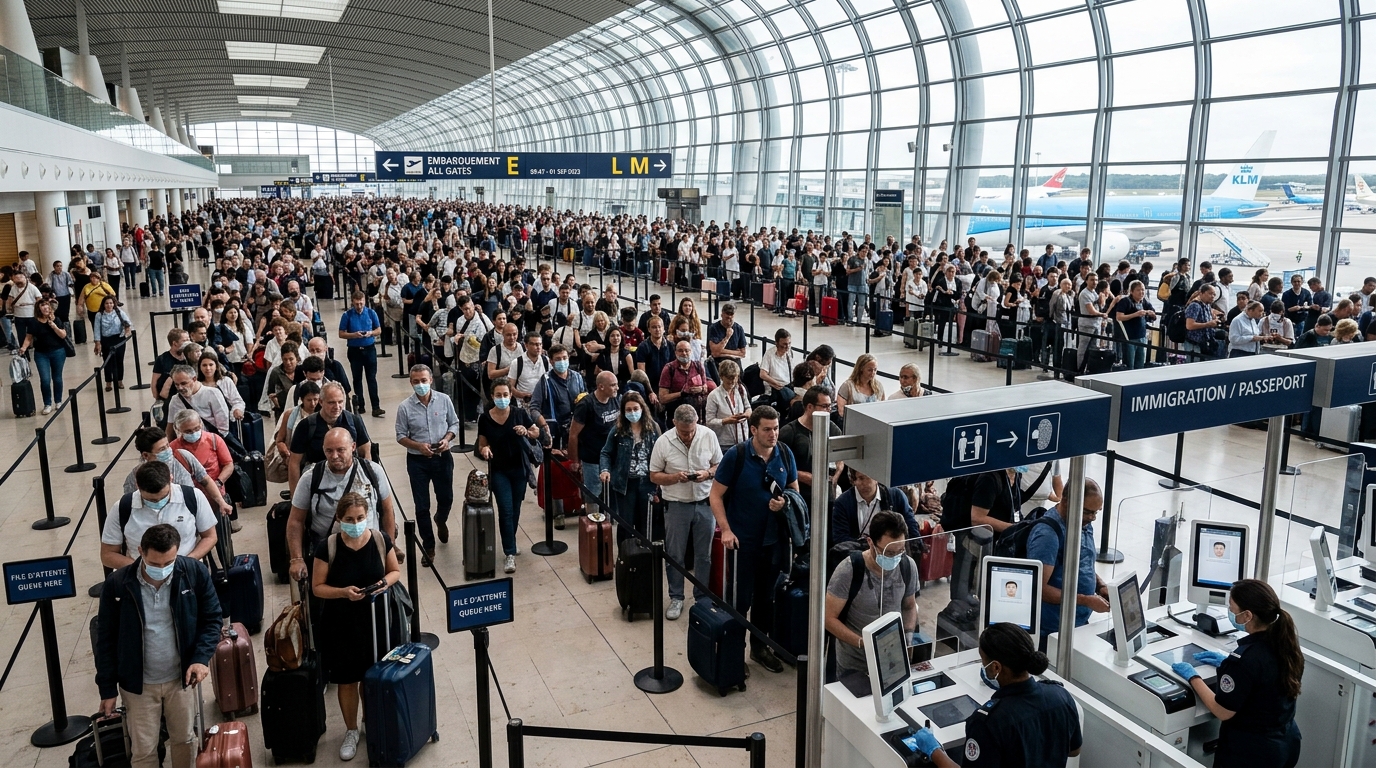
The 60-Second Standoff: Why CDG and AMS Queues Doubled on September 1st
The long-awaited EES biometric rollout just started, and travelers are facing massive bottlenecks at major European hubs.
60 seconds doesn't sound like much until you multiply it by 300 people trying to squeeze through a single hallway in Terminal 2E at Paris-Charles de Gaulle. On September 1st, 2026, that minute became the most expensive unit of time in European aviation.
The official launch of the EU Entry/Exit System (EES) on September 1, 2026, which requires biometric registration for all non-EU arrivals, has turned major hubs like CDG and Amsterdam Schiphol (AMS) into case studies in logistical friction. While SchengenNews and Reuters have reported on the systematic rollout, the reality on the ground is far messier than a press release suggests. If you are flying into the Schengen Area from the US, UK, Canada, or anywhere else outside the bloc, the rules of the game just changed.
The "60-second standoff" refers to the time it takes for a first-time traveler to have their fingerprints scanned and their face captured by the new EES kiosks. It’s a one-time registration, but when an entire Boeing 777 lands at once, that’s five hours of cumulative processing time added to a queue that was already struggling.
Why CDG and Schiphol are the Epicenters
Paris-Charles de Gaulle and Amsterdam Schiphol are the primary gateways for long-haul traffic. They are also airports designed in an era when "biometrics" was a plot point in a Tom Cruise movie, not a border requirement.
At CDG, the layout is notoriously fragmented. When you land at Terminal 2E and need to connect to a domestic flight at Terminal 2G, you’re already fighting a losing battle against the clock. The new EES kiosks have been shoehorned into corridors that were never meant to hold hundreds of idling passengers. On September 1st, the lines at CDG Terminal 2E reportedly backed up so far they blocked the flow of passengers disembarking from adjacent gates.
Schiphol, despite its "one-terminal" concept, is facing a different beast. The Dutch pride themselves on efficiency, but the biometric kiosks require a level of "tech literacy" that isn't universal. One family struggling with the facial scanner for three minutes creates a ripple effect that adds thirty minutes to the back of the line.
The 3-Hour Connection is the New Minimum
If you are booking a flight with a connection in Europe, ignore the "Minimum Connection Time" (MCT) displayed on booking engines. Airlines will still sell you a 75-minute connection in Paris. Do not buy it.
Until the EES "teething period" concludes—which likely won't be until 2027—you need a three-hour buffer for any non-Schengen to Schengen connection. If you're flying New York to Paris to Rome, you have to clear the EES border in Paris. If that line is two hours long, you are missing your flight to Italy.
If you’ve already been caught in this mess and your flight was delayed or you were bumped due to these systemic bottlenecks, it’s worth checking your rights. For flights departing from the EU or on an EU carrier, you might be eligible for flight compensation depending on how the airline handled the delay.
The "Regional Pivot" Strategy
Here is a counterintuitive tip that most frequent flyers haven't embraced yet: Stop flying into the major hubs.
If your final destination is anywhere in Northern France, Western Germany, or Belgium, consider flying into a secondary airport and taking the train. For example, instead of fighting the biometric surge at CDG, look for flights into Brussels (BRU) or even Luxembourg (LUX). These airports have significantly lower volumes of non-EU international arrivals. You can clear the EES registration in twenty minutes, hop on a high-speed Thalys or TGV train, and be at the Gare du Nord in less time than it would take to clear the "All Passports" queue at CDG.
Survival Tactics for the Biometric Border
The EES isn't going away. It’s the new reality. Here is how you handle it without losing your mind.
1. The "First Out" Advantage Seat selection has never been more critical. If you are on a wide-body aircraft (like an A350 or 787), being in row 45 means you have 250 people ahead of you in the EES queue. If you can’t afford Business Class, pay for the "Premium Economy" or "Extra Legroom" seats at the front of the cabin. That $80 investment could save you two hours of standing in a hallway.
2. Digital Readiness The EES kiosks want your passport, your face, and your fingerprints. Don't be the person fumbling for their physical documents at the front of the line. Have your landing cards (if required) and your accommodation details ready. More importantly, ensure your phone is connected the moment you touch down so you can check your gate for the next leg. I usually set up an eSIM for the Netherlands before I even leave the tarmac at JFK so I’m not hunting for airport Wi-Fi while trying to navigate the crowd.
3. The Family "Split" Rule If you are traveling as a family where some members hold EU passports and others don't, do not stay together in the "All Passports" lane out of solidarity. The EU passport holders should go through the e-gates (which remain much faster) and head straight to the baggage carousel to collect the suitcases. This divides the labor and ensures that by the time the non-EU members clear the EES registration, the bags are already off the belt.
The Hidden Cost of the EES Rollout
Beyond the time, there’s the stress of the unknown. The EES is meant to replace passport stamping, which sounds great in theory. In practice, the system is digital, which means if the server at Schiphol goes down, the border stops.
This is the year to actually buy travel insurance that specifically covers "missed connections due to administrative or border delays." Most standard policies are vague on this. Read the fine print. If the EES queue is the reason you missed your non-refundable hotel in Provence, you want a policy that acknowledges border-force-related delays.
What to Expect in the Coming Months
September 1st was just the beginning. As we move into the holiday season, the volume of travelers will spike. The EU is working on a mobile app that will allow travelers to perform some of the EES registration (like uploading photo data) before they arrive at the airport, but as of now, that app is still in a limited pilot phase.
Until that app is universal, you are the data entry clerk. You are the one scanning your fingers. You are the one staring into the camera.
The "60-second standoff" is a reminder that while technology aims to make the world smaller, the transition period usually makes it feel much, much slower. If you're heading to Europe this autumn, pack your patience, book longer layovers, and maybe consider that train ride from Brussels. It’s a lot prettier than the back of a customs officer's head in a Paris basement.
We are entering an era where your arrival time is no longer determined by the pilot, but by the person three rows ahead of you who can't figure out where to put their thumb on the scanner. Welcome to the future of travel—it’s going to take a minute.