
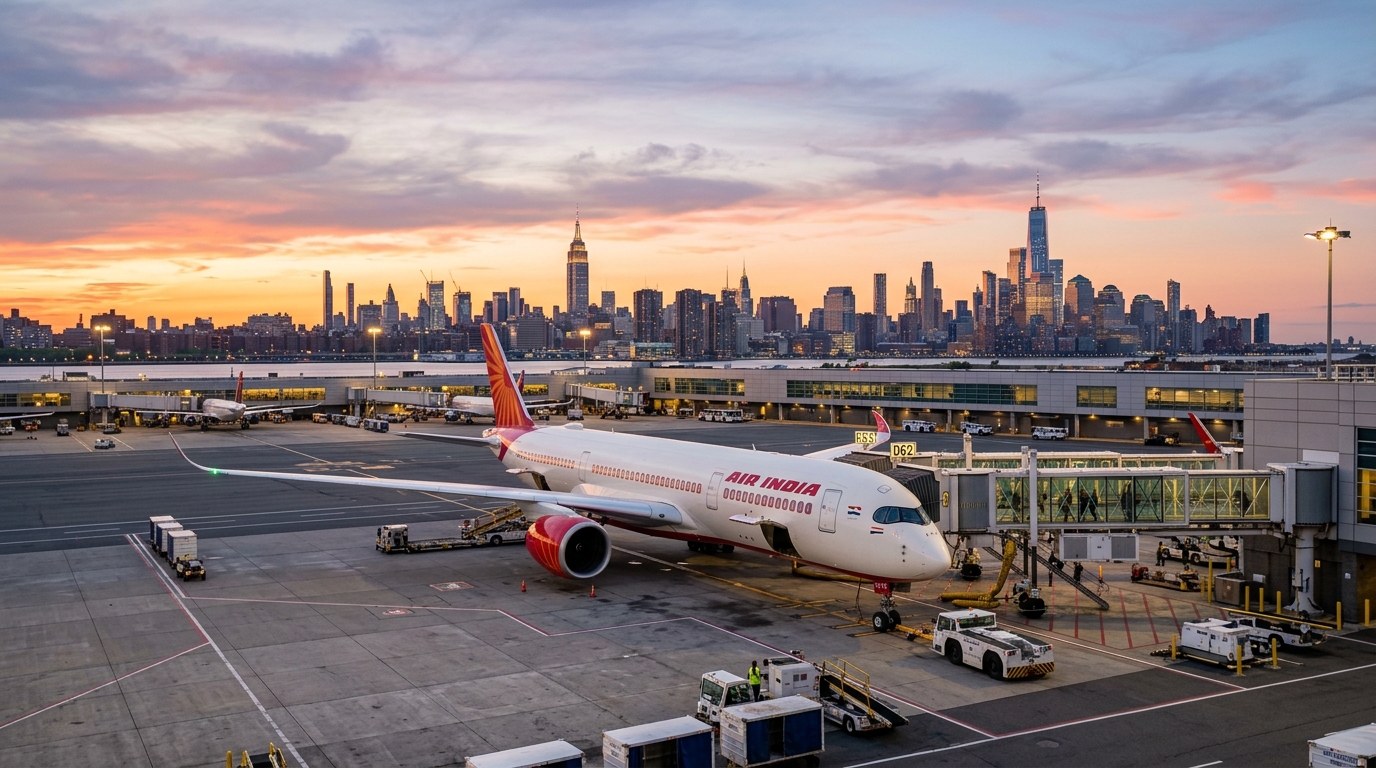
The A350 Newark Nonstop: Why Air India’s New Flagship Route is a Game Changer This November
Travelers can finally skip the European layover with Air India’s newest long-haul cabin hitting the Delhi-Newark route next month.
The A350 Newark Nonstop: Why Air India’s New Flagship Route is a Game Changer This November
The era of the "vintage" Air India long-haul experience is finally hitting the scrapyard. Starting November 1, 2026, Air India will officially deploy its flagship Airbus A350-900 on the Delhi (DEL) to Newark (EWR) route, permanently replacing the aging Boeing 777 fleet that has anchored this corridor for years.
If you’ve ever flown the old 777 on this 15-hour trek, you know the drill: flickering low-res screens, seats that don't always recline quite right, and a cabin that feels like a time capsule from 2005. That ends next month. The A350 is not just a new plane; it is a tactical upgrade for travelers who have spent the last decade opting for a grueling three-hour layover in London Heathrow (LHR) or Frankfurt (FRA) just to avoid the old Air India cabins.
The Death of the "European Detour"
For years, the savvy traveler’s play for getting from the Tri-State area to New Delhi was to fly a European or Middle Eastern carrier. You’d sacrifice three to six hours in a terminal like Dubai (DXB) or Doha (DOH) to ensure you had a working charging port and a seat that didn't feel like a park bench.
With the A350-900 landing at EWR, that logic flips. The nonstop flight is roughly 14 to 15 hours. A connecting flight through Europe or the Middle East easily pushes your total travel time to 19 or 22 hours. When the hardware on the nonstop flight is finally on par with the world’s best, the layover becomes an unnecessary tax on your PTO.
The A350 is whisper-quiet. It features a carbon-composite fuselage that allows for higher cabin humidity and lower effective altitude pressure. You land feeling less like a piece of dried fruit and more like a human being. If you are looking to secure your spot on these inaugural flagship flights, you can compare the latest fares and book here.
What’s Actually Inside the A350-900?
Air India’s A350 isn't just a "refresh"—it’s a completely different product philosophy.
Business Class: The Suite Life
The Business Class cabin features 28 private suites in a 1-2-1 configuration. These aren't just lie-flat seats; they have actual sliding doors. If you’ve flown the Qatar QSuite or British Airways Club Suite, you’ll recognize the level of privacy here. Every seat has direct aisle access, a 21-inch HD screen, and enough storage for a small library.
Premium Economy: The Sweet Spot
This is where the A350 really wins for the 25-45 demographic. The 24-seat Premium Economy cabin is a 2-4-2 layout with 38 inches of pitch. It’s the perfect compromise for those who can’t justify the $5,000 Business Class price tag but refuse to spend 15 hours with their knees touching their chin.
Economy: Better, But Still Economy
The 264 Economy seats are arranged in a 3-3-3 layout. The big win here is the Panasonic eX3 entertainment system. No more tapping a resistive touch screen with the force of a hammer just to get a movie to play. The screens are crisp, responsive, and actually stocked with content you’ll want to watch.
A Surprising Tip for the DEL-EWR Leg
Here is something most people overlook when booking the Delhi-Newark route: The "A" and "K" window seats in rows 30 through 35.
Because of the A350’s wing placement and the specific flight path over the polar regions (depending on the day’s winds), these seats offer some of the most consistent views of the Aurora Borealis during the winter months. While most passengers are asleep, if you keep your window shade open just a crack during the middle of the flight, you have a high probability of catching a light show that people pay thousands of dollars to see in Iceland.
Also, a technical note for the gearheads: Air India’s A350s come equipped with a high-definition tail camera. You can watch the takeoff and landing from a perspective usually reserved for birds, which, frankly, never gets old.
Navigating the Transition: What to Watch Out For
While the November 1st start date is firm, aviation is a fickle beast. If you are flying in late October or early November, keep a close eye on your equipment type.
Use a flight tracker to verify the "Tail Number" of the aircraft assigned to your flight 24 hours before departure. If you see a Boeing 777-300ER still listed on November 3rd, there may have been a last-minute maintenance swap. This is where travel insurance pays off—not necessarily for the plane swap itself, but for the potential delays that come with bedding in a new aircraft type on a long-haul route.
Connectivity and Landing in Delhi
Once you touch down at Indira Gandhi International Airport (DEL), the real world hits you fast. New Delhi is a sensory overload in the best way possible, but it is also a city where being offline is a major handicap.
Do not wait until you are standing in the chaotic arrivals hall to find a SIM card kiosk. The lines are long, the paperwork is tedious, and the prices are "tourist-tier." Instead, set up an India eSIM before you even leave Newark. You’ll have 4G/5G data the second the wheels touch the tarmac, allowing you to book an Uber or an Ola without wandering around looking for public Wi-Fi.
If you’re heading straight into the heart of the city for a post-flight meal, have your driver drop you at Connaught Place . It’s the central hub of the city and a great place to walk off the jet lag before checking into your hotel.
Why Newark (EWR) Over JFK?
For years, JFK was the "glamour" airport for India flights. But for anyone living in Manhattan, Jersey City, or the Philadelphia suburbs, Newark has quietly become the superior choice.
The security lines at EWR Terminal A (and the renovated Terminal B where Air India operates) are generally more predictable than the madness of JFK Terminal 4. Plus, the Air India A350 deployment at EWR signals that this airport is no longer the "second-class citizen" of the New York metro aviation scene.
The Logistics Checklist for November Travelers
If you’re booked for the first week of November, here is your "Air India 2.0" survival kit:
- Download the App: Ensure you have the updated Air India app. The new management (Tata Group) has poured millions into the digital interface. It actually works now.
- VPN is Non-Negotiable: If you’re planning to use airport Wi-Fi at DEL or EWR, use a Secure VPN. Public networks at major international hubs are prime hunting grounds for data scrapers.
- Meal Pre-Selection: Even with the new A350 catering, the "Special Meals" (like the Hindu Non-Veg or Kosher options) are often loaded onto the plane first and served before the general cabin. If you’re looking to eat and sleep immediately, this is a veteran move.
- Check Your Compensation Rights: New routes and new aircraft can sometimes lead to technical teething issues. If your flight is delayed by more than 3 hours, don't just take a meal voucher. Know your rights regarding flight compensation.
The Final Word
The deployment of the A350 to Newark is a line in the sand. It is Air India’s way of saying they are ready to compete with the Emirates and Singapores of the world. For the traveler, it means the end of the "layover compromise." You no longer have to choose between a nonstop flight and a comfortable cabin.
Now, you can have both. Just remember to pack your own noise-canceling headphones—even on a brand-new A350, the person in 42B might still have a crying toddler. Some things in aviation never change.