
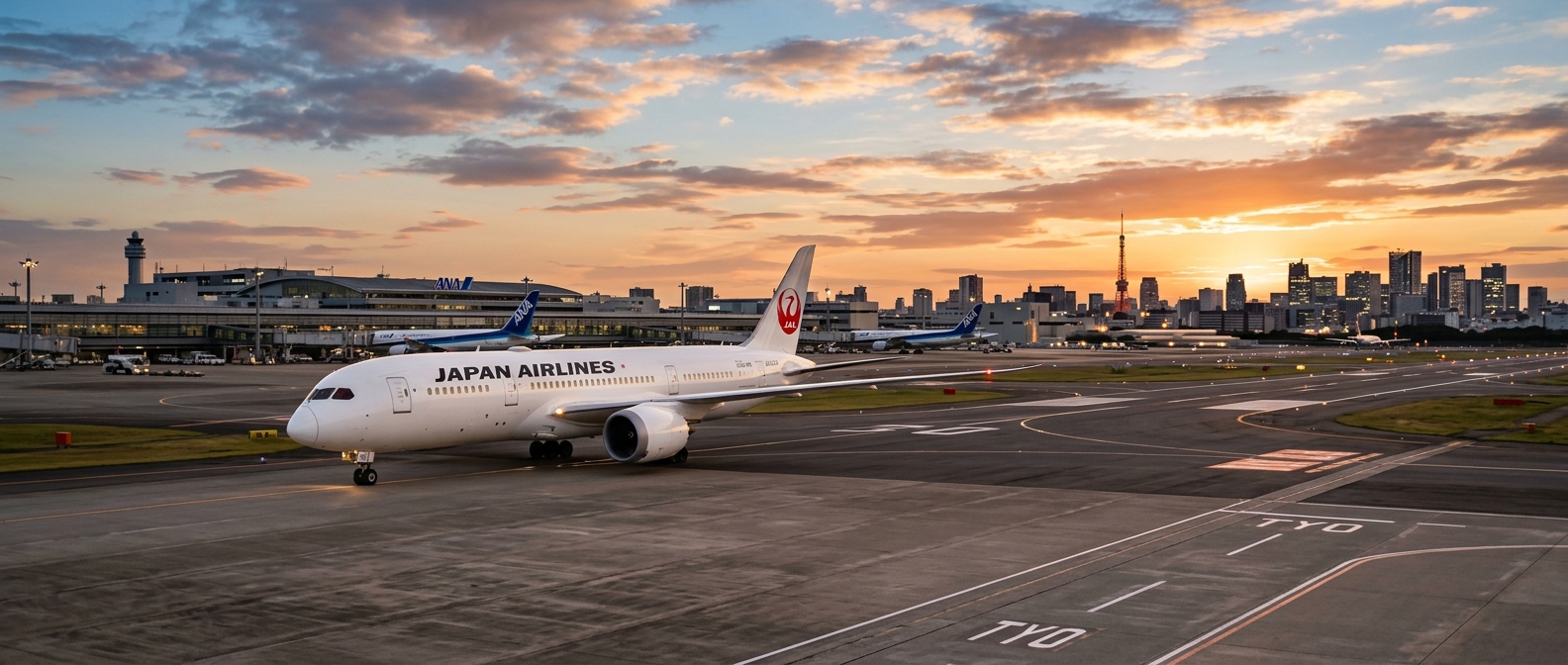
Wait Until September 1st to Book: JAL and ANA Just Slashed Fuel Surcharges for Autumn
Booking your October or November flight to Japan today could cost you $170 more than waiting just four days for the new government-subsidized rates to kick in.
Wait Until September 1st to Book: JAL and ANA Just Slashed Fuel Surcharges for Autumn
If you have a browser tab open right now with a flight to Tokyo for October, close it. Do not click purchase. Do not pass "Go." If you wait just a few days—specifically until the clock strikes midnight on September 1st—you are likely to save upwards of $170 per person on that exact same seat.
On August 18, 2026, Japan Airlines (JAL) and All Nippon Airways (ANA) officially announced a significant reduction in fuel surcharges for all international tickets issued between September 1 and October 31. This isn’t a standard market fluctuation; it’s the result of a fresh government emergency subsidy designed to stabilize rising travel costs as Japan enters its peak autumn foliage season.
This is the rare moment where procrastination actually pays off. Here is how to navigate the next 96 hours to ensure you aren't leaving hundreds of dollars on the table.
The Surcharge Calculus: Why September 1st is the Magic Date
Airlines generally calculate fuel surcharges in two-month blocks based on the average price of Singapore kerosene-type jet fuel. Usually, these adjustments are incremental—a few dollars here, a slight hike there. However, the announcement on August 18th represents a sharp downward correction thanks to direct government intervention.
The most important thing to understand is that fuel surcharges are tied to the date the ticket is issued, not the date you actually fly.
If you book a flight today (late August) for a trip in late October, you are paying the "Zone K" or "Zone L" rates established earlier this summer when fuel prices were peaking. By waiting until September 1st, your ticket falls into the new, subsidized bracket. For long-haul routes—think London (LHR) to Haneda (HND) or New York (JFK) to Narita (NRT)—the difference is roughly ¥25,000 to ¥28,000 per round trip. At current exchange rates, that is a clean $170 savings per ticket.
If you’re flying a family of four, that’s $680 saved just for waiting four days. That is more than enough to cover a week of high-end meals or a luxury Ryokan stay in Hakone.
The Risk: Base Fare vs. Surcharge
There is always a "but." The risk of waiting is that the base fare (the actual price of the seat before taxes and surcharges) could rise as the plane fills up.
However, historically, the price jump in base fares over a 96-hour period in late August rarely exceeds $170, especially for mid-autumn travel. Most travelers booking for October and November have already secured their seats. We are currently in a "lull" period for autumn bookings.
If you see a "low fare" alert or only "2 seats left at this price," you have a choice to make. But for most standard Economy and Premium Economy fares, the base price is likely to remain stable enough that the $170 surcharge drop will still result in a net win.
To keep an eye on these shifting prices without refreshing a dozen tabs, you can use a tool like the PingWing flight search to track the total cost and see if the downward trend holds as we approach the first of the month.
The "Award Traveler" Secret: It Works for Points, Too
Here is something most casual travelers don’t realize: JAL and ANA are among the few remaining major carriers that pass on full fuel surcharges to "Award" tickets booked with miles.
If you are planning to use British Airways Avios to book a JAL flight, or Virgin Atlantic points to book an ANA First Class cabin, you still have to pay the "Taxes and Fees" in cash. Those fees are composed largely of—you guessed it—fuel surcharges.
I once made the mistake of booking a "free" flight from Los Angeles (LAX) to Tokyo in August, only to realize I was paying $450 in cash fees. Had I waited for the surcharge window to reset, those fees would have dropped to under $300. If you are sitting on a pile of miles and looking for that October "Koyo" (autumn colors) trip, wait until September 1st to pull the trigger. The points cost won't change, but the cash out-of-pocket will.
Where to Spend Your Savings: The October Sweet Spot
October is arguably the best month to visit Japan. The humidity of the "shonetsu" (intense heat) summer has broken, the typhoons are thinning out, and the maple leaves are beginning to turn in the northern altitudes.
With that $170 you saved per person, skip the basic business hotels and head for something specific. If you find yourself in Kyoto, avoid the crowded main gates of the big temples. Instead, take the train out to the northern edge of the city to the Otagi Nenbutsu-ji Temple . It features 1,200 whimsical stone figures, and the moss-covered grounds are spectacular when the red maples begin to drop their leaves.
If you’re staying in Tokyo, use the extra cash to book a private transfer from the airport. Navigating the Keisei Skyliner or the Narita Express with three suitcases after a 12-hour flight is a special kind of hell. You can pre-book Airport Transfers to meet you at the arrivals hall with a sign, whisking you directly to your hotel in Shinjuku or Minato without the subway stairs.
Connectivity and Logistics
Once you've secured that cheaper flight on September 1st, don't let the savings bleed out through "hidden" travel costs. Data roaming is the biggest offender.
The days of picking up a physical pocket Wi-Fi at a kiosk in Narita are mostly over. It’s clunky, you have to charge it, and if you lose it, the penalties are steep. Before you leave the tarmac at your home airport, download a Japan eSIM. It activates the moment you touch down, giving you instant access to Google Maps and translation apps without the $10-a-day "travel pass" fees from your home carrier.
The "Book Now, Cancel Later" Strategy
If you are genuinely terrified that the base fare will spike before September 1st, check the fare rules for a "Refundable" or "Changeable" ticket.
Some higher-tier Economy fares allow for changes with a minimal fee. If the fee to change a ticket is $50, but the fuel surcharge savings is $170, you are still $120 in the green. You could book today to "lock in" the seat, then on September 1st, "re-issue" the ticket to capture the lower surcharge.
Warning: This is for advanced users. Always read the fine print. If the airline considers a re-issue as a "cancellation and re-book," you might be forced to pay the current market rate for the base fare, which could negate your savings. For 90% of travelers, simply waiting until the 1st is the cleaner, safer play.
Final Thoughts: The Value of 96 Hours
Travel hacking isn't always about finding a "mistake fare" or churning credit cards. Sometimes, it’s just about knowing the administrative calendar of the airline you’re flying. JAL and ANA are predictable. They follow the fuel prices and government mandates with Japanese precision.
We spend so much time worrying about whether a Tuesday at 3:00 AM is the best time to book (it’s not) that we miss the actual structural shifts in pricing like this one. Mark your calendar for September 1st. Set an alarm.
The autumn colors in the Arashiyama Bamboo Grove look a lot better when you know you didn't overpay by $170 just to get there. Japan is rarely "on sale," but for the next two months, the government is essentially cutting you a check to come visit. It would be a shame not to cash it.