
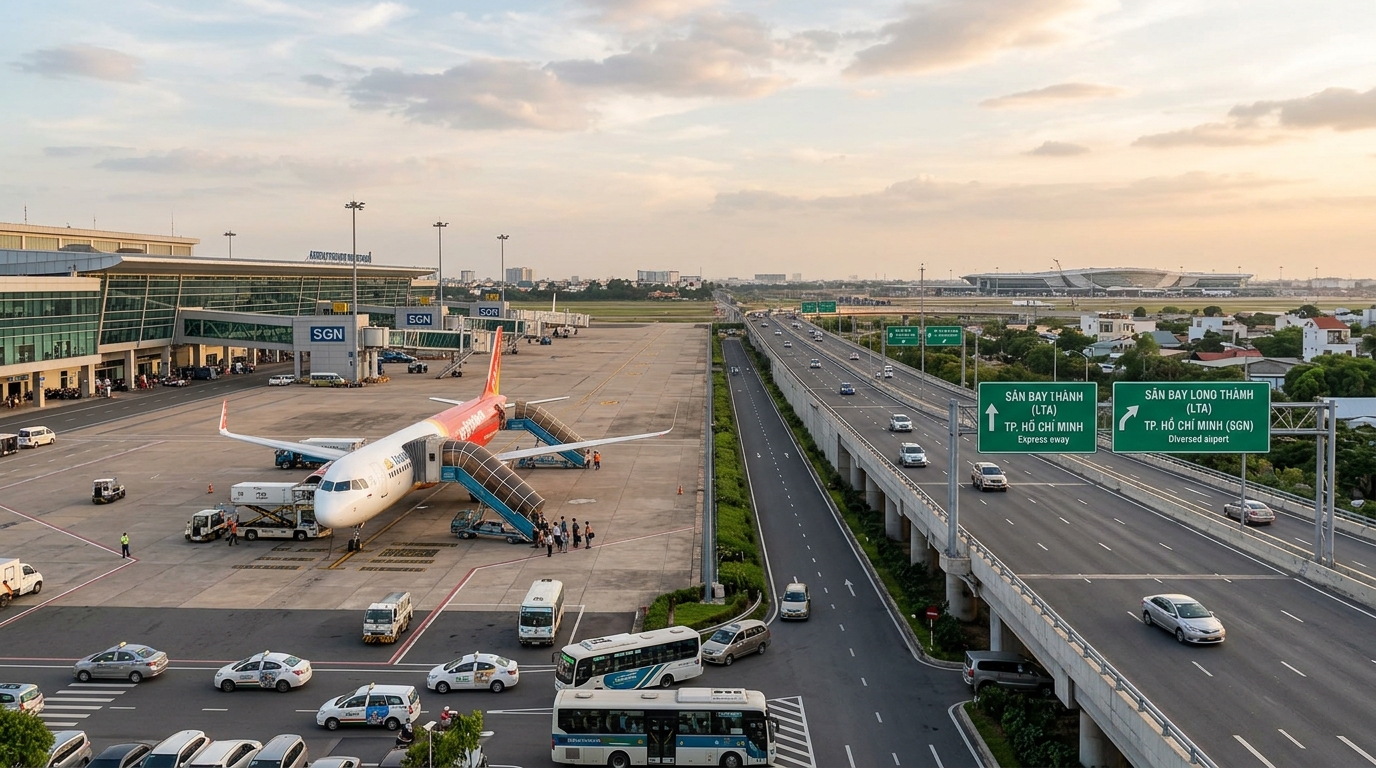
The SGN-LTA Split: Which Flights are Staying at Tan Son Nhat After September 1st?
As Long Thanh Phase 1 begins its operational transition, travelers are confused about which airport to head to for domestic vs. international connections.
Truong Son Street has been a bottleneck for a decade, a sweltering asphalt gauntlet that every traveler to Ho Chi Minh City knows too well. But the gridlock is about to shift. Starting September 1st, 2026, the Civil Aviation Authority of Vietnam (CAAV) is pulling the trigger on a massive operational pivot, moving 60 percent of international traffic away from the aging Tan Son Nhat (SGN) to the brand-new Long Thanh International Airport (LTA).
This isn't just another terminal opening; it is a total remapping of how you enter and exit Southern Vietnam. If you are booking a flight that touches down in or departs from Saigon anywhere near that September 1st cutoff, the "SGN" code on your ticket might not be the only thing you need to check. The distance between these two hubs is roughly 40 kilometers, but in Saigon traffic, that’s a two-hour variable that can turn a tight connection into a missed holiday.
The 60% Rule: Who is Moving to Long Thanh (LTA)?
The CAAV roadmap is specific. Long Thanh is designed to be the new "International Gateway," while Tan Son Nhat is being repositioned as the "Domestic and Regional Workhorse."
By September 2026, expect almost all long-haul international flights to migrate to LTA. If you are flying in from London (LHR), Paris (CDG), Los Angeles (LAX), or Sydney (SYD), your flight will almost certainly land at Long Thanh’s Phase 1 terminal.
Flag carriers like Vietnam Airlines and major international players—think Emirates, Qatar Airways, and ANA—will be the first to shift their wide-body operations. The logic is simple: SGN’s runways are at a breaking point, and LTA’s 4,000-meter runway is built specifically for the A380s and 787 Dreamliners that the city center airport currently struggles to accommodate efficiently.
The SGN Survivors: Who Stays at Tan Son Nhat?
Don't delete SGN from your flight tracker just yet. The "SGN-LTA Split" isn't a total abandonment of the old city airport. In fact, for many business travelers, SGN will remain the preferred choice.
- The Golden Route (SGN-HAN): The Ho Chi Minh City to Hanoi corridor is one of the busiest flight paths in the world. This route, along with other domestic hops to Da Nang (DAD) and Nha Trang (CXR), will stay firmly rooted at Tan Son Nhat.
- Budget Regional Hops: Low-cost carriers (LCCs) like VietJet and Bamboo Airways are expected to keep a significant portion of their regional international flights—think Bangkok (BKK), Singapore (SIN), and Kuala Lumpur (KUL)—at SGN for the first phase. Why? Because the turnaround times for these short-haul flights are more profitable when the airport is closer to the city's commercial heart.
- Government and VVIP Flights: The dedicated terminals for state officials and private jets will remain at SGN, maintaining its status as the "prestige" city-entry point.
The "Long Thanh Gap": A Logistics Nightmare in the Making
The most critical piece of advice for anyone traveling after September 2026 is to look at your connection type. Currently, if you fly from San Francisco to Saigon and then catch a domestic flight to Phu Quoc, you simply walk from the international terminal to the domestic terminal at SGN. It takes ten minutes.
After the split, that same trip could require an international arrival at LTA, a 90-minute taxi ride across the Long Thanh - Dau Giay Expressway, and a new check-in at SGN. If you haven't factored in a four-hour buffer, you will miss your domestic leg. To navigate this, you'll want to ensure your Vietnam eSIM is active the moment you touch down at LTA, as you’ll need to coordinate with drivers or check real-time traffic updates via the Thu Thiem Tunnel to gauge your arrival time at the old airport.
A Surprising Tip: The "Reverse Commute" Strategy
Most travelers will be fighting for the closest transport from LTA to the city center. Here is something most people haven't considered: the rise of "Satellite Stays."
If you have a 6:00 AM international departure from Long Thanh, do not stay in District 1 the night before. The traffic heading out of the city toward the new airport during the morning rush is unpredictable. Instead, look for boutique hotels popping up in the Thu Thiem area or even the outskirts of District 2 (Thao Dien). You’ll shave 30 minutes off your commute and avoid the bottleneck at the Saigon River crossings.
Additionally, check your airline’s "Co-terminal" status. Some airlines may offer "dual-hub" ticketing where you fly into LTA but are allowed to depart from SGN on your return leg without a change fee. This is a tactic used by airlines in cities with similar splits, like Tokyo (Narita/Haneda) or London (Heathrow/Gatwick), to keep their slots filled.
Choosing Your Transport: SGN vs. LTA
Getting to Tan Son Nhat is easy—you grab a Grab or a taxi from Ben Thanh Market and you’re there in 20-40 minutes.
Getting to Long Thanh is a different beast. While the government is fast-tracking a light rail connection, it likely won't be fully operational on day one. Your primary options will be:
- Shuttle Buses: Dedicated high-end shuttles will run from major hotels in District 1.
- Private Transfers: If you are traveling with a family or heavy gear, booking a private airport transfer in advance is non-negotiable. Don't rely on the "taxi queue" at a brand-new airport in its first month of operation; the chaos of a "Phase 1" opening is a global constant.
How to Read Your 2026 Booking
When the 2026 flight schedules begin to populate in booking engines, pay obsessive attention to the airport codes.
- SGN: Tan Son Nhat (The city airport).
- LTA: Long Thanh (The new international hub).
If you see a flight marketed as "Ho Chi Minh City" but the code is LTA, do not assume you can "just pop into the city for a quick lunch" during a four-hour layover. You’ll spend the entire four hours in the back of a car.
If you find yourself stuck with an accidental airport swap due to a schedule change—which will happen frequently during the 2026 transition—don't just swallow the cost. Use a service like AirHelp to see if the airline's shift in arrival airport qualifies as a significant schedule disruption, which often entitles you to a full refund or a rebooking on a flight that stays at SGN.
The New Reality of Southern Vietnam Travel
The opening of Long Thanh is a net positive. It means fewer "holding patterns" over the city, more international routes, and a modern terminal experience that SGN simply cannot provide. But for the traveler caught in the transition, it requires a mindset shift.
We are moving from a "one-airport city" to a "multi-airport system." This means checking your departure gate is no longer enough; you have to check your departure latitude. The days of leaving for the airport "an hour or two before the flight" in Saigon are officially ending for international travelers.
If you’re planning a trip for late 2026, start by downloading a reliable tracker. Keeping an eye on the PingWing app will help you spot these code changes long before you head to the wrong terminal. The transition will be messy, the traffic will be legendary, but the view of the South China Sea from a brand-new LTA gate will almost—almost—make you forget the two-hour drive to get there.