
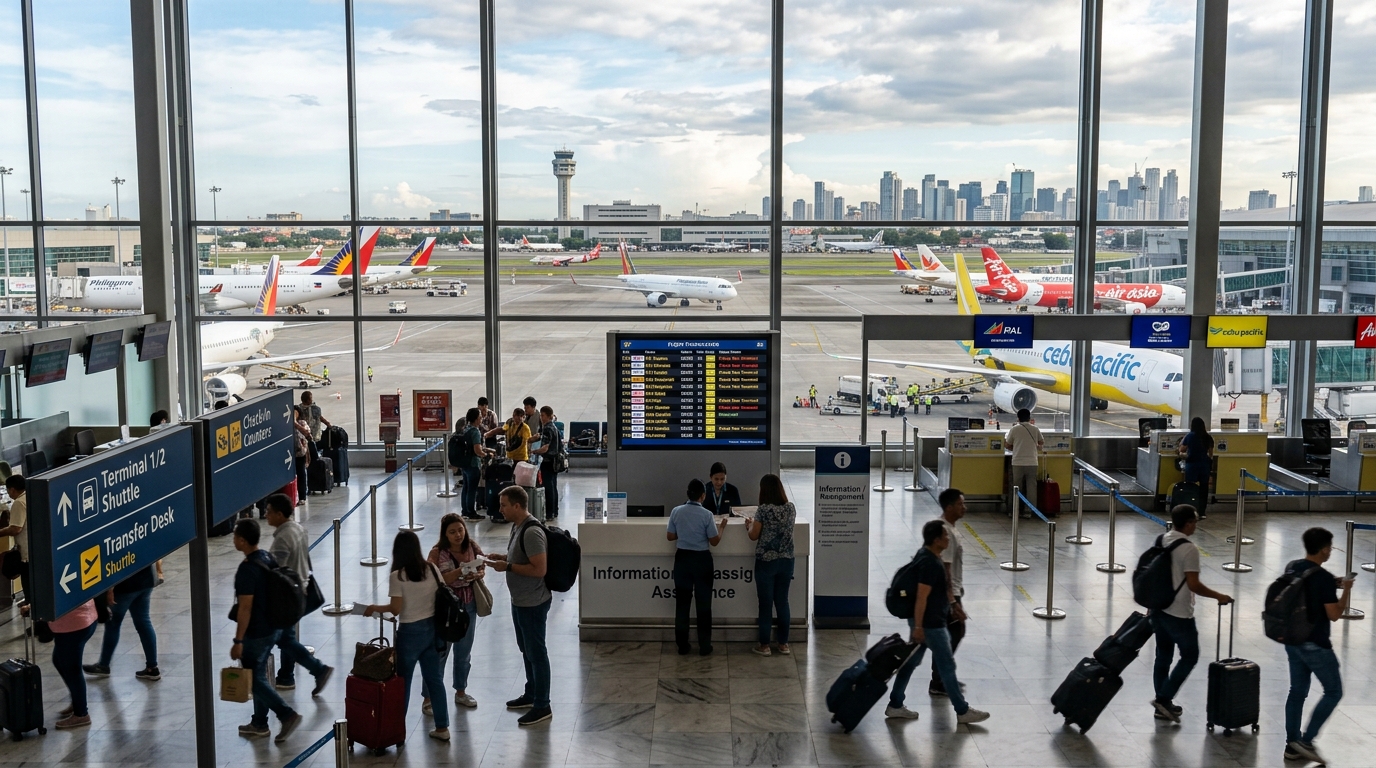
The NAIA Terminal Shuffle: Why Your Manila Connection Just Moved to a Different Building
Travelers are arriving at the wrong terminals in Manila as the new operator, NNIC, begins a massive airline reassignment to fix congestion.
The 45-minute crawl from Terminal 1 to Terminal 3 in Manila isn't just a commute; it’s a test of human patience. I’ve seen grown men crumble into existential despair while stuck in a white taxi on Andrews Avenue, watching their departure time tick by while the meter jumps and the air conditioning gives up the ghost.
This chaos is reaching a fever pitch this month. Following the October 5, 2026, announcement by the New NAIA Infrastructure Corp (NNIC), a massive terminal reassignment is underway to streamline international operations and decongest the world’s most "stressed" airport. If you are flying into or out of Manila (MNL) this season, the terminal printed on your itinerary from six months ago is likely a lie.
The "Manila Shuffle" is real. Here is how you navigate the new logic of Ninoy Aquino International Airport without losing your mind—or your flight.
The New Logic: Who Goes Where?
For decades, NAIA terminals were assigned based on a mix of historical legacy and whichever building had a spare gate. It was nonsensical. You’d have Philippine Airlines (PAL) split across two buildings and international carriers scattered like confetti.
Under the new NNIC management, the goal is "sectorization." The vision is to turn Terminal 1 and Terminal 3 into primarily international hubs, while Terminal 2 and Terminal 4 handle the domestic heavy lifting.
- Terminal 1: Now the fortress for major long-haul foreign carriers. If you’re flying United, Qatar Airways, or Turkish Airlines, this is your home. It’s the oldest building, but the NNIC has been aggressively upgrading the HVAC systems and lounge spaces.
- Terminal 2: Originally the PAL-only terminal, it’s transitioning into a domestic workhorse. If you’re heading to Boracay or Cebu on a "premium" domestic flight, you’ll likely be here.
- Terminal 3: The crown jewel. It’s now the primary hub for Philippine Airlines’ international wing and major regional players like Cathay Pacific and Singapore Airlines.
- Terminal 4: The "Old Domestic" terminal. It’s small, it’s crowded, and it’s where the low-cost domestic turboprops live.
The most important thing you can do before leaving your hotel in Makati or Quezon City is to check the live status. Don't trust your printed ticket. Since the NAIA terminal reassignment October 2026 rollout began, airlines are shifting gates weekly. I use PingWing to track the actual tail number of the incoming aircraft—if the plane is landing at T3, that’s where you need to be, regardless of what your PDF says.
The Transfer Trap: Why "Free" Is Often Fatal
Manila is one of the few major capitals where the airport terminals are not connected by a train or a sterile, air-conditioned walkway. They are separated by public roads, city traffic, and a complex web of elevated expressways.
The airport provides a "Free Shuttle" for connecting passengers. Here is my honest, well-traveled advice: Avoid it if your connection is under three hours.
The shuttle operates on "Philippine Time," which is to say, it departs whenever it’s full or whenever the driver feels the cosmic alignment is right. It also has to navigate the same perimeter traffic as everyone else. If you are sweating a tight connection, exit the terminal, ignore the touts, and book a Grab (the local version of Uber).
To do this effectively, you need data the second you touch down. I’ve found that roaming charges in the Philippines are predatory, and the airport Wi-Fi is… optimistic at best. Buying a Philippines eSIM before you land ensures you can summon a car while you’re still waiting at the luggage carousel.
A Counterintuitive Tip: The "Newport" Backdoor
If you find yourself with a six-hour layover because of a terminal change or a delay, do not sit on the floor of Terminal 3. There is a "secret" bridge called Runway Manila. It’s an air-conditioned, elevated pedestrian walkway that connects Terminal 3 directly to Newport City .
Instead of paying $20 for a sad airport sandwich, walk across the bridge. You’ll find yourself in a complex filled with high-end hotels, a mall, and actual restaurants. It’s the only place near the airport where you can feel like a human being again. If you’re stuck at Terminal 1 or 2, you’re less lucky—you’ll need a vehicle to get anywhere civilized.
Logistics: The NAIAX Factor
If you are moving between terminals, tell your driver to take the NAIAX (NAIA Expressway). It’s a tolled elevated highway that skips the surface-level gridlock. It will cost you about 45 to 80 pesos extra, but it can save you 30 minutes of staring at the back of a jeepney.
However, even with the NAIAX, the "Terminal Shuffle" can be brutal. If you’re coming from the south or the north via the Skyway, the off-ramps are frequently clogged. This is why I always tell people flying out of Manila to aim to be at the airport four hours early. That sounds insane, but in Manila, "on time" is late.
What if You Arrive at the Wrong Terminal?
It happens to the best of us. You tell the driver "Terminal 1," you get out, look at the departures board, and your flight isn't there.
- Don't Panic, but Move Fast: Check the airline desk immediately. During this October 2026 transition, NNIC has supposedly stationed "Customer Experience Agents" in bright vests to help displaced travelers.
- The Inter-Terminal Jeepney: There are specialized white buses specifically for this transition. They are faster than the standard shuttle but still subject to traffic.
- Documentation: If the terminal change happened within 24 hours of your flight and caused you to miss the connection, the airline is technically liable under the Philippine Air Passenger Bill of Rights. Take photos of the boards.
Because of the high risk of missed connections during this reassignment phase, I strongly suggest travel insurance that specifically covers "travel delay" and "missed connections." Most standard policies are finicky about Manila because the airport is a known "high-delay" zone, but a good policy will save you the $400 rebooking fee.
The Silver Lining
Why are we putting up with this? Because the NNIC takeover is the first time in thirty years that NAIA has seen real investment. We’re talking about doubled runway capacity and a terminal experience that doesn't feel like a 1970s bus station. The "Shuffle" is the growing pain required to get there.
In a year, the logic will be simple: International in the big buildings, Domestic in the small ones. Until then, we’re all just pawns in a very expensive game of musical chairs.
Final Pro-Tip for the Manila Bound
If you are renting a car to head out to Batangas or up to Baguio, do not pick it up at the airport. The congestion makes exiting the airport complex a nightmare that adds an hour to your trip. Take a private transfer to a hotel in Makati, sleep off the jet lag, and have your rental delivered there the next morning. Your blood pressure will thank you.
Manila is a city that rewards the prepared and punishes the hopeful. Check your terminal again. Then check it one more time before you close the car door. I’ll see you at the gate—hopefully the right one.