
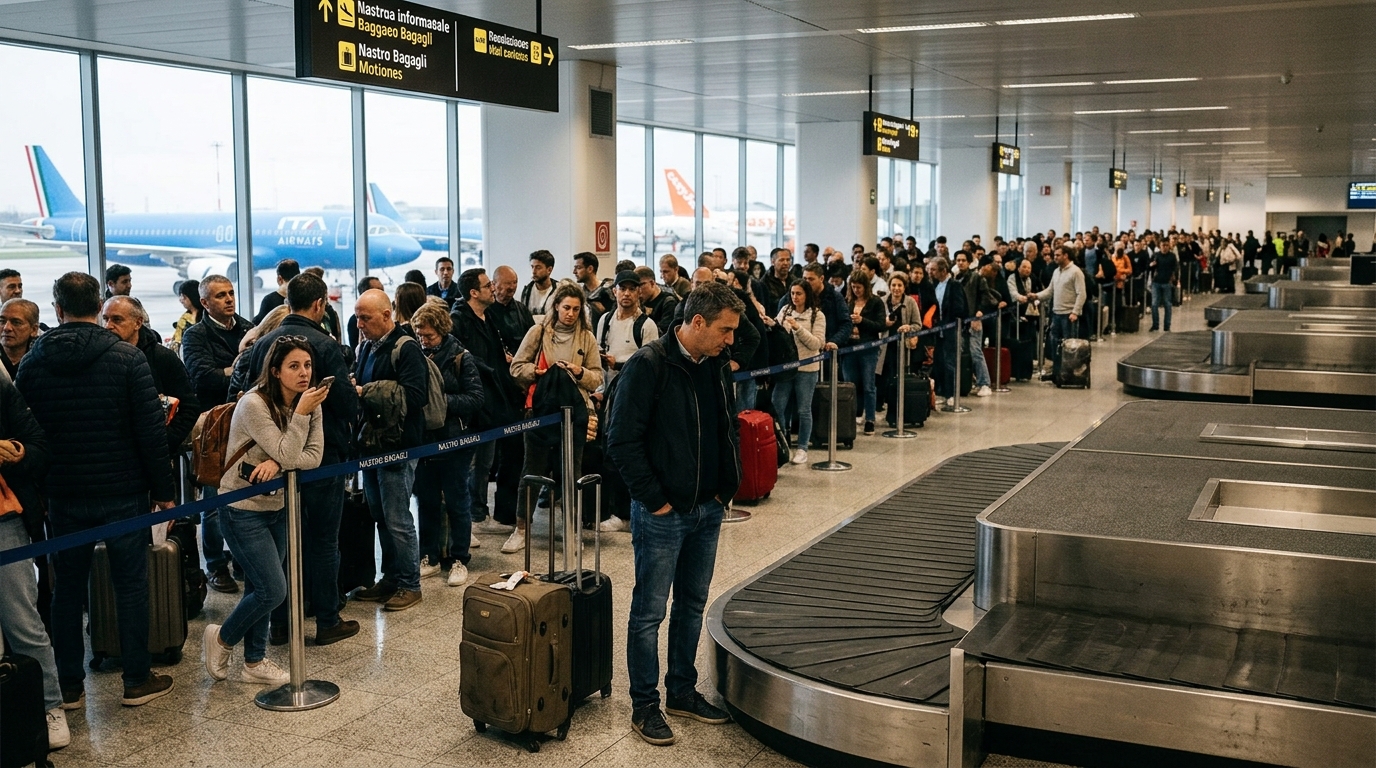
The September 24th Baggage Gridlock: Why You Should Carry-On at Milan and Venice Tomorrow
A massive strike by Italian baggage handlers is set to paralyze luggage carousels at Linate, Malpensa, and Marco Polo—here is how to avoid the 3-hour wait.
Italian airports are about to become the world’s most expensive waiting rooms. If you are flying into Milan or Venice on September 24, 2026, the arrival hall is a trap.
A nationwide strike by Italian airport staff and baggage handlers is scheduled to peak tomorrow, with ground crews at Milan Malpensa (MXP), Linate (LIN), and Venice Marco Polo (VCE) walking off the job. While Italy’s civil aviation authority, ENAC, typically mandates "guaranteed time slots" for flights to take off and land, those guarantees do not extend to the people who move your suitcases from the plane's belly to the carousel.
The result? The flights will land, but the luggage will stay in the dark. We are looking at a projected three-hour gridlock at baggage claim—if the bags even make it out of the hold at all.
The Anatomy of an Italian Ground Strike
Italian strikes, or scioperi, are a choreographed part of the nation's labor landscape. They aren't usually chaotic surprises; they are announced weeks in advance. But for the traveler landing at MXP tomorrow, the "announcement" doesn't make the empty carousel spin any faster.
When the ground handlers strike, the entire ecosystem of the airport stutters. It’s not just about the guys throwing bags. It’s the pushback tug drivers, the cabin cleaning crews, and the refueling teams. However, the baggage handlers are the primary friction point for you. If you check a bag, you are essentially handing your evening plans over to a skeleton crew that has no incentive to hurry.
Milan Malpensa is particularly vulnerable because of its size. It’s a sprawling terminal. If the tug drivers aren't moving containers to the sorting facility, your bag sits on the tarmac. In Venice, the situation is even more delicate. Marco Polo is a compact, high-volume airport. Once the luggage belts stop moving, the arrival hall hits capacity within forty-five minutes.
The Survival Strategy: One-Bagging
The only way to win this game is not to play. You need to carry-on.
I don't mean "try to fit it in the overhead." I mean you must commit to the "One-Bag" lifestyle for this specific 24-hour window. If your suitcase is in your hand, you are out of the airport and on the Malpensa Express train while everyone else is staring at a stationary rubber belt.
If you’re worried about the 10kg limit common on carriers like ITA Airways or EasyJet, here is the secret: wear your heavy layers. It’s late September in Lombardy. It’s cool enough to justify a trench coat or a blazer. Stuff your pockets with chargers, your Kindle, and your toiletries. Once you pass the gate agent, you can take the coat off.
For those who absolutely cannot avoid checking a bag—perhaps you’re transporting liquids or equipment—buy an AirTag today. It won't get your bag off the plane faster, but it will prevent the soul-crushing uncertainty of not knowing if your bag is in Milan or still sitting in London. If you end up in a dispute over lost luggage, having comprehensive travel insurance is the difference between a minor inconvenience and a €1,000 disaster.
Navigating the "Big Three" Tomorrow
Milan Malpensa (MXP): The distance from the gates to the exit is significant. If you are landing at Terminal 1, don't linger. The queues for the trains and taxis will swell the moment a flight's passengers realize their bags aren't coming. If you’ve managed to travel light, move directly to the train station on the lower level.
Milan Linate (LIN): Linate is the "city airport," favored by business travelers. It’s efficient, but that efficiency relies on a high-speed turnaround. When the handlers strike here, the backlog is immediate. Because Linate is so close to the center, many people rely on quick exits. If you find yourself stuck, don't wait for a taxi at the curb. Use a ride-hailing app or check for pre-booked airport transfers to bypass the inevitable line of frustrated travelers.
Venice Marco Polo (VCE): Venice is a logistical puzzle. Most travelers are heading to the historic center, which requires a water taxi or the Alilaguna boat. If you are delayed by three hours at baggage claim, you might miss the last convenient water bus to the Piazzale Roma .
The Counterintuitive Tip: The "Gate-Check" Trap
Here is something most travelers get wrong during a strike: they think that if they are forced to gate-check their bag because the overhead bins are full, it’s "safer" than checking it at the ticket counter.
It isn't. In fact, it's worse.
During a ground strike, the crew responsible for "bridge-side" baggage (the stuff you hand over at the aircraft door) is often the same crew walking off the job. If you are the last to board a flight to Venice tomorrow and the bin space is gone, your bag will be tagged and sent to the hold. When you land, that bag will not be brought back to the jet bridge. It will go to the carousel. You have just accidentally entered the 3-hour baggage lottery you were trying to avoid.
The Fix: Board as early as your group allows. If you are in a late boarding group, bring a soft-sided duffel that can be squished under the seat in front of you. Avoid "hardshell" carry-ons if you are flying a low-cost carrier tomorrow; they are the first targets for forced gate-checking.
Connectivity is Your Shield
In a strike scenario, information is your most valuable currency. The airport screens are notoriously slow to update when labor actions are underway. They might say "Delayed" when the reality is "Cancelled," or "Bags Expected" when the handlers have already left the building.
You need to be able to check your airline’s app, labor news sites, and flight trackers in real-time without hunting for spotty airport Wi-Fi. If you haven't sorted your data yet, grabbing an Italy-specific eSIM before you land will keep you connected the second the wheels hit the tarmac. You can use that connection to pivot—book a bus, change a hotel check-in time, or find a nearby café to wait out the chaos.
What Happens if Your Flight is Cancelled?
While the baggage handlers are the headline act, the strike can lead to full flight cancellations if the ground support falls below safety minimums.
If your flight is scrapped, don't join the 200-person line at the service desk. It’s a waste of energy. Get on the phone with the airline or use their app to rebook. Under EU Regulation 261/2004 (which still applies to flights into and within Italy), you are entitled to care and assistance, though "extraordinary circumstances" (like a third-party strike) can sometimes complicate compensation claims. If you feel the airline is dodging their responsibility, it’s worth checking your eligibility through a service like AirHelp once the dust settles.
The Ripple Effect: September 25th and Beyond
Strikes in Italy have a "hangover" effect. Even if the strike officially ends at midnight, the morning of September 25th will be a mess of displaced luggage and "repositioned" aircraft. If you are flying out of Italy the day after the strike, arrive at the airport earlier than usual. The check-in counters will be dealing with the backlog of everyone who couldn't fly the day before.
Travel in Italy is about the dolce vita, but tomorrow, it’s about tactical efficiency. Leave the heavy suitcase at home. Bring a backpack. Wear your coat. And most importantly, keep your phone charged and your data active.
The beauty of Venice is worth a lot of things, but it isn't worth three hours spent staring at a silent, grey piece of moving plastic in a windowless room. Get your bag, get out, and get to the Spritz.