
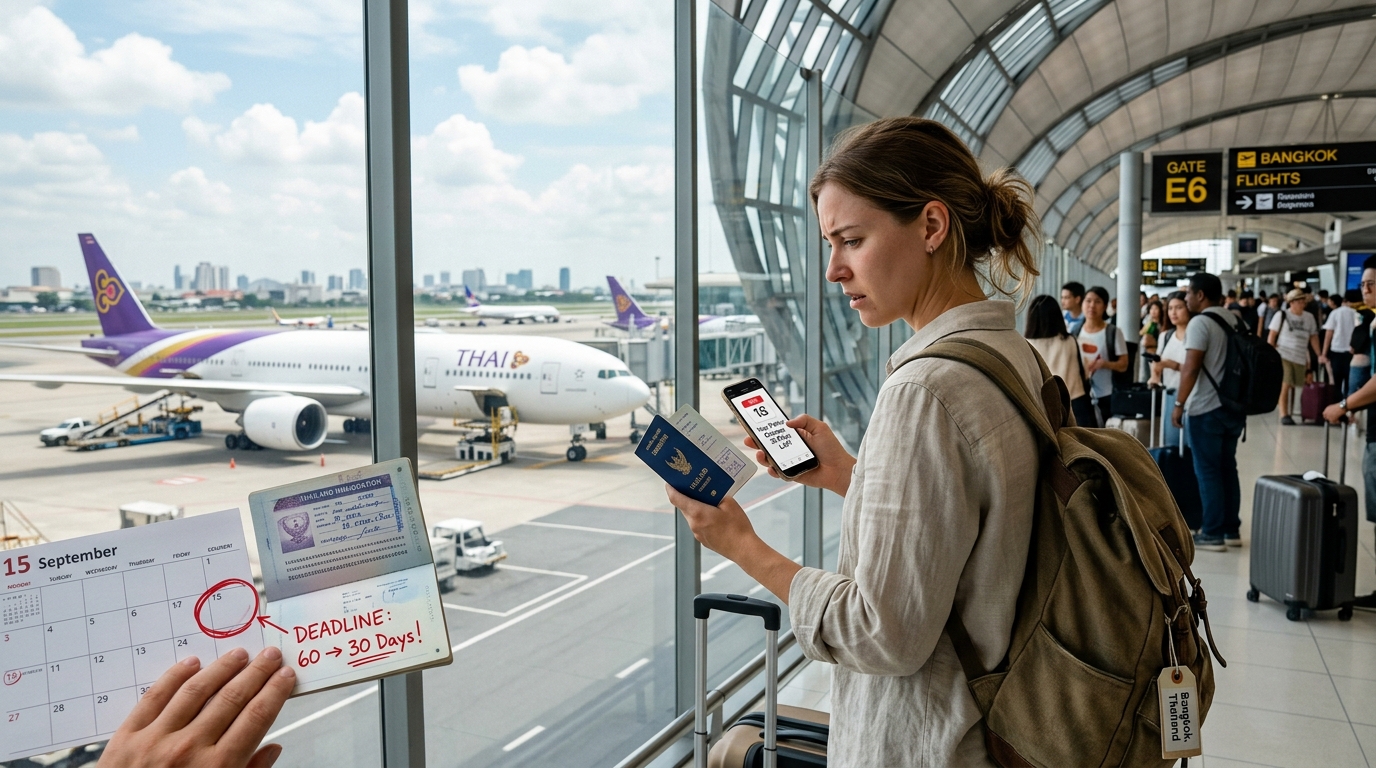
The September 15th Visa Cliff: Why Your Thailand Stay Just Got Slashed in Half
Travelers entering Thailand after next Monday will lose 30 days of their visa-free stay as the temporary 60-day policy officially expires.
The September 15th Visa Cliff: Why Your Thailand Stay Just Got Slashed in Half
The 60-day dream is dead. If you’re touch-downing at Suvarnabhumi (BKK) or Don Mueang (DMK) anytime after next Monday, your world just got 30 days smaller. As of September 15, 2026, Thailand is officially pulling the plug on its generous, temporary 60-day visa exemption policy, reverting to the standard 30-day stay for travelers from 60 countries.
This isn't just a minor bureaucratic tweak; it’s a fundamental shift in how you plan your Southeast Asian itinerary. For the last few months, we’ve enjoyed a "slow travel" golden era where you could land in Bangkok, meander down to the islands, and loop back up to Chiang Mai without ever looking at a calendar. Those days are over. If you haven’t adjusted your return flight or your digital nomad "home base" strategy yet, you’re about to hit the visa cliff at full speed.
The Midnight Transition: Why Timing is Everything
Thai immigration operates on a strict "time of arrival" basis. If your flight is scheduled to land at 11:30 PM on September 14th, but a headwind or a gate delay pushes your actual touchdown to 12:05 AM on September 15th, you are getting a 30-day stamp. Period.
There is no "but my flight was supposed to arrive yesterday" grace period. If you’re flying in during this transition window, keep a very close eye on your flight’s real-time progress. I’ve seen travelers lose an entire month of their planned stay because of a 40-minute tarmac delay. If your schedule is tight, you might want to book a flight that arrives well ahead of the deadline to ensure you lock in that final 60-day window.
The Extension Play: How to Buy Another 30 Days
Don't panic and cancel your island-hopping plans just yet. While the automatic exemption is dropping to 30 days, the ability to extend your stay in-country usually remains an option—for a price.
Once you’re on the ground, you can visit a local Immigration Office to apply for a 30-day extension. In Bangkok, this usually means a trip to the Government Complex at Chaeng Watthana or the more central IT Square Laksi .
The process is a quintessential Thai experience:
- Pay 1,900 THB.
- Provide a passport photo (4x6 cm).
- Fill out the TM.7 form.
- Wait for 2–4 hours in a plastic chair.
It’s a half-day of your life gone, but it legally bumps your 30-day stay back up to 60. If you’re staying in Chiang Mai, you’ll likely head to the immigration office near the airport or the one at Maya Lifestyle Shopping Center . Pro tip: Show up 30 minutes before they open. The queues after the September 15th change are expected to be brutal as everyone who missed the 60-day window tries to buy their time back.
The "Counterintuitive" Solution: The DTV
If you are a digital nomad, a remote worker, or someone with a "special interest" (like Muay Thai or Thai cooking), the 30-day cliff shouldn't even be your concern. You should be looking at the Destination Thailand Visa (DTV).
Introduced recently, the DTV is the real "cheat code" for staying in Thailand long-term. It allows for a 180-day stay per entry and is valid for five years. While the standard 30-day exemption is shrinking, the DTV remains the most robust way to avoid the constant stress of visa runs. It requires proof of funds (500,000 THB) and a reason for staying, but it’s far superior to the old "border run" cycle.
Connectivity and Logistics: Don't Get Stranded
When your visa time is halved, your logistics need to be twice as sharp. You don't want to spend three of your precious 30 days trying to find a reliable SIM card or figuring out why your banking app is blocked.
As soon as you clear immigration, you need to be "online" to manage your extension appointments and grab rides. Instead of overpaying for a tourist SIM at the airport kiosk, grab a Thailand eSIM before you even board. It saves you the "passport-scanning" dance at the airport and ensures you have data the second the wheels touch the tarmac. This is especially vital if you’re planning to head straight from the airport to a more remote area like Pai or Koh Lanta where the Wi-Fi can be... optimistic.
The Border Run Math: Is it Still Worth It?
For years, the "border run" was the rite of passage for long-stayers. You’d hop in a van at 5:00 AM, drive to the Cambodian border at Aranyaprathet , walk across, turn around, and come back.
With the stay period reverting to 30 days, the "math" of the border run changes. Is it worth spending $100 USD on transport and visa fees just to get another 30 days? Probably not.
If you need more time, it’s often cheaper and infinitely more pleasant to fly to a neighboring country for a weekend. A quick trip to George Town, Malaysia, or Luang Prabang, Laos, gives you a fresh stamp and a mini-vacation. If you do go the overland route, be warned: Thai immigration has become increasingly strict about "back-to-back" exemptions. If they see three or four 30-day stamps in a row, they might start asking questions about why you haven't applied for a formal Tourist Visa or a DTV.
Risk Management: The Overstay Trap
With the stay period being cut in half, the risk of an accidental overstay skyrockets. It’s easy to remember "two months," but "30 days" requires actual counting—especially in months with 31 days.
Thai Immigration does not play games with overstays. The fine is 500 THB per day, capped at 20,000 THB. But the real danger isn't the fine; it's the blacklisting. If you overstay by more than 90 days, you’re banned from the country for one year. If you’re caught by police before you reach the airport with an overstay, you can be detained in the Immigration Detention Center, which is a place you never, ever want to see from the inside.
This is where travel insurance becomes your safety net. While it won't pay your overstay fine, it is essential if a medical emergency or a flight cancellation forces you to stay past your visa date. Immigration is much more lenient if you have a hospital certificate and insurance documentation proving you weren't "choosing" to overstay.
The "Hidden" Secondary Entry Points
Here is a tip most travelers miss: Suvarnabhumi is the strictest entry point in the country. If you have a complex visa history or you're worried about the 30-day limit, consider flying into a secondary international airport like Phuket (HKT) or even Udon Thani (UTH) if you're coming from a regional hub.
Officers at these smaller ports are often less jaded than the ones processing 50,000 people a day in Bangkok. They are generally more helpful and less likely to give you the "third degree" about your onward travel plans. Regardless of where you land, always have a digital or printed copy of your exit flight. With the 30-day rule back in effect, airlines are going to be much more aggressive about checking for proof of onward travel at the check-in counter.
Getting Around Once You're In
Since you only have 30 days, you can't afford to waste time on slow buses or unreliable ferries. If you're heading north to the mountains, renting a bike is the only way to see the real Thailand outside of the "Grab" bubble. You can easily rent a motorbike in places like Chiang Mai or Surat Thani to explore at your own pace. Just ensure you have an International Driving Permit (IDP) with a motorcycle endorsement; the police checkpoints in Nimman and Old City are legendary, and they love a good "no license" fine.
The New Reality
The September 15th cliff is a reminder that Thai travel policy is a pendulum. It swings toward openness when the economy needs a boost and back toward restriction when the bureaucracy feels things are getting too "loose."
Don't let the 30-day limit sour your trip. Thailand is still the most frictionless travel destination in Asia; it just requires a bit more intentionality now. Watch your dates, have your extension plan ready, and for heaven's sake, don't rely on a midnight flight to save your 60-day stamp.
I’ve spent a decade navigating these rule changes, and the one thing that never fails is flexibility. The travelers who get frustrated are the ones who try to fight the system. The ones who have a great time are the ones who see a 30-day limit as an excuse to finally go see what's happening in Vietnam or Taiwan for a month before coming back.
Bookmark the immigration site, set a calendar alert for day 25 of your stay, and keep your passport ready. The cliff is coming, but you’ve got the parachute.