
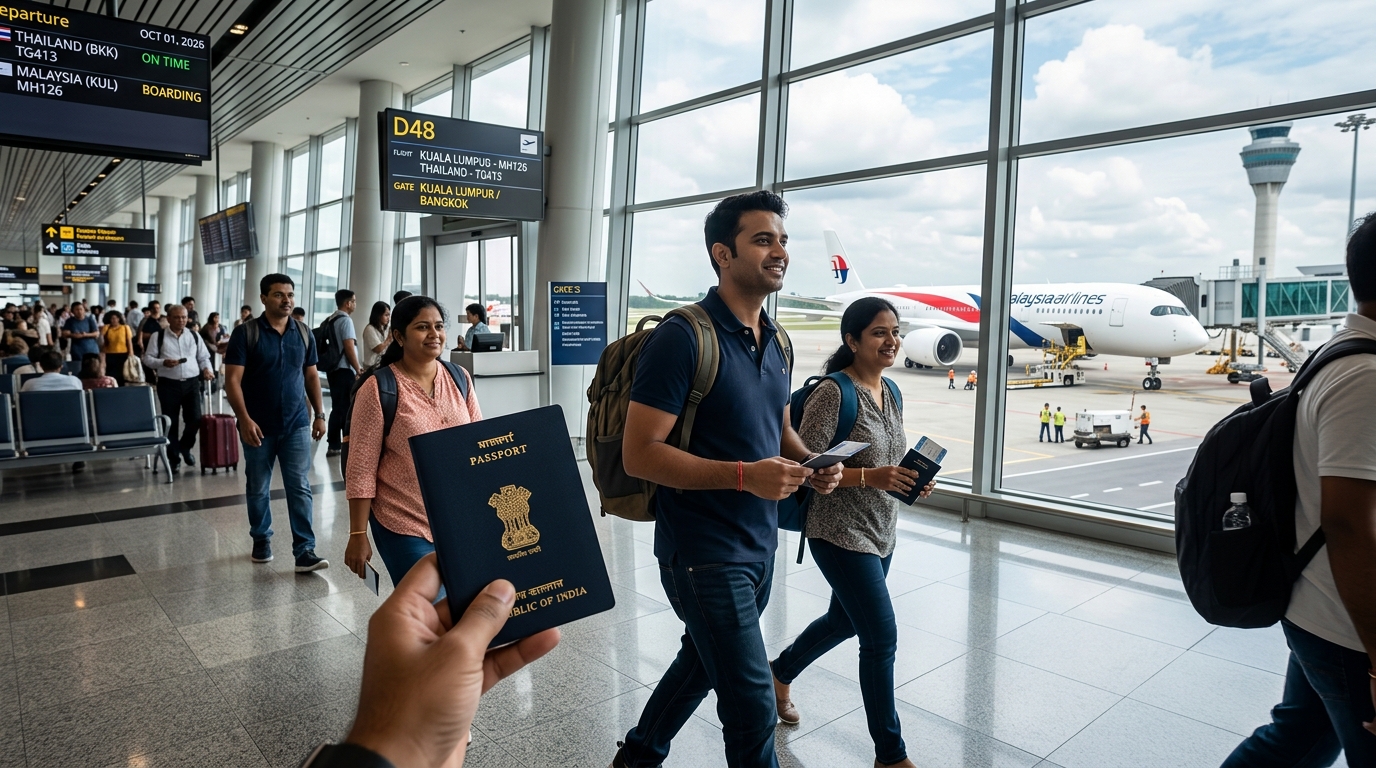
The October 1st Visa Pivot: Why Your Indian Passport Just Got More Powerful in SE Asia
New reciprocal visa-free agreements are going live in 10 days—here is exactly how long you can stay in Thailand and Malaysia under the new 2026 rules.
October 1, 2026, marks the end of the "trial phase" and the beginning of a new era for the Indian passport. Starting ten days from now, the temporary visa-free windows for Thailand and Malaysia aren't just being renewed—they are being codified into a permanent, reciprocal agreement that effectively doubles the time you can spend on the ground without touching a single visa form.
For the frequent flyer, this isn't just about saving 2,000 Baht at a crowded VOA counter. It’s a fundamental shift in how you can plan your life and work. If you’ve been sitting on the fence about a "workation" or a multi-city Southeast Asian loop, the friction just hit zero.
Thailand: 60 Days of Frictionless Entry
Until now, Indian travelers often felt like guests on a ticking clock. The 30-day window was fine for a quick dash to Phuket, but it felt cramped for anyone wanting to actually see the country. From October 1st, the official policy grants Indian nationals a 60-day visa-free stay upon arrival.
This isn't just a 30-day extension; it’s a psychological shift. You can now land at Suvarnabhumi (BKK) or the often-underestimated Don Mueang (DMK), get your stamp, and head straight to the city without the dread of the Visa on Arrival (VOA) queue.
If you’re heading into Bangkok, skip the standard tourist traps. Head instead to the Ari neighborhood . It’s where the local creative class hangs out—think craft beer bars, mid-century modern cafes, and zero "I Heart BK" t-shirts. With 60 days on your clock, you actually have time to live like a local here rather than just passing through.
Pro Tip: Even though it’s visa-free, Thai immigration officers have become stricter about proof of onward travel and "sufficient funds." They rarely ask, but when they do, they want to see 20,000 Baht per person in cash or equivalent. Don't get caught out. Also, ensure your Thailand eSIM is active before you hit the taxi stand; the airport Wi-Fi at BKK is notoriously patchy once you leave the terminal building.
Malaysia: The 30-Day Reciprocal Power-Up
Malaysia is matching the energy. While the headlines focus on Thailand, the Malaysia-India corridor is arguably becoming more lucrative for the business traveler. Starting October 1st, the 30-day visa-free entry is being solidified as a permanent fixture of the bilateral relationship.
The process remains simple, but don't let the "visa-free" label make you lazy. You still need to submit the Malaysia Digital Arrival Card (MDAC) within three days before your arrival. I’ve seen dozens of travelers held up at the KUL immigration gates because they thought "visa-free" meant "form-free." It doesn't.
If you’re using Kuala Lumpur as a base, the Bukit Bintang area is the standard choice, but for a better vibe, look toward The Zhongshan Building . It’s a refurbished colonial building that now serves as an independent arts hub with records stores, galleries, and a tiny hidden bar.
The Strategy: The "Golden Triangle" Loop
The real magic of the October 1st pivot isn't just staying in one country. It’s the ability to bounce between them. Because both countries are removing the visa barrier, the "visa run" is dead—replaced by the "regional hop."
Here is how you play the new rules:
- Fly into Bangkok (BKK): Spend 45 days exploring the north (Chiang Mai) and the islands.
- Train or Fly to Kuala Lumpur (KUL): Use the 30-day Malaysian window to explore Penang and Langkawi.
- The Surprise Move: Take a bus or a short flight from Malacca to Singapore (which still requires a visa, but you’ve saved so much time and money on the other two that the paperwork feels light).
To make this work, stop booking round-trip tickets. The "Open-Jaw" strategy is your friend here. Book India -> Bangkok and then Kuala Lumpur -> India. Use a tool like PingWing's flight search to compare these multi-city routes. Often, the price difference between a round-trip and an open-jaw is less than the cost of the domestic flight you'd need to take to get back to your original starting point.
Connectivity and Security: The Invisible Essentials
When you’re staying in a country for 60 days, you aren't a tourist; you’re a temporary resident. This means your digital hygiene needs to level up.
First, the "Public Wi-Fi" trap. In places like Bangkok’s Jodd Fairs or the malls in KL, you’ll find free Wi-Fi everywhere. Do not use them for banking or accessing your work Slack without protection. I’ve had my credentials scraped once in a "free" airport lounge, and it’s a headache that ruins a trip. Use a Secure VPN to keep your data encrypted, especially if you’re planning to take advantage of the longer stay to get some work done.
Second, insurance. Most "travel insurance" is designed for 7-14 day holidays. If you’re staying for two months, check the fine print on your policy. Many standard credit card insurances expire after 30 days. For these longer stints, specialized travel insurance that covers extended stays and local scootering (a must in places like Koh Samui) is non-negotiable.
The Surprising Tip: The "Second City" Arrival
Everyone flies into BKK or KUL. Because of the new visa-free surge, these airports are going to be slammed in October.
Here is the counterintuitive move: Don't land in the capital.
Instead of BKK, look for flights into Phuket (HKT) or even Surat Thani (URT). Instead of KUL, look at Penang (PEN). These smaller international airports often have much shorter immigration lines, and because the visa-free policy is nationwide, the stamp is exactly the same. You can be out of the airport and in a rented car within 30 minutes, whereas at KUL, you might spend that time just walking from the gate to the train.
Why This Matters for the Indian Passport
For decades, the Indian passport was a document of "permission." You had to ask for permission to enter, provide bank statements to prove you were "worthy," and wait weeks for a sticker.
The October 1st pivot represents a shift toward "welcome." Thailand and Malaysia are acknowledging that Indian travelers are now the engine of Southeast Asian tourism. By removing the visa barrier, they are inviting you to be spontaneous.
You no longer need to plan a trip three weeks in advance. You can see a cheap flight on PingWing on a Thursday night and be eating Hainanese Chicken Rice at the Burgess Hainanese Chicken Rice stall by Friday afternoon.
Logistics Checklist for the October Pivot
- Passport Validity: Ensure you have at least 6 months left. This is the #1 reason people are turned away at the gate, visa or no visa.
- Onward Ticket: While you can stay 60 days in Thailand, have a "placeholder" ticket out of the country. If you don't have your return flight booked yet, use an onward ticket service or a refundable fare.
- The MDAC (Malaysia Only): Don't forget to fill it out 72 hours before you land.
- Currency: Carry some local currency for the initial taxi/grab. While SE Asia is digital-first, the "cash is king" rule still applies to the best street food stalls.
The power of your passport just doubled. The question isn't whether you should go, but how you’re going to spend those extra 30 days. Don't waste them sitting in a hotel room in a tourist bubble. Get out, head to the secondary cities, and use the freedom to actually see the region, not just the highlights.
The era of the "Visa Run" is over. The era of the "Regional Nomad" has officially arrived. Where are you landing first?