
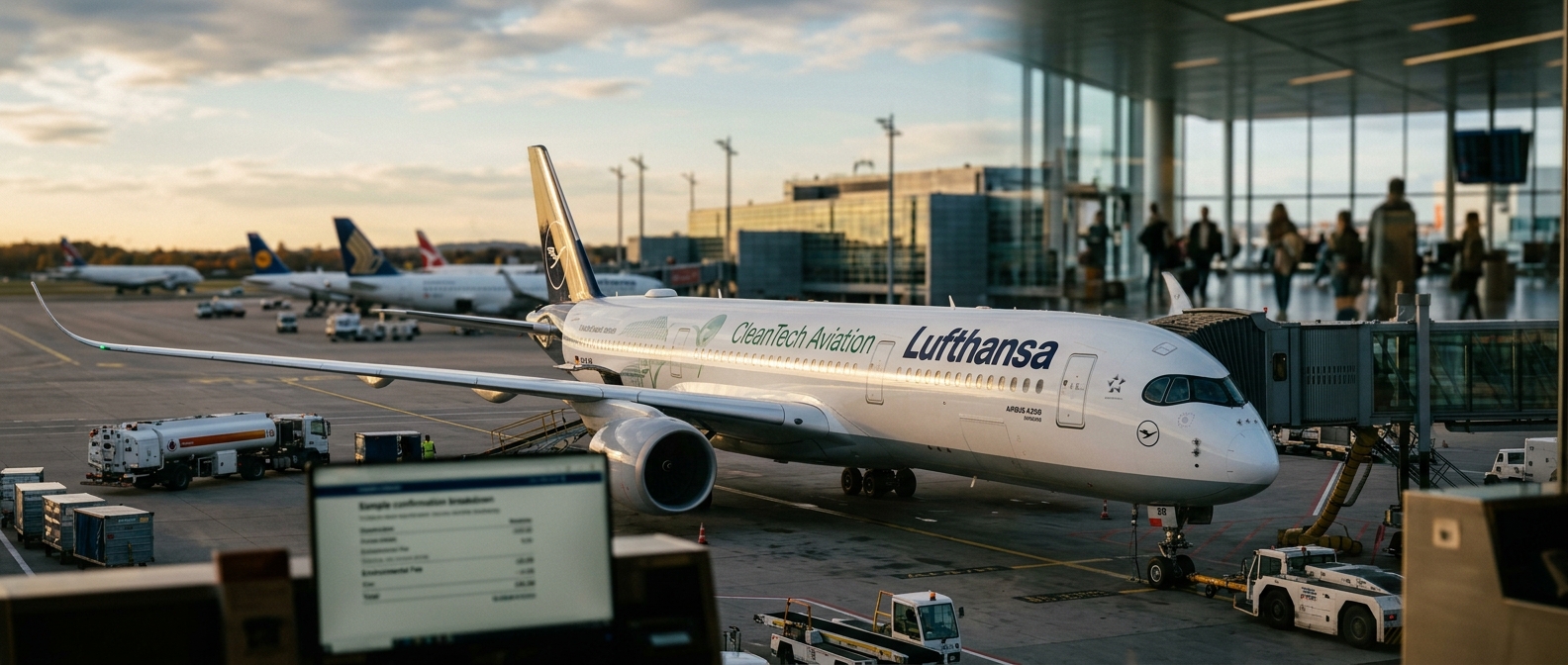
The SAF Surcharge: Why Your October Flight to Europe Just Got a Hidden 15 Dollar Fee
New 2026 environmental mandates are hitting ticket prices this week, and most travelers are missing the line-item charge.
The SAF Surcharge: Why Your October Flight to Europe Just Got a Hidden 15 Dollar Fee
CATEGORY: news TARGET SEARCH QUERY: aviation news September 2026 fuel surcharges
You probably didn’t notice the line item. Most people don’t. You were likely focused on whether you could squeeze a week’s worth of clothes into a carry-on or if the "Basic Economy" fare included a seat assignment. But if you booked a flight out of London, Paris, or Frankfurt this week for travel after October 1st, you just paid a "Green Tax" you weren't expecting.
The RefuelEU Aviation mandate, requiring a minimum of 2% Sustainable Aviation Fuel (SAF) usage across the board, takes full effect for the 2026 winter schedule. In response, major carriers like Lufthansa Group and IAG (the parent company of British Airways and Iberia) have begun implementing "Environmental Surcharges" on all departures from EU and EFTA airports starting October 1st. We’re talking about an extra $5 to $15 per ticket for short-haul flights, and significantly more for long-haul journeys.
It’s the end of the "cheap" environmental era. For years, airlines asked if you’d like to voluntarily offset your carbon for the price of a latte. Now, the choice has been taken out of your hands.
The Breakdown: Who is Charging What?
The surcharge isn't a flat fee across the industry, which makes it even more annoying to track. Lufthansa was the first to blink, announcing a tiered fee structure that scales based on your flight distance and fare class. If you're flying Business Class from Frankfurt (FRA) to New York (JFK), expect that "hidden" fee to look more like $40.
IAG followed suit shortly after. For a standard flight out of London Heathrow , you’ll see the fee baked into the "Taxes, Fees, and Surcharges" section. Air France-KLM has also adjusted their existing SAF contributions to meet the new 2026 legal requirements.
The logic from the airlines is simple: SAF is currently three to five times more expensive than traditional kerosene. They claim they can’t absorb the cost of the 2% mandate without passing it on to you. But as someone who spends half their life in terminals, I see this as the beginning of a much larger trend. By 2030, that mandate jumps to 6%, and by 2050, it’s 70%. If $15 feels like a nuisance now, wait until the surcharge is the price of the ticket itself.
The "Hub-and-Spoke" Workaround (That Might Save You More Than $15)
Here is a counterintuitive strategy you won’t hear from the airlines: the surcharge only applies to flights departing from EU airports. It does not apply to flights transiting through non-EU hubs if the journey originated elsewhere, nor does it apply to many carriers flying into Europe from outside the mandate’s jurisdiction.
If you are planning a multi-city trip or a long-haul journey, look at hubs like Istanbul (IST) or Dubai (DXB). Because Turkey and the UAE aren't bound by the RefuelEU mandate in the same way, carriers like Turkish Airlines or Emirates aren't currently forced to tack on these specific "Environmental Surcharges" for the 2026 season.
I recently compared a flight from London to Bangkok. By booking a flight with a stopover in Istanbul rather than a direct flight from LHR or a connection in Paris, I saved nearly $60 in various "environmental" and airport-specific fees. Plus, you get to spend a few hours at the Turkish Airlines Lounge , which, let's be honest, beats a cold sandwich at a terminal gate any day.
How to Spot the Fee Before You Pay
Airlines are getting very good at hiding these costs. They often bundle them under "YQ" or "YR" codes in the fare breakdown. When you’re using a flight search tool, don’t just look at the headline price. Click the "i" or "Fee Breakdown" button.
If you see a charge labeled "Environmental Surcharge" or "SAF Contribution," that’s it. If you haven't booked your autumn trip yet, do it before the next round of price adjustments. Traditionally, airlines update their surcharge tables at the end of every quarter. Buying your tickets for the Christmas holidays now, rather than waiting until November, could save you a family-sized portion of these fees.
While you're at it, make sure your digital essentials are sorted. If you're heading into the EU, don't get stuck paying roaming fees on top of your new flight surcharges; grabbing a Europe eSIM before you land is the easiest way to keep your budget from bleeding out.
The Loyalty Loophole
If you’re a points chaser, there’s a silver lining. Currently, most airlines do not apply the SAF surcharge to "Reward Flights" or "Award Tickets" in the same way they do to cash fares. While you still have to pay the standard taxes and carrier-imposed surcharges (which are already high on airlines like British Airways), the specific new 2026 environmental levies are often omitted from the points-redemption calculation—at least for now.
This makes your miles more valuable. If a cash ticket has jumped by $30 due to new fuel mandates, but the points price remains the same, your "cents per point" value just went up.
Is the SAF Surcharge Actually Helping?
This is the $15 question. Sustainable Aviation Fuel is made from feedstocks like used cooking oil, municipal waste, or woody biomass. It can drop CO2 emissions by up to 80% compared to fossil fuels. The problem? There isn't enough of it.
The 2% mandate is designed to force production to scale. By making us pay for it, the EU is effectively subsidizing the birth of a new fuel industry. It’s a bitter pill to swallow when you’re just trying to get to a wedding in Tuscany, but it’s the reality of 2026 travel.
However, be wary of airlines that use this mandate to "greenwash" their brand while still operating aging, fuel-heavy fleets. If you’re going to pay an environmental fee, you might as well fly on an airline that uses modern, efficient aircraft like the A350 or the 787 Dreamliner. These planes burn significantly less fuel overall, meaning that 2% SAF goes a lot further.
Don’t Get Nickeled and Dimed Elsewhere
If the "Green Tax" is unavoidable, you have to find savings in the margins. The most common mistake I see travelers make is paying for things they could have gotten for free or significantly cheaper.
- Skip the Airport Transfer: Instead of a $70 cab from Charles de Gaulle into Paris, take the RER B.
- Avoid the "Gate-Check" Trap: Airlines are getting stricter with cabin bag sizes to reduce weight (and fuel burn). Use an app like PingWing to track your flight’s equipment type; if you see you're on a smaller Embraer or CRJ, you know the overhead bins will be tiny. Plan accordingly.
- Check for Disruptions: With new mandates and fuel changes, operational hiccups are more common. If your flight is delayed by more than three hours on an EU-regulated route, you might be entitled to hundreds of dollars in flight compensation, which more than covers a $15 fuel fee.
The Honest Truth About 2026 Travel
We have been spoiled by a decade of artificially low fuel costs and lax environmental oversight. Those days are over. The SAF surcharge is the first of many "hidden" costs that will become standard over the next few years.
My advice? Don't let the $15 ruin your trip, but don't ignore it either. Awareness is your best tool. When you see that surcharge, let it be a reminder to audit the rest of your travel spending. Are you paying for a seat you don't need? Are you buying a "Flex" fare when "Standard" would do?
Travel is becoming a series of micro-transactions. The winners are the travelers who know which ones to pay and which ones to pivot around. Bookmark your favorite flight tracker, stay on top of the "YQ" codes, and remember that even with a $15 surcharge, the view from 35,000 feet is still worth the price of admission.
The next time you're sitting at the Gate A12 at Schiphol watching the fuel trucks pull up, you'll know exactly what you're paying for—and hopefully, you've saved enough on your eSIM and airport transfer to buy yourself a decent meal once you land.