
The Nagoya NGO Bottleneck: Why the 2026 Asian Games Just Made Your Layover 3 Hours Longer
With 17,000 athletes arriving this week, Chubu Centrair is hitting capacity—here is how to track the surge.
The Nagoya NGO Bottleneck: Why the 2026 Asian Games Just Made Your Layover 3 Hours Longer
The 20th Asian Games begin on September 19, 2026, but if you think the travel chaos starts with the opening ceremony, you’re already behind. With 17,000 athletes and officials scheduled to arrive in Nagoya starting September 8, Chubu Centrair International Airport (NGO) is about to transform from a polite, efficient transit hub into a logistical bottleneck of historic proportions.
If you have a flight connecting through Nagoya in mid-September, you aren't just a passenger anymore; you’re an uninvited guest at a very crowded party. Here is how to navigate the surge and why your usual "90-minute layover" is now a high-stakes gamble.
The Math of the "Athletic Surge"
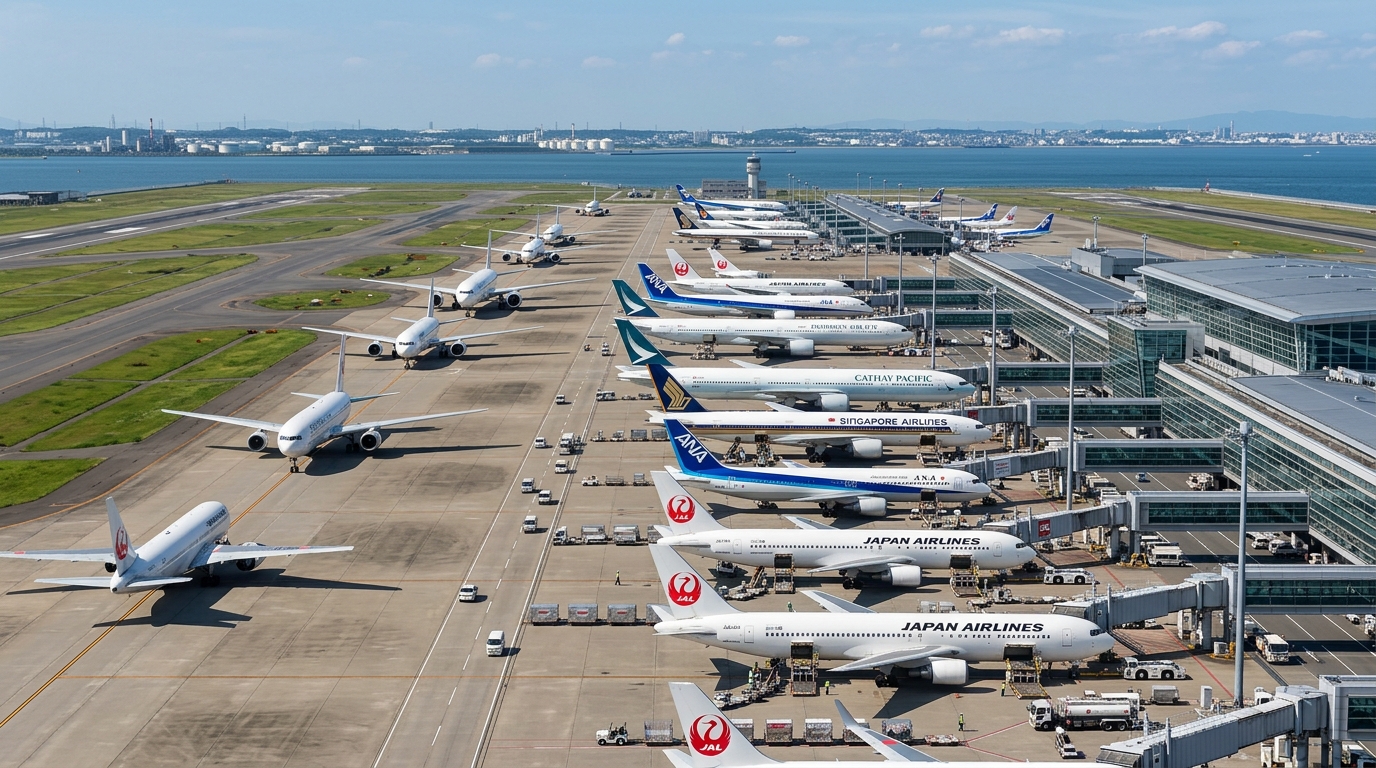
Chubu Centrair is a marvel of engineering—a man-made island in Ise Bay—but it has a finite footprint. Unlike the sprawling multi-runway systems of Tokyo’s Haneda or Narita, NGO operates primarily on a single runway. Under normal conditions, it’s one of the smoothest airports in Asia.
But "normal" doesn't account for 17,000 people arriving with specialized gear. We aren't just talking about extra bodies in the immigration line. We are talking about 15-foot pole vaulting poles, crates of rhythmic gymnastics equipment, and hundreds of custom-tuned racing bicycles. This is "heavy baggage" on a scale that commercial ground handling teams rarely see outside of an Olympic year.
When a flight carrying the Kazakhstani wrestling team or the Thai cycling delegation lands, the ground crew doesn't just "unload the bags." They engage in a complex, slow-motion Tetris match. For the average traveler, this means your suitcase—the one containing nothing more dangerous than a spare pair of shoes—is sitting in a queue behind a literal ton of sporting equipment.
The Three-Hour Creep: Where the Time Goes
The "three-hour delay" isn't a single event; it’s a cumulative tax paid in 20-minute increments across the terminal.
- The Tarmac Penalty Box: With a single runway, NGO will likely prioritize "Official Games" charters and flights carrying high-profile delegations. If your low-cost carrier (LCC) arrives at the same time as a VIP delegation from Seoul or Doha, expect to sit on the taxiway. Ground controllers will hold commercial traffic to clear the way for "Games-priority" arrivals.
- The Immigration Choke Point: Nagoya’s immigration hall is designed for steady flow, not a 17,000-person spike. Even if you aren't an athlete, you’re standing in line with people whose visas require extra scrutiny, team doctors carrying crates of medication, and officials with complex documentation.
- The Custom Scrum: Japan’s customs officials are notoriously thorough. The introduction of thousands of athletes means every piece of equipment, every supplement bottle, and every spare part is being logged. This slows the physical exit from the secure zone to a crawl.
If you are planning a trip during this window, I strongly suggest you get comprehensive travel insurance that specifically covers missed connections and travel delays. In a bottleneck like this, a 2-hour "safe" connection is practically a guarantee that you'll be watching your next flight take off from the terminal window.
The Shinkansen Escape Hatch
Here is the secret that veteran Japan travelers use when the hubs get hairy: Nagoya is the central spine of the Tokaido Shinkansen.
If you see that NGO is hitting red on the flight trackers, don't fly into Nagoya at all. Instead, book your long-haul flight into Osaka (KIX) or Tokyo (NRT/HND). The Shinkansen (bullet train) from Tokyo to Nagoya takes about 90 minutes; from Osaka, it’s a mere 50 minutes.
While the airport is struggling to process a single runway’s worth of planes, the trains will be running every few minutes with surgical precision. It is often faster to land in a different city and take the train into Nagoya than it is to wait out a 4-hour immigration and baggage delay at Centrair.
The "Takkyubin" Hack: Bypassing the Baggage Carousel
If you absolutely must fly into NGO, do not—under any circumstances—wait for your bags if you have a tight schedule.
Japan has a magical service called Takkyubin (luggage forwarding). Most travelers use it to send bags from one hotel to the next. In September 2026, you should use it to escape the airport.
Look for the Yamato Transport or Sagawa counters immediately after clearing customs. Hand them your heavy suitcases and have them delivered to your hotel in Nagoya, or even as far as Kyoto or Tokyo. It costs about $15–$25 per bag. By the time you’ve finished your first bowl of hitsumabushi (Nagoya’s famous grilled eel) at the Osu Shopping District , your bags will be someone else’s problem. You can walk out of the airport with just a backpack, bypassing the thousands of people wrestling with oversized crates in the arrivals hall.
Survival in the Terminal: Layovers and Connectivity
If you are stuck at NGO for a long layover because your connection was pushed back, the airport does have one saving grace: The Flight of Dreams . This is a massive permanent exhibit built around the first-ever Boeing 787 Dreamliner. It’s located in a separate building connected to Terminal 2. It’s significantly quieter than the main departure lounges and offers decent food options that aren't overrun by the "Games" crowd.
However, do not rely on the airport Wi-Fi. With 17,000 extra people trying to upload "We arrived!" selfies to Instagram, the public bandwidth will be stretched thin. Before you leave home, buy a Japan-specific eSIM to ensure you have your own dedicated data stream. You’ll need it to track your flight’s real-time status and to navigate the Meitetsu Line trains that take you from the airport into the city center.
How to Track the Surge in Real-Time
To survive the Nagoya bottleneck, you need to stop looking at the "Scheduled Departure" time and start looking at the "Turnaround Time."
In the PingWing app, watch the incoming flight for your specific tail number. If that plane is held on the tarmac for 45 minutes because a Singaporean swim team is unloading their gear at the adjacent gate, your departure time is already a fiction.
Watch these three metrics specifically during the Games:
- Average Taxi-In Time: If this jumps from the usual 7 minutes to 25+ minutes, the airport is "stacking" planes on the ground.
- Gate Occupancy: If your gate is still occupied by an arriving flight 20 minutes before you’re supposed to board, start looking for your backup plan.
- NGO-NRT/NGO-HND Domestic Frequency: Many athletes will arrive in Tokyo and take a domestic "hop" to Nagoya. These short-haul flights are the most likely to be delayed or cancelled to make room for international long-haul arrivals.
The "Reverse Commute" Surprise
The most surprising tip for the 2026 Asian Games? The busiest day isn't the day of the Opening Ceremony—it’s the day the swimming and athletics events end.
In major sporting events, athletes often leave as soon as their competition window closes. This creates a "secondary surge." While the world is watching the closing ceremonies on TV, the airport is being hit by a massive wave of "exiting" athletes. If you are flying out of Nagoya around September 30 or October 1, 2026, apply the same "3-hour rule" you used for your arrival.
The security lines will be filled with people who have medals in their pockets and very complicated "oversized" luggage needs. If you're heading back to the city to see the sights one last time, perhaps visit Nagoya Castle early in the morning and head to the airport much earlier than you think is reasonable.
Final Thought
Nagoya is a city that prides itself on "Monozukuri"—the art of making things. It is the industrial heart of Japan, home to Toyota and a culture of extreme efficiency. The city will handle the 2026 Asian Games, but the sheer physics of 17,000 people hitting a single-runway airport means that efficiency has a ceiling.
Don't fight the bottleneck. Track it, bypass it with the Shinkansen, or simply send your bags ahead and enjoy the fact that you're witnessing one of the largest logistical puzzles in the world. Just don't expect to do it in under 90 minutes.