
The Nagoya Exodus: Why You Must Leave for NGO 5 Hours Early on October 4th
The closing ceremony of the 2026 Asian Games will create a massive departure bottleneck that your flight tracker won't predict.
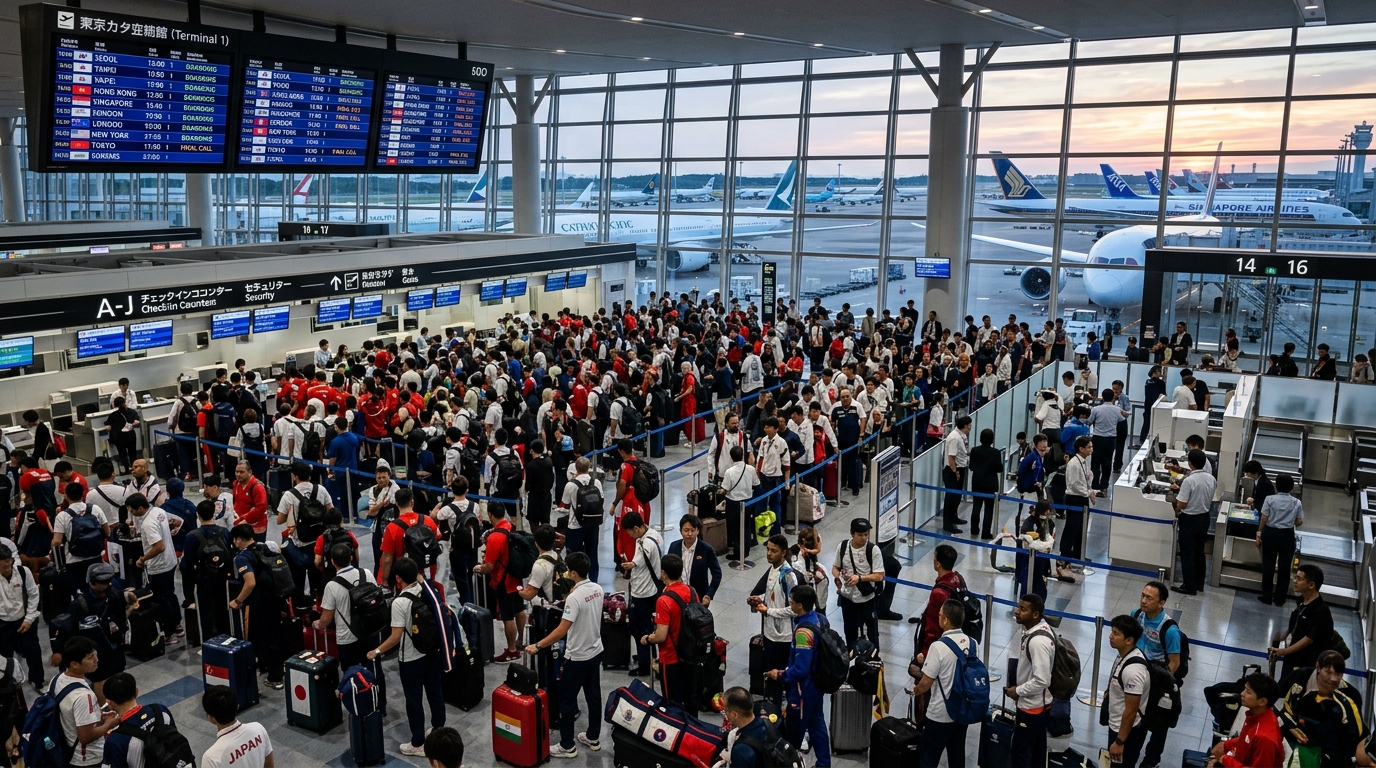
October 4, 2026, will be the busiest day in the history of Chubu Centrair International Airport (NGO). As the flame goes out on the 20th Asian Games in Aichi-Nagoya, over 15,000 athletes and officials will attempt to leave the city simultaneously, joined by tens of thousands of spectators, journalists, and support staff.
If you are a regular traveler or a business flyer with a seat booked out of Nagoya that Sunday, your standard "two hours before departure" routine is a recipe for a missed flight.
Most flight tracking apps and airline notifications are reactive. They’ll tell you if your plane is late, but they won't tell you that the security line at NGO currently snakes past the check-in counters and into the Sky Deck access ramp. To survive the "Nagoya Exodus," you need to rethink your entire transit strategy for the first weekend of October.
The Math of a Logistics Nightmare
Chubu Centrair is a marvel of engineering—a managed island in Ise Bay—but it has its limits. When you drop 15,000 elite athletes into an airport, you aren't just adding 15,000 people. You are adding 15,000 sets of oversized luggage. We’re talking about pole vaulting poles, track bikes, specialized medical kits, and crates of equipment.
On a normal day, checking in a bag at NGO takes ten minutes. On October 4th, the sheer volume of "odd-size" luggage will choke the baggage handling systems. Security screening for athletes often involves additional protocols for sporting equipment that can't go through standard X-ray tunnels. This ripple effect will hit the "regular" lines hard.
If you’re flying out on this day, five hours is not an exaggeration; it’s a buffer. You need one hour for the potential train delays, two hours for the check-in and baggage drop queue, and at least ninety minutes for security and immigration. The final thirty minutes? You’ll need that just to navigate the human sea to reach your gate.
The Meitetsu Bottleneck
The primary artery connecting Nagoya to the airport is the Meitetsu Line. The Mu-Sky Limited Express is usually the gold standard for Japanese efficiency—fast, clean, and reliable. However, Meitetsu Nagoya Station is notoriously cramped. It’s a subterranean labyrinth where multiple lines share a terrifyingly small number of platforms.
On October 4th, expect the Mu-Sky to be fully booked weeks in advance. If you haven't reserved a seat, you’ll be relegated to the limited express or local trains, which will be packed with departing fans.
The Pro Move: Skip the train entirely. While the road to the airport (the Centrair Line) will also be heavy with traffic, a private car allows you to bypass the station crush. If you are traveling with a group or have significant luggage, booking Airport Transfers in advance is the only way to guarantee you won't be left standing on a platform watching overcrowded trains pass you by.
Why Your Data Connection Matters More Than Ever
In a congested airport, information is your only leverage. When the overhead boards are swamped or the gate agents are overwhelmed by a delegation of 200 fencers, you need to know what’s happening with your airframe before the airport staff does.
Congestion often leads to "gate holds"—where planes are ready but can't push back because the taxiways are blocked. Or worse, your flight might be diverted or delayed because the ground crew can't keep up with the baggage loading.
Before you even head to the airport, make sure your connectivity is ironclad. Public Wi-Fi at NGO will likely crawl under the weight of thousands of people trying to stream the closing ceremony highlights or call home. I highly recommend grabbing a Japan-specific eSIM before you land in the country. Having a dedicated 5G/LTE pipe ensures you can refresh your flight tracker and rebook a connection in seconds while others are still waiting for the login page to load.
The "Shinkansen Shuffle": A Counterintuitive Escape
Here is the tip most travelers won't consider: Don't fly out of Nagoya.
If you are looking at the flight schedules for October 4th and seeing astronomical prices or "Sold Out" signs, look at the Tokaido Shinkansen instead. Nagoya is a major stop on the high-speed rail line between Tokyo and Osaka.
It takes roughly 50 minutes to get from Nagoya to Shin-Osaka Station and about 90 minutes to get to Tokyo. Both Kansai International (KIX) and Haneda (HND) are significantly larger than NGO and better equipped to absorb a massive influx of passengers. By taking a morning train to Osaka or Tokyo, you bypass the localized chaos of the Asian Games exit entirely. You’ll spend more on a train ticket, but you’ll save your sanity and likely find better long-haul flight availability.
Survival Tactics Inside NGO
If you must fly from Centrair, Terminal 2 (the low-cost carrier terminal) will be particularly brutal. It’s designed for high-frequency, low-margin efficiency, which breaks down quickly when people start arriving with three suitcases each.
If you find yourself stuck in the terminal with hours to kill, head to the "Flight of Dreams" . It’s a massive hall featuring the first-ever Boeing 787 prototype. It’s located slightly away from the main departure gates of Terminal 1 and often serves as a quieter pocket of the airport. There are restaurants and shops surrounding the plane; it’s a much better place to wait out a delay than a cramped gate seat.
A note on logistics: Ensure your Travel Insurance is up to date and specifically covers "travel delay" and "missed connections." Many policies require a 6-to-12-hour delay before they kick in, but on a day like October 4th, those windows are easily hit. If the baggage system fails and your flight leaves without your bags, you’ll want that coverage to handle the subsequent headache.
The "Day After" Strategy
If your schedule is flexible, the smartest thing you can do is stay in Nagoya for one more night. While the athletes will be rushed out on the 4th, the city will begin to exhale on October 5th.
Spend that extra day exploring the Osu Kannon district or eating your weight in hitsumabushi (eel) without the pressure of a ticking clock. The hotel prices will drop, the trains will have seats again, and the airport staff will be much friendlier once they’ve had a night’s sleep.
Traveling during a major international sporting event isn't just about the crowds; it's about the specialized demands those crowds place on an infrastructure designed for "normal" use. NGO is a fantastic airport—I’ve often cited it as one of the most user-friendly in Asia—but 15,000 athletes is a stress test that no regional hub is designed to pass with flying colors.
Pack your patience, book your transport early, and for the love of all things holy, give yourself that five-hour window. You might end up with extra time to drink a coffee and watch the planes, which is infinitely better than watching your plane depart from the wrong side of the security glass.