
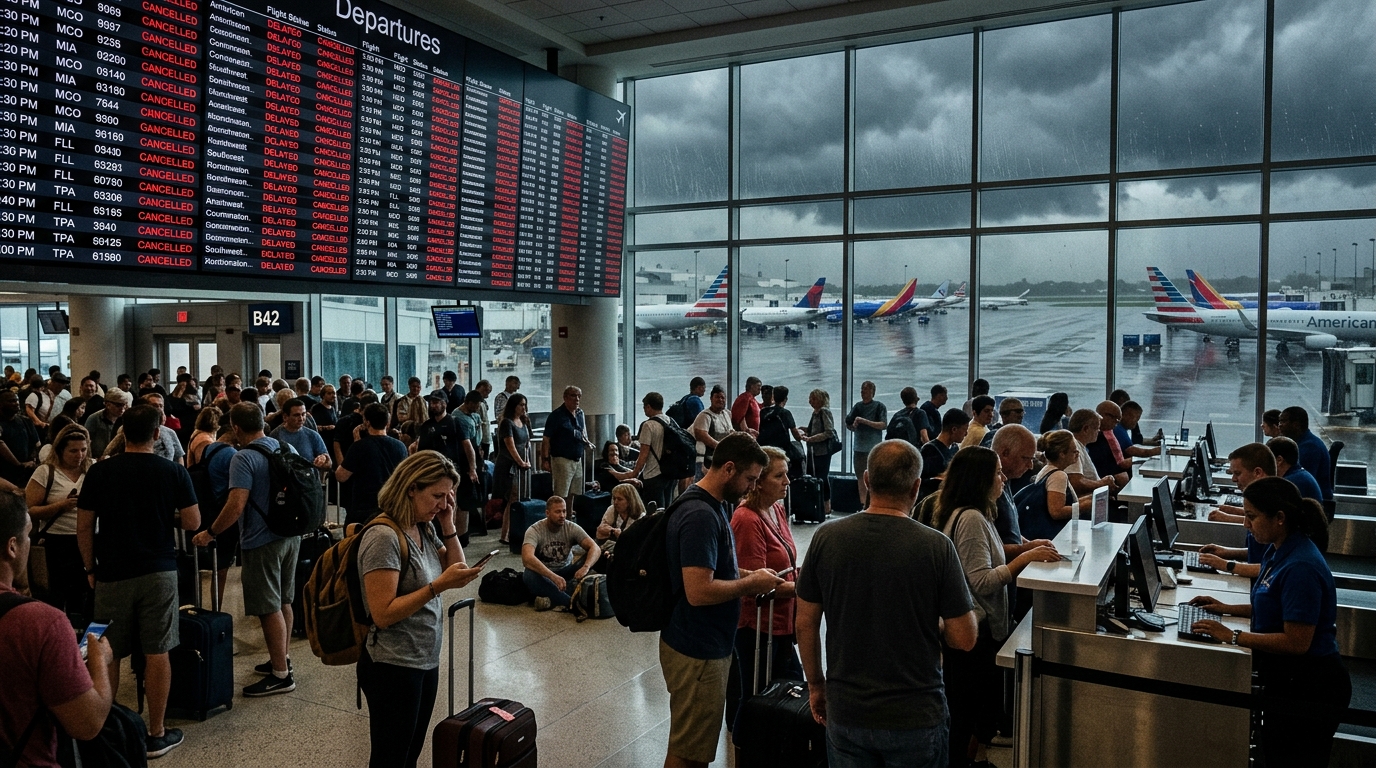
The Milton Shutdown: Why Every Florida Flight Just Turned Red
A massive hurricane is grounding thousands of flights, and travelers need to know their refund rights vs. rebooking reality right now.
The flight boards at Tampa International (TPA) didn’t just change; they bled. Within a matter of hours on October 7, 2026, the status columns for hundreds of flights shifted from a hopeful green "On Time" to a definitive, terminal red "Cancelled."
Hurricane Milton is no longer a "potential weather event" discussed in hushed tones by meteorologists. It is a kinetic force that has shuttered TPA, Orlando International (MCO), and Sarasota-Bradenton (SRQ), effectively cutting off the Florida peninsula from the global aviation network. If you are one of the thousands of travelers currently staring at a "Flight Cancelled" push notification, you are likely feeling a mix of panic and frustration.
But panicking is a luxury you don’t have right now. You need to move. Here is the reality of the Milton shutdown and exactly how you should navigate the next 48 hours.
The "Act of God" Trap
Airlines love the phrase "Force Majeure." In plain English, it means a hurricane is an "Act of God," and because Delta, United, or American didn’t personally summon Milton from the Gulf, they aren’t legally required to pay for your hotel, your $30 airport Caesar salad, or the Uber to a Marriott three towns away.
However, there is a massive distinction most travelers miss: The Refund Rule.
If an airline cancels your flight for any reason—including a Category 4 hurricane—you are entitled to a full refund to your original form of payment. Not just a "travel credit" that expires in a year. Not a "flight bird" voucher. Cold, hard cash.
The catch? If you accept that refund, the airline’s obligation to you ends. You are no longer their problem. In a mass-cancellation event like Milton, taking the refund might feel like a win, but if the next available flight out of Florida costs $1,200 and your original ticket was $300, you’ve just lost $900 in purchasing power.
Rebooking vs. The Refund: The Math of a Disaster
Before you click "Request Refund" in the app, look at the rebooking options. During major storms, airlines issue "Travel Waivers." These allow you to rebook your flight to a later date or a nearby airport (like JAX or even ATL) without paying the fare difference.
If you can find a seat on a flight three days from now, even if that seat is currently selling for triple what you paid, the waiver covers it. This is almost always more valuable than a refund. If you’re worried about the costs of staying put while you wait for that new flight, this is where comprehensive travel insurance becomes your best friend, covering the "trip interruption" costs the airline won't touch.
The "International Desk" Hack
When a hub like MCO shuts down, the domestic customer service lines become a digital graveyard. You will wait on hold for four hours only to be disconnected.
Here is the counterintuitive move: If you are flying a major carrier like United or American, don't call the U.S. support number. Use Skype or a VOIP service to call their international support desks in the UK, Singapore, or Germany. These agents have the same access to the rebooking system, but they aren't dealing with 50,000 angry Floridians at the same moment. They can often get you confirmed on a "ghost" seat—a seat that just opened up due to someone else's cancellation—before the domestic queue even moves an inch.
Connectivity is a Safety Issue
In the middle of a hurricane shutdown, your phone is your lifeline. Between checking the PingWing tracker for tail-number movements and refreshing airline apps, you will burn through data. If you’re a traveler from outside the U.S. caught in this mess, do not rely on "travel passes" from your home carrier which often throttle speeds during peak congestion.
Local infrastructure gets strained during storms. Having a dedicated United States eSIM ensures you have a clean, local data priority to keep your maps and flight trackers live. If the airport Wi-Fi at MCO goes down—which it frequently does during power surges—you’ll be the only one in the terminal still able to see which planes are actually being ferried out of the storm's path.
The Ripple Effect: Why your NYC flight just turned red
You might be sitting in Newark (EWR) or Philadelphia (PHL) thinking, "The sun is shining here, why is my flight to London cancelled?"
Aviation is a giant, interconnected jigsaw puzzle. The aircraft scheduled to take you across the Atlantic might currently be pinned down under a hangar in Tampa. When a major "source" state like Florida goes dark, it creates a vacuum of airframes.
If you are flying anywhere in the Eastern Seaboard today, check your incoming flight’s origin. If that plane is coming from Florida, start looking for alternatives now. Don’t wait for the airline to tell you the plane isn't coming; they are often the last to admit it.
Where to Wait (If You’re Stuck)
If you are physically at an airport like MCO and the gates are closing, do not stay in the terminal. Airports are terrible shelters. If you can safely evacuate to a hotel, do it immediately. Many travelers congregate around the International Drive area because of the high density of hotels, but these fill up within minutes of a TPA/MCO closure announcement.
If you are stranded, your priority should be:
- Confirmation of your new flight.
- A physical roof.
- Power.
If the airline claims they can't get you out for four days, look at "re-routing" yourself. Can you take a bus or a rental car to a city outside the strike zone? Sometimes driving five hours north to Savannah (SAV) or Charleston (CHS) is the difference between getting home tomorrow or getting home next week.
The "Hidden" Compensation
While airlines aren't required to pay for weather delays under U.S. law, your credit card might be. If you booked your flight with a premium travel card (Chase Sapphire, Amex Platinum, etc.), you likely have built-in trip delay reimbursement.
This usually kicks in after a 6-to-12-hour delay and covers up to $500 per ticket for lodging and meals. Keep every single receipt. Even that $4 bottle of water. The insurance adjusters require a paper trail that would make an auditor blush.
The Reality Check
Hurricane Milton is a reminder that for all our technology, we are still guests in the sky. The airlines are currently "ferrying" planes—flying them empty to airports like Atlanta (ATL) or Birmingham (BHM) just to get the multi-million dollar assets out of the wind.
If the airlines are running away, you should be too.
Don't argue with a gate agent about a "weather" designation. They didn't pick the weather, and they don't have a secret plane hidden in the back. Your goal today isn't to get on the flight you booked; it's to get on the first flight that moves.
In a week, the Florida sun will be back, and the "Red Board" will be a memory. But right now, the most important tool you have isn't your ticket—it's your flexibility. Use the apps, call the international desks, and if you have to, start heading north by land. The sky is closed until Milton says otherwise.