
The Great Rail Escape: Why Frequent Flyers are Swapping Short-Haul Flights for Sleepers in 2026
International train travel is the fastest-growing travel category—we compare the cost and time of 5 popular European routes.
The 4:00 AM alarm is a special kind of violence. You’re standing in a shivering queue at London Heathrow (LHR) or Paris Charles de Gaulle (CDG), clutching a lukewarm paper cup of bitter espresso, all to endure a 75-minute "short-haul" flight that actually takes six hours when you factor in the suburban train to the terminal, the liquid-limit security theater, and the inevitable wait at the baggage carousel.
In 2026, the math has officially shifted. Rail transport is now the fastest-growing travel category globally, with a 35% increase in interest over air travel according to recent data from Visit Ukraine. We aren’t just talking about eco-conscious students anymore; frequent flyers and business travelers are ditching the boarding pass for the sleeper berth. The "Great Rail Escape" is fueled by a simple realization: when you measure travel by "door-to-door" time and "quality-of-life" metrics, the plane often loses.
If you’re planning your 2026 calendar, here is how the most popular European corridors stack up when you pit the wing against the rail.
1. London to Paris: The Classic Showdown
- The Plane: LHR to CDG. Flight time: 1h 15m. Actual time: 5h 30m (including Heathrow Express, 2-hour security buffer, and RER B into Paris).
- The Train: Eurostar from St. Pancras International to Gare du Nord .
- The Verdict: Rail wins, hands down.
The Eurostar takes 2 hours and 16 minutes. Even with a 45-minute check-in for passport control, you are arriving in the heart of the 10th Arrondissement while the flyers are still stuck in a taxi on the A1 motorway. In 2026, Eurostar has streamlined its biometric gates, making the "station-to-platform" transition faster than a Starbucks line.
Pro Tip: If you’re traveling for work, the Eurostar Premier lounge offers better food than most short-haul Business Class cabins. Plus, you have 5G signal almost the entire way through the tunnel—something no airline can match without charging you $20 for "Basic Wi-Fi."
2. Paris to Berlin: The Sleeper's Renaissance
- The Plane: CDG to BER. Total time: ~5 hours.
- The Train: The Nightjet or the new high-speed daytime direct.
- The Verdict: The Sleeper is a "time hack."
The flight between Paris and Berlin is notorious for delays at BER. Instead, travelers are opting for the ÖBB Nightjet leaving Gare de l'Est at night and waking up at Berlin Hauptbahnhof at 8:00 AM.
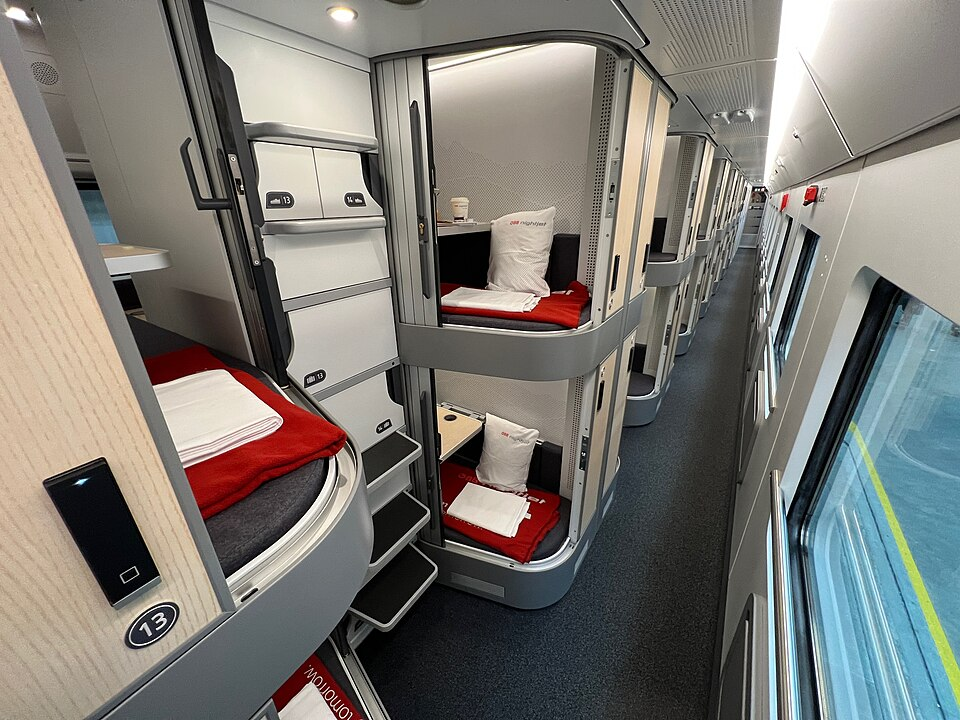
When you fly, you lose a productive afternoon. When you take the sleeper, you "save" the cost of a hotel night. In 2026, the new "mini-cabins" (solo pods) on the Nightjet have become the gold standard for solo travelers who want privacy without the price tag of a full deluxe compartment. Because you'll be crossing borders and switching networks, ensure you've pre-installed a Europe eSIM to avoid the dreaded "no signal" dead zones in the rural stretches of the Rhine Valley.
3. Vienna to Venice: The Scenic Route
- The Plane: VIE to VCE. Total time: ~4 hours.
- The Train: Railjet or Nightjet.
- The Verdict: Choose the train for the soul, not just the clock.
Flying into Venice (VCE) is a logistical headache involving expensive water taxis or crowded buses. Taking the train from Wien Hauptbahnhof directly into Venezia Santa Lucia puts you right on the Grand Canal the moment you step off the platform. The daytime Railjet route through the Semmering Pass—a UNESCO World Heritage site—is arguably the most beautiful commute in the world.
4. Brussels to Prague: The "European Sleeper"
- The Plane: BRU to PRG. Total time: ~4.5 hours.
- The Train: The "Good Night Train" (European Sleeper).
- The Verdict: Ideal for the "Slow Travel" convert.
The European Sleeper is a private start-up that has revitalized the route from Brussels to Prague via Amsterdam and Berlin. While the flight is technically "faster," the train allows you to board in Brussels at 7:00 PM, have a glass of Belgian beer in the dining car, and wake up in Prague refreshed. There is no middle-seat squeeze, no "cabin air" dehydration, and no liquid restrictions on your toiletries.
5. Madrid to Barcelona: The Price War
- The Plane: MAD to BCN. Total time: ~4 hours.
- The Train: AVE, Avlo, Ouigo, or Iryo.
- The Verdict: Rail is cheaper and faster.
This is the route that killed the "Air Bridge." With four different companies competing on the high-speed tracks, you can often find tickets for €19. The journey takes 2.5 hours. By the time a flyer has cleared security at Madrid-Barajas, the train passenger is already halfway through a plate of jamón in the bar car.
The Hidden Math: Why the "Cheaper" Flight is a Lie
In 2024 and 2025, airlines aggressively unbundled their fares. By 2026, the "base fare" for a short-haul flight across Europe rarely includes a carry-on bag larger than a backpack.
- Train Baggage: Usually free (within reason).
- Airport Transfers: A round-trip from London to LHR and CDG to Central Paris can easily cost €80.
- Reliability: While rail strikes happen, air traffic control (ATC) delays and "operational issues" in 2025 reached record highs.
If you do choose the rail route, remember that European rail networks are fragmented. A delay in Germany can cause you to miss a connection in Switzerland. For peace of mind, I always recommend getting comprehensive travel insurance that specifically covers missed connections and "force majeure" travel disruptions—something basic credit card insurance often skips for rail travel.
The Counterintuitive Tip: The "Last-Minute Interrail" Hack
Most people think Interrail (or Eurail) passes are only for gap-year students with oversized rucksacks. That is a mistake.
In 2026, with dynamic pricing making last-minute train tickets cost as much as a flight to the moon, the Interrail One-Country or Global Pass has become a secret weapon for flexible travelers. If you need to get from Munich to Zurich tomorrow and the ticket is €150, you can often buy a 4-day Interrail pass for a similar price and "activate" a travel day instantly. It gives you the flexibility of a "full-fare" airline ticket at a fraction of the cost.
The Connectivity Reality Check
Let’s be honest: train Wi-Fi is still a gamble. While the high-speed lines in Spain (AVE) and France (TGV) are improving, the "Free Wi-Fi" on most sleepers is often just a landing page that never loads.
If you’re planning to work while crossing the continent, don't rely on the onboard router. Tethering to your phone is the only way to stay productive. Since you'll be hopping through different cellular towers at 300km/h, a dedicated data plan is essential. For those doing the "Grand Tour," a Global eSIM ensures you don't get hit with roaming charges the second you cross from the EU into a non-EU country like Switzerland or the UK.
The Final Word
The "Great Rail Escape" isn't about being a luddite or hating aviation. We love flying—that’s why we track it. But being a "smart traveler" in 2026 means knowing when the sky is no longer the limit, but a bottleneck.
Next time you’re about to book that "cheap" €40 flight from Milan to Rome, stop. Look at the total time. Look at the stress levels. Then look at the Frecciarossa schedule. Sometimes the best way to travel "by air" is to keep your feet on the ground and let the landscape blur past your window at 190 mph while you actually get some sleep.
The most valuable luxury in modern travel isn't a first-class seat; it's the removal of the 4:00 AM security line. Book the sleeper. Your sanity will thank you.