
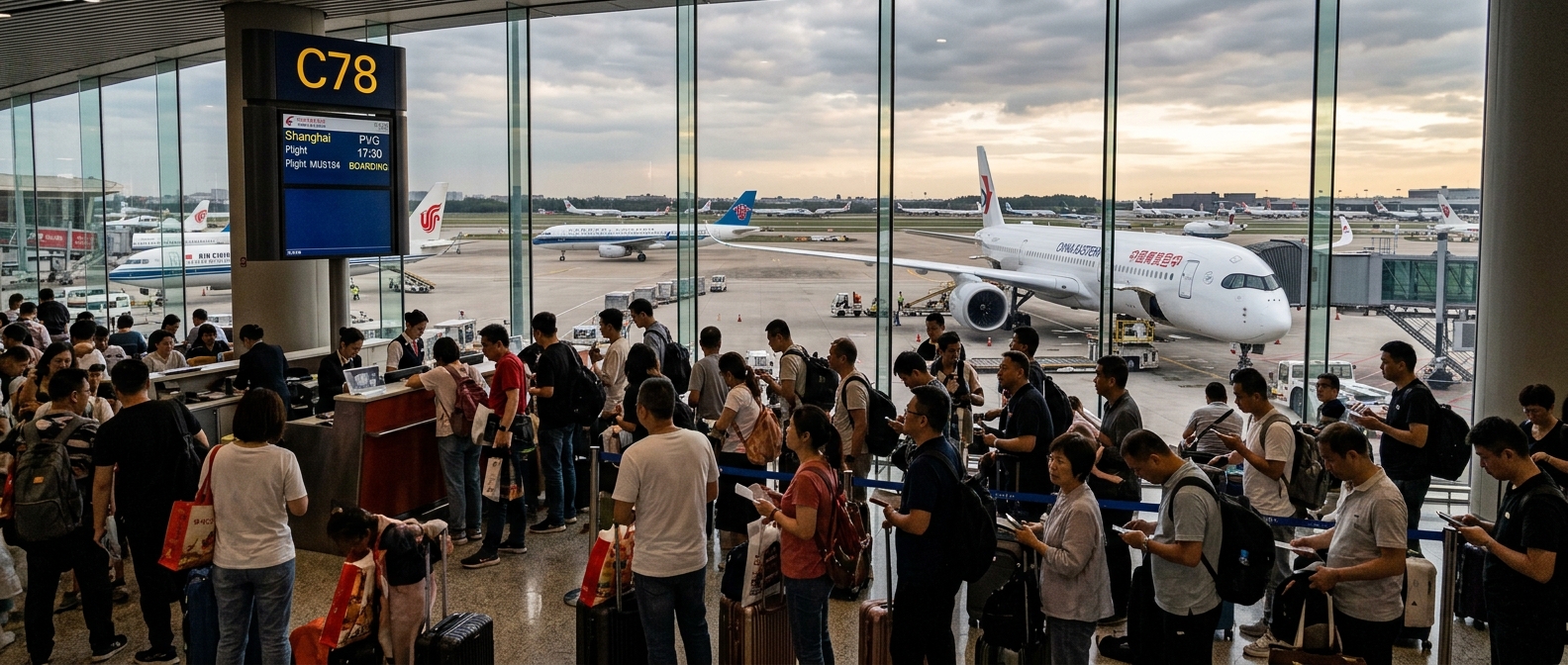
The Golden Week Return Rush: How to Score a Last-Minute Seat Out of China This Wednesday
With the October holiday ending on the 7th, travelers are facing a total sell-out of domestic and regional return flights.
The wall hits at midnight on Wednesday. October 7th, 2026, marks the conclusion of the National Day Golden Week, an annual migration that historically sees the highest single-day passenger volumes on the planet. If you are currently staring at a "Sold Out" screen for every flight from Shanghai to Singapore or Beijing to London, you aren't alone—you’re just fighting for the same three square inches of pressurized cabin space as 100 million other people.
But "sold out" is a relative term in the aviation industry. Seats exist; they are simply hidden behind algorithmic paywalls, cached data, or regional booking blocks. If you need to be back at your desk by Thursday morning, you have to stop searching like a tourist and start searching like a dispatcher.
Here is how you find a way out when the map looks like a sea of red.
The "Peripheral Pivot": Skip the Tier-1 Hubs
Everyone is trying to fly out of Pudong (PVG), Capital (PEK), and Baiyun (CAN). These airports are the primary pressure points. When these hubs hit 100% capacity, the algorithms stop showing you connecting options that involve them, even if there’s a seat on the second leg.
Instead of looking for a direct flight from Shanghai, look at the high-speed rail map. China’s rail network is the "cheat code" for Golden Week. If Shanghai is blocked, check availability from Hangzhou (HGH), Nanjing (NKG), or even Ningbo (NGB). These airports often have regional flights to Hong Kong, Seoul, or Tokyo that don't appear in a standard "SHA to HKG" search. A two-hour train ride from Hongqiao Railway Station to a secondary city can open up a flight path that simply doesn't exist on the main boards.
The 2:00 AM Refresh and the "Ghost" Inventory
Airlines hold seats for various reasons: group bookings that didn't materialize, unpaid "pay later" reservations, and technical blocks for weight and balance. In China, many local travel platforms allow users to "reserve" a seat for 30 to 60 minutes without immediate payment.
The magic happens between 1:00 AM and 3:00 AM China Standard Time. This is when the automated systems flush out unpaid reservations from the previous evening. I have seen entire rows of "sold out" flights on China Eastern or Spring Airlines suddenly flicker back into availability at 2:15 AM.
To catch these, you need a rock-solid data connection that won't flake out when you're hitting the refresh button. If you're navigating local apps like Trip.com or Umetrip while on the move, a reliable China eSIM is often faster and more stable than hotel Wi-Fi that’s being hammered by five hundred other desperate travelers.
The Business Class Paradox
This is the most counterintuitive reality of Golden Week: sometimes the "expensive" seat is the cheapest way home.
During the return rush, Economy class sells out first because corporate travel departments and budget-conscious families snap them up months in advance. However, the "Full Fare" Business Class seats (often coded as J or C) are sometimes held back until the last 48 hours to accommodate high-value frequent flyers or emergency government travel.
If an Economy seat on a 3-hour regional flight is being scalped for $900, but a Business Class seat is sitting there for $1,100, take the upgrade. Not only do you get the seat, but you also get the priority check-in lane. At airports like Shenzhen Bao'an (SZX) on October 7th, the security line for general passengers can easily exceed two hours. The "Priority" lane isn't a luxury; it’s a survival tool.
Look "The Wrong Way"
If you are trying to get to Europe or North America, the standard routes are through the Middle East or direct over the pole. These will be the first to go.
Instead, look for "reverse" routes. To get from Beijing to London, check flights heading to Bangkok (BKK) or Singapore (SIN) first. While Southeast Asia is a popular Golden Week destination, the return flow is usually from those cities back into China. You are looking for the "deadhead" direction. Flying south to fly north sounds insane until you realize it’s the only way to find an open transcontinental link.
Avoid the "Black Market" Trap
On platforms like WeChat and Xiaohongshu, you will see "agents" claiming they have guaranteed seats on sold-out flights for a premium. Avoid these like a bird strike.
Most of these are "points brokers" who book seats using stolen or traded frequent flyer miles. Airlines like Air China and Cathay Pacific have become incredibly aggressive at auditing these bookings. You don’t want to be the person standing at the check-in desk at 5:00 PM on the busiest day of the year only to be told your ticket has been voided for a policy violation. Stick to official airline apps or reputable aggregators. If you're worried about the cost of these last-minute pivots, it's worth checking if your travel insurance covers "trip interruption" or "forced re-routing," though "I didn't book early enough" is rarely a valid claim.
The "Split-Ticket" Maneuver
Search engines are programmed to find the most efficient route. During Golden Week, efficiency is your enemy.
Try booking two separate tickets on two different airlines. For example:
- Ticket A: A domestic flight from a crowded city to a border hub like Kunming (KMG) or Urumqi (URC).
- Ticket B: An international leg from that hub to your final destination.
Yes, you will have to collect your bags and re-check them. Yes, it is a hassle. But while the direct PVG-LHR flight is $4,000, the combination of a domestic leg to a smaller gateway can often save you thousands and, more importantly, actually get you on a plane.
The "Hidden City" Risk
If you’re truly desperate, you might look at "Hidden City" ticketing—booking a flight from Shanghai to Paris with a layover in Hong Kong, and simply walking out at Hong Kong.
Don't do this during Golden Week.
Security is at an all-time high, and luggage systems are strained. If you skip a leg, your remaining itinerary will be canceled instantly. Furthermore, China's "Exit-Entry" protocols are strict; if your paper trail doesn't match your actual movement during a peak period, you are asking for a long conversation with immigration officials that will make you miss your next flight anyway.
Tactical Ground Movement
If you manage to score that seat, your next hurdle is getting to the airport. On October 7th, the roads leading to major airports become literal parking lots.
In Shanghai, take the Maglev. In Beijing, use the Airport Express. If you absolutely must take a car because of heavy luggage, book a private airport transfer at least 24 hours in advance and triple your estimated travel time. I once saw the highway to Guangzhou Baiyun move exactly two kilometers in one hour on a Golden Week Wednesday. Do not rely on Didi or hailing a cab on the street; the demand-to-supply ratio is broken.
What to do if you’re actually stranded
If the clock strikes midnight and you are still on the ground, stop searching for Wednesday. Immediately pivot your search to Friday or Saturday.
The "peak" of Golden Week is a sharp spike. By the 9th or 10th of October, prices often drop by 60-70% and seats open up. It is often cheaper to book two extra nights at a hotel in a quiet district like Gubei and work remotely than it is to pay the "desperation tax" for a Wednesday night flight.
The Golden Week return rush is a lesson in the fragility of modern logistics. It’s a reminder that sometimes, the best travel hack isn't a secret website or a credit card point—it's the willingness to go where everyone else isn't. If the front door is jammed, look for the side window. It’s usually open; you just have to be willing to climb through.
One tool I always keep bookmarked for these moments is a real-time flight tracker. It’s not just for seeing if your plane is late; it’s for seeing where the planes are coming from. If you see a flight from an obscure city landing at your airport, that’s your next lead. Track the tail numbers, find the route, and you might just find the one seat everyone else missed.