
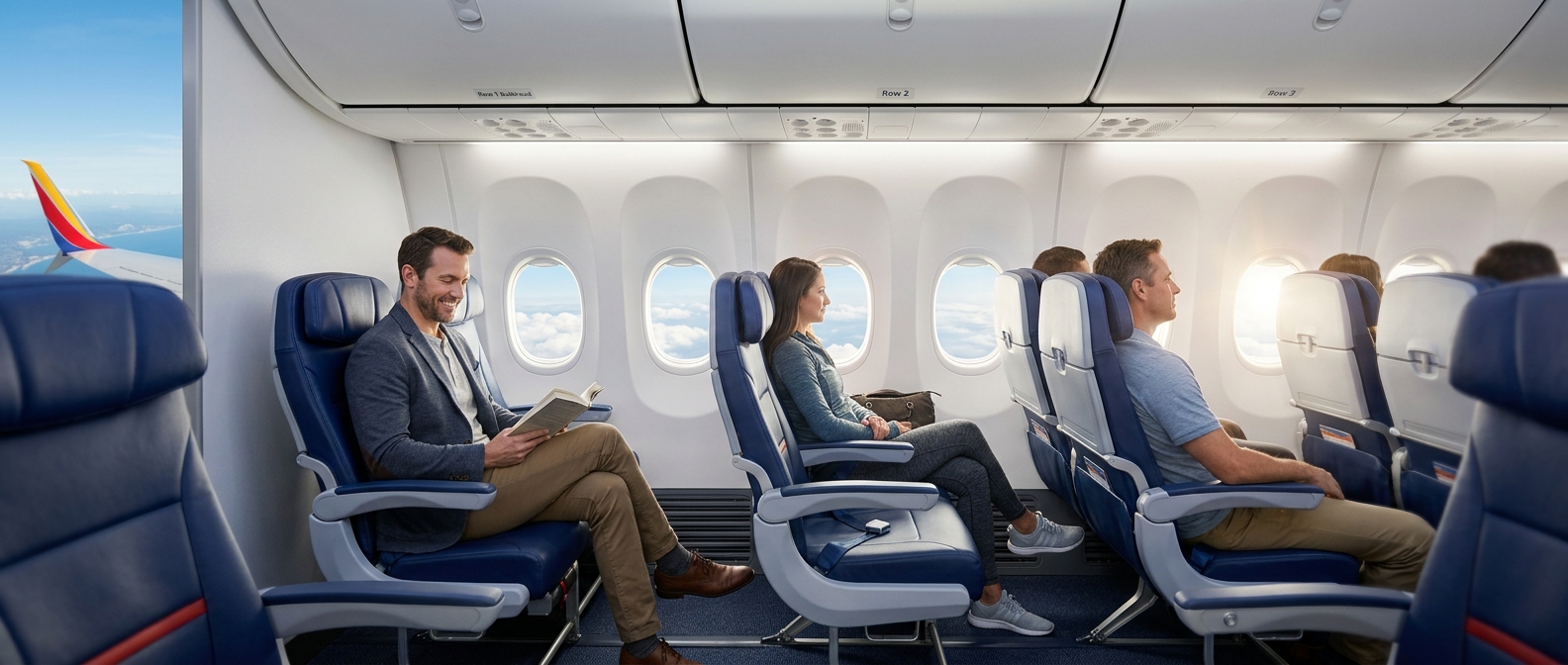
Southwest’s New Extra Legroom Seats: The 3 Rows You Should Book First
With the end of open seating, Southwest is finally rolling out assigned "Premium" rows—here is exactly where to sit.
The Southwest "cattle call" is officially a relic of aviation history. Following the August 2026 Investor Day update, Southwest Airlines has confirmed that the first wave of Boeing 737-800 retrofits, featuring assigned seating and extended legroom "Premium" rows, are entering service this week.
For decades, the Southwest experience was defined by the frantic 24-hour-mark check-in and the mid-cabin "is this seat taken?" dance. That’s gone. In its place is a structured, tiered cabin that looks a lot more like the "Big Three" carriers, but with a uniquely Southwest twist. If you’re looking at a Southwest seat map for the first time in 2026, the layout can be jarring. You aren't just looking for an open aisle anymore; you’re looking for the high-value real estate that justifies the new "Premium" price point.
The Boeing 737-800, the workhorse of the fleet, is the first to see these changes. The new configuration adds roughly 34 inches of pitch (the distance from one seat back to the next) to the first few rows and the exit rows. Here is exactly where you should put your money—or your Rapid Rewards points—on the new Southwest seat map.
1. Row 1: The "First Class" Bulkhead
Row 1 has always been the holy grail for Southwest loyalists who managed to snag an A1-15 boarding position. In the new assigned seating era, it remains the most coveted spot on the plane, but for different reasons.
With the 2026 retrofit, Southwest has maintained the bulkhead wall but optimized the legroom. You get the benefit of being the first off the plane—crucial if you’re trying to make a tight connection at a sprawling hub like Denver (DEN) or Baltimore (BWI). Because there is no seat in front of you, you’ll never have a laptop screen crushed by a sudden recline.
However, there is a trade-off that many travelers forget. In Row 1, you have zero under-seat storage. Every single item, from your laptop bag to your purse, must go in the overhead bin for takeoff and landing. If you’re someone who likes to keep their noise-canceling headphones or a tablet within reach at all times, this is a legitimate annoyance. But if you value "knee-freedom" above all else, Row 1 is your primary target.
2. Row 15: The Exit Row (Specifically 15A and 15F)
While the front of the plane is being marketed as the "Premium" section, savvy Southwest flyers know that the exit rows often provide more actual legroom than the front-of-cabin seats.
On the retrofitted 737-800s, Row 15 is the winner. Southwest has opted for a configuration that keeps the "missing seat" or "extended space" layout in the exit rows. On many of these aircraft, Row 14 lacks a window seat (14A), meaning the person sitting in 15A has enough legroom to literally stand up and walk out to the aisle without disturbing their seatmates. It is the closest thing to a long-haul Business Class seat in terms of personal space, even if the seat width remains the same.
Before you book, check your flight status on a tracker like PingWing to ensure your tail number has actually been retrofitted. If you're booking flights for a trip later this year, remember that the rollout is rolling—not every 737-800 has the new interior yet, and you don't want to pay a premium for a "standard" seat on an old bird.
3. Row 4: The "Sweet Spot" Premium
If Row 1 feels too exposed and the exit row feels too much like a "responsibility" (remember, you have to be able to operate that door), Row 4 is the sleeper hit of the 2026 seat map.
In the new configuration, the first five to six rows are designated as Premium. Row 4 sits right in the middle of this section. It’s far enough back that the galley noise and the constant stream of people using the front lavatory won’t bother you, but it’s far enough forward that you’re still among the first 25 people off the aircraft.
More importantly, Row 4 usually benefits from the "halo effect" of the Premium section’s improved seat pitch. While Row 1 gets the headlines, Row 4 offers a consistent 34 inches of legroom without the bulkhead storage restrictions. You can tuck your backpack under the seat in front of you and still have plenty of room to stretch your legs.
The Surprising "Middle Seat" Strategy
Here is something you won't hear from the airline's marketing team: the middle seat in the new Premium rows might actually be better than a window seat in the back.
Usually, the middle seat is the "loser" of the aviation world. But on the retrofitted Southwest fleet, the RECARO seats used in the Premium section have been slightly redesigned. The armrests in the middle seat are a fraction of an inch wider, and the increased pitch means you aren't fighting for "knee territory" with the people on either side of you. If you’re traveling as a couple, booking the aisle and window in Row 4 or 5 is a high-percentage play; in the early days of assigned seating, many solo travelers are still avoiding the "Premium Middle" because of the upcharge, giving you a better chance at an empty seat between you.
Power and Connectivity: What Else Changed?
The 2026 retrofits aren't just about where your butt goes; they’re about how you stay powered up. For the first time, Southwest is aggressively installing USB-A and USB-C power ports at every seat.
On the 737-800, these ports are located on the seatback in front of you. This is a massive upgrade from the "bring a power bank or die" era of Southwest travel. However, be aware that the power output is shared across the row. If three people are all trying to fast-charge iPads, the charging speed will drop significantly.
If you're heading to a destination where you'll be relying heavily on your phone for navigation—say, finding a hidden mezcal bar in the Gaslamp Quarter —don't rely solely on the plane's power. It's a backup, not a primary source. And while you're at it, make sure you've downloaded an eSIM for the United States if you're visiting from abroad, so you aren't hunting for airport Wi-Fi the moment you land.
How to Read the 2026 Seat Map
When you open the Southwest app to pick your seat, you’ll see three distinct colors:
- Dark Blue/Maroon: Premium seats (Rows 1-6 and Exit Rows). These cost extra or require a "Business Select" or "Wanna Get Away Plus" fare upgrade.
- Light Blue: Standard assigned seating. This is the bulk of the cabin.
- Gray: Occupied or blocked for weight and balance.
The mistake most people make is assuming that "Standard" seating is the same as the old Southwest. It isn’t. To make room for the extra inches in the Premium section, the seats in the very back of the plane (Rows 25 and beyond) have actually felt a slight "squeeze" in pitch. If you are over six feet tall, Row 30 is going to feel significantly tighter than the Southwest seats you remember from five years ago.
The Verdict: Is it worth the upgrade?
Southwest’s transition to assigned seating is a play for the business traveler who abandoned them for Delta or United because they couldn't guarantee a specific seat. If you are that traveler, the Premium upgrade is a no-brainer. The 737-800 is a narrow-body aircraft; every inch of personal space matters when you’re stuck in a metal tube for four hours.
Row 15 remains the "pro" choice for those who know the airframe, while Row 1 is for the "get-me-off-this-plane" crowd. Row 4 is the balanced choice for everyone else.
As the airline continues to retrofit the remainder of the fleet throughout 2026 and 2027, the "open seating" era will fade into a "remember when?" story we tell younger travelers. For now, the game has changed. You aren't checking in at 12:01 PM anymore—you're hunting for the best row the moment you book. Choose wisely, because on a full flight to Orlando or Vegas, those extra two inches of legroom are the difference between arriving refreshed and arriving with a cramped lower back.