
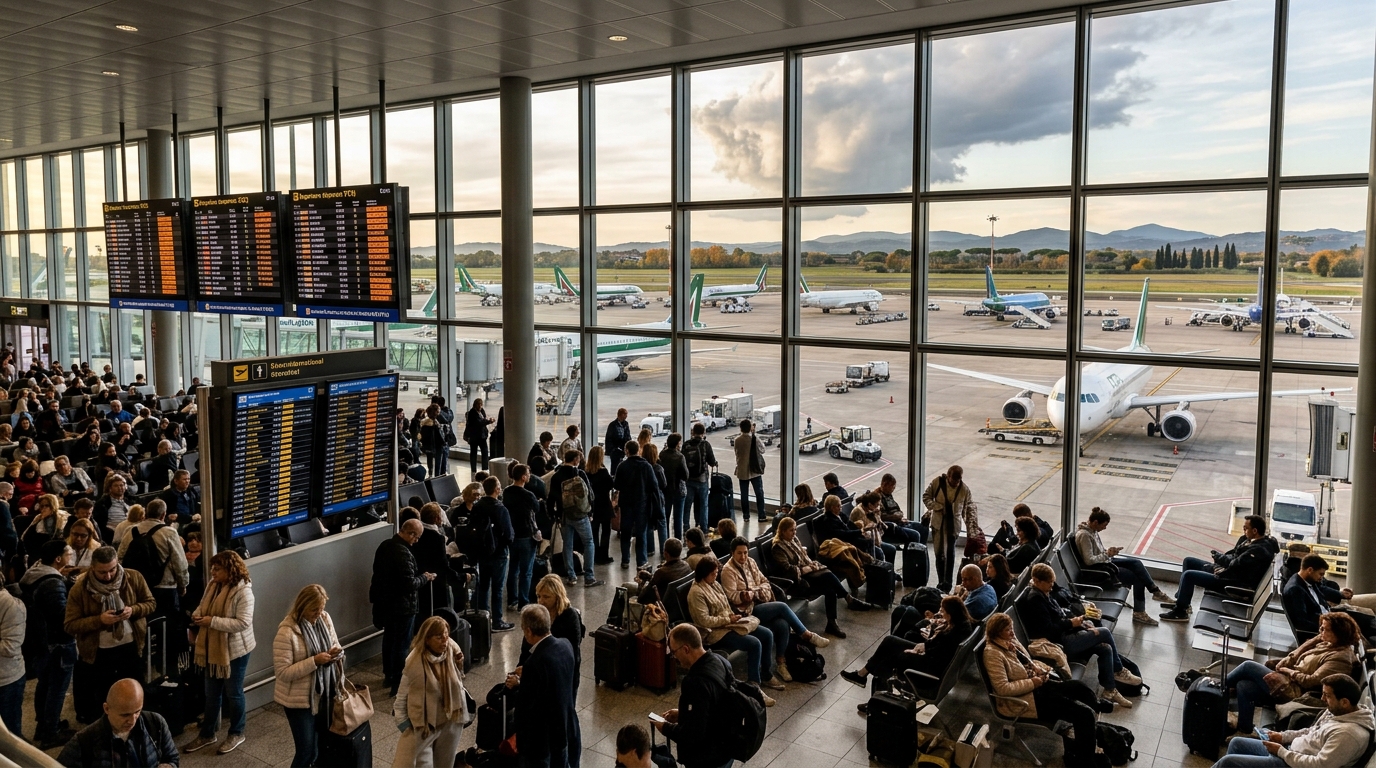
Italy's Autumn Strike Wave: The 2 Dates That Could Kill Your September Trip
Two massive nationwide strikes are set to paralyze Italian airspace just as the shoulder season begins.
If you have a flight into Rome on September 13, 2026, or anywhere in Italy on September 30, your itinerary is currently sitting on a ticking clock.
According to recent alerts from Sky VIP Services, two major labor disruptions are scheduled to hit the Italian aviation sector this autumn. First, a targeted security strike will hit Rome’s primary hubs on September 13. Then, a massive, nationwide ENAV air traffic control strike is set to paralyze the country's airspace on September 30.
Italy in September is supposed to be the "shoulder season" dream—warm enough for a spritz in Trastevere , but cool enough to walk the Spanish Steps without melting. Instead, thousands of travelers are about to learn a hard lesson in Italian labor relations.
Here is exactly how these strikes will play out and the counterintuitive moves you should make right now to keep your trip from collapsing.
The September 13 Squeeze: Rome Under Pressure
The strike on September 13 is localized but lethal for efficiency. It targets security services at Rome’s Fiumicino (FCO) and Ciampino (CIA) airports.
When security staff walk out, the ripple effect is different than a pilot strike. The planes are there. The pilots are ready. But the bottleneck at the metal detectors becomes a mile long. If you are flying out of Rome that Sunday, arriving two hours early won't be enough. You’re looking at a scenario where passengers are still in the security queue while their planes are pushing back from the gate.
The Move: If you’re flying into FCO on the 13th, you’re mostly fine—immigration is usually handled by a different cohort. But if you’re flying out, try to move your flight to the 12th or the 14th now. If you can’t, book a fast-track security pass immediately, though even those can fail if the strike is total.
The September 30 Shutdown: A Nationwide Blackout
The September 30 strike is the "Big One." This involves ENAV, the agency responsible for air traffic control (ATC) across all of Italy.
When ATC strikes, it doesn’t just affect flights landing in Milan (MXP) or Venice (VCE). It affects every flight passing through Italian airspace. A flight from London (LHR) to Malta (MLA) that usually cruises over the Italian coast will be rerouted or cancelled. Within Italy, the shutdown is usually near-total during the strike hours.
However, Italy has a unique legal quirk you need to exploit: the fasce orarie di tutela.
The "Guaranteed Windows" Strategy
By law, Italy mandates "guaranteed periods" during which flights must operate, even during a strike. These windows are typically:
- 7:00 AM to 10:00 AM
- 6:00 PM to 9:00 PM
If your flight is scheduled to depart at 8:15 AM, you have a significantly higher chance of actually taking off than someone scheduled for 2:00 PM. Airlines prioritize these windows to clear backlogs. If you are currently booked on a mid-day flight on September 30, call your airline and see if you can shift into the morning "protection window."
The Surprising "Border-Hop" Maneuver
Here is a tactic most travelers miss: If the Italian skies are closed, the ground is still open.
If you absolutely must be in Northern Italy on September 30, don't fly to Milan. Fly to Nice (NCE) in France or Zurich (ZRH) in Switzerland. From Nice, it’s a stunning three-hour train ride along the coast to Genoa. From Zurich, the EuroCity train will have you in Milan in just over three hours.
While everyone else is sleeping on stone floors at Malpensa, you’ll be watching the Alps roll by from a dining car. If you end up having to pivot your arrival to a neighboring country, make sure you have your connectivity sorted before you land so you can navigate the rail networks. Grabbing a regional Europe eSIM ensures you aren't hunting for Wi-Fi at a train station in Lugano while trying to rebook your hotels.
Why Your "Flight Delayed" Notification is a Trap
During Italian strikes, airlines often wait until the very last second to officially cancel a flight. They do this because if the strike is called off at the eleventh hour (which happens frequently in Italian labor negotiations), they want their passengers at the gate.
If you see a "Delayed" status on September 30, do not assume you have time to go get a long lunch. The moment a strike window opens or a deal is struck, the airport will attempt to flush as many planes out as possible. If you aren't there, the plane leaves without you, and you lose your right to a rebooking.
Track your inbound aircraft’s tail number. Use a tool like PingWing to see where the physical plane actually is. If the plane that is supposed to take you from Rome to Palermo is currently stuck in London, you know the "on-time" status on the airport departure board is a lie.
The Reality of Compensation
Under EU Regulation 261/2004, you are usually entitled to compensation for long delays or cancellations. However, strikes by airport staff or air traffic control are often classified as "extraordinary circumstances." This is the airline’s "Get Out of Jail Free" card—it means they don’t have to pay you the €250–€600 cash payout.
But they still owe you a duty of care. If your flight is cancelled due to the strike, the airline must provide:
- A rerouting to your destination at the earliest opportunity.
- Hotel accommodation if you’re stranded overnight.
- Vouchers for food and drinks.
If they refuse, pay for the hotel yourself, keep every single receipt, and then use a service like AirHelp to claw that money back. They are experts at navigating the "extraordinary circumstances" excuses that Italian carriers like to throw at passengers.
The "Paper Trail" Protection
If you decide to brave the strike days, your most important piece of luggage isn't a suitcase—it's your insurance policy.
Most standard travel insurance policies will not cover a strike if it was "foreseen." Since these September dates are now public knowledge, buying a policy today specifically to cover a cancellation on the 30th might be tricky. You need to check the "Travel Abandonment" clause in your policy. If a strike delays you by more than 12-24 hours, some premium policies allow you to cancel the whole trip and get your money back.
If you haven't booked your protection yet, look for a policy that specifically mentions labor disputes. Ekta Travel Insurance often has clear terms on flight disruptions that are easier to parse than the 50-page PDFs from traditional providers.
A Final Note on the "September Slide"
Italian strikes are rarely about making your life miserable—they are about leverage. They are almost always announced weeks in advance, and they are often shortened or cancelled the night before.
The smartest thing you can do for a September trip to Italy isn't to cancel it. It’s to build "The Buffer." Don't book a non-refundable, high-stakes activity—like a private tour of the Vatican Museums —for the afternoon of September 13 or the morning of October 1. Give yourself 24 hours of "slide" on either side of these strike dates.
September in Italy is worth the hassle. The light is golden, the grapes are being harvested, and the heat is finally breaking. Just make sure you’re watching the flight boards as closely as you’re watching the pasta menu. Bookmark the PingWing tracker now; you’re going to need it when the ENAV workers walk out and the departure boards start turning red.