
American Airlines’ New Anti-Gate-Lice Tech: Why Your Group 5 Boarding Pass Just Got Flagged
A viral crackdown on passengers crowding the gate is finally rolling out nationwide, and it will stop you at the scanner.
American Airlines’ New Anti-Gate-Lice Tech: Why Your Group 5 Boarding Pass Just Got Flagged
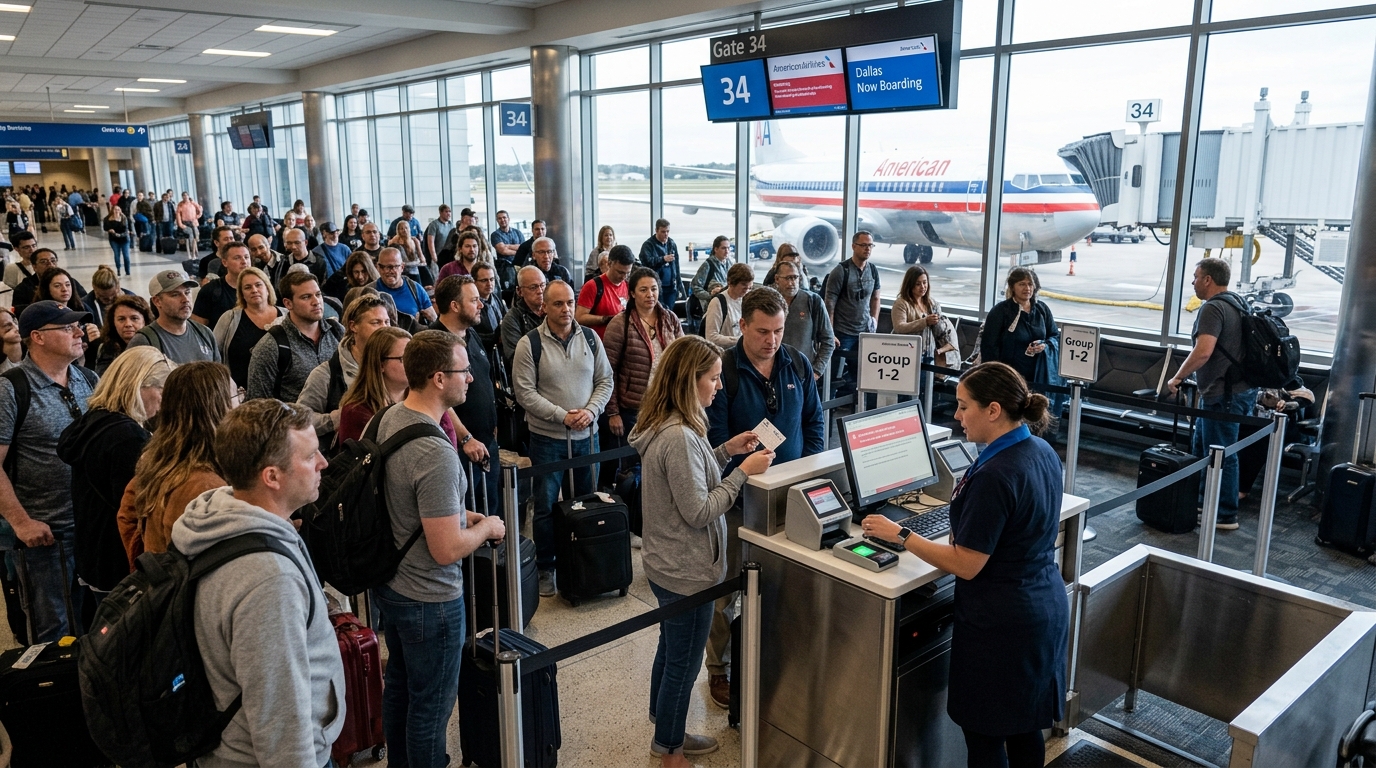
The sound is unmistakable: a sharp, discordant "error" beep that cuts through the ambient hum of gate announcements and rolling luggage. It’s the sound of a passenger in Group 5 trying to sneak onto a Boeing 737 during the Group 2 call, and as of this August, it’s becoming the new soundtrack of American Airlines hubs nationwide.
American Airlines recently expanded its automated boarding technology to over 100 airports, including major hubs like DFW and DCA, specifically designed to alert gate agents when a passenger scans their pass before their group is called. The "shame beep" isn't just a glitch; it’s a systematic crackdown on "gate lice"—that eager, hovering mass of travelers who crowd the boarding area long before their zone is summoned. If you’ve been relying on the "I didn't hear the announcement" excuse to snag early overhead bin space, your luck just ran out.
The Death of the "Gate Lice" Strategy
We’ve all seen them. They congregate around the carpet’s edge like they’re waiting for a concert to start, blocking the path for First Class and Executive Platinum flyers. The industry term "gate lice" is harsh, but for frequent flyers trying to navigate a crowded terminal, it’s felt earned.
Until now, gate agents were the only line of defense. But agents are human. They’re under intense pressure to hit "D-Zero" (pushing back the plane exactly on time). When a line of 180 people is bearing down on them, many agents would simply let a Group 6 passenger slide through during Group 4 just to keep the line moving.
The new software changes the power dynamic. When the scanner flags an out-of-order boarding pass, it doesn’t just beep; it locks the screen. The agent is forced to acknowledge the error. In most cases, they are now instructed to politely tell the passenger to step aside and wait for their group. It’s an automated enforcement of etiquette that removes the agent’s "nice guy" discretion.
Why Everyone Is So Desperate (And Why It's Getting Worse)
The root of the gate lice phenomenon isn't a collective lack of manners. It’s math.
A standard Boeing 737-800 holds about 160 to 190 passengers. Even with modern "Space Bins," there is rarely enough room for every single person to bring a full-sized roll-aboard. If you are in Group 5 or higher on a full flight, the statistical probability of you having to gate-check your bag is nearing 100%.
For many, gate-checking is the ultimate travel fail. It means waiting 20 minutes at the baggage carousel at your destination or, worse, having your "checked-at-gate" bag sent to the wrong city because the tag was printed in a rush. To avoid this, people hover. They crowd. They try to cheat the system.
But with AA’s new tech, the "hover and hope" strategy is dead. If you’re at the gate early, you’re just standing in the way of the people who actually have a right to be there.
How to Actually Get Your Bag on the Plane (Without the Beep)
If you’re a Group 5 traveler and you’re terrified of the baggage carousel, you need a better strategy than trying to outsmart a computer.
1. The Credit Card Shortcut This is the most obvious path, but many people overlook the math. The Citi® / AAdvantage® Platinum Select® or the Barclays equivalent usually nets you Group 5 boarding automatically. On American, Group 5 is the first group of "regular" boarding after the elites and premium cabin. If you’re in Group 5, you almost always get bin space. If you’re in Group 6-9, you’re in the danger zone.
2. The "Soft Bag" Pivot Hard-shell suitcases are the enemy of the late-boarding traveler. They don't compress. If the bin is 90% full, a hard-shell won't fit, and the flight attendant will send it to the hold. I’ve switched to a high-quality, semi-structured duffel for shorter trips. You can almost always mash a soft bag into the weirdly shaped gaps that roll-aboards leave behind.
3. The Opposite-Side Trick This is the most effective "secret" I’ve used: When you finally board in Group 6 or 7, don't just look at the bins over your seat. Look at the bins on the opposite side of the aisle. People have a psychological tendency to look only at "their" side. Often, the left side of the plane is stuffed, while the right side has a perfectly bag-sized gap three rows back.
The Ethics of the Boarding Area
While you’re waiting for your group to be called, don’t just stand there staring at the screen. If you're stuck in a terminal like JFK Terminal 8 or the sprawling concourses of Charlotte Douglas, find a seat.
If you’re worried about missing the "real" status of your flight, don't rely on the gate agent’s muffled microphone. Using a tool like PingWing allows you to track your flight’s actual status and gate changes in real-time, often before the gate agent even makes an announcement. If the plane hasn't even arrived at the gate yet, there is zero reason to be standing in the boarding lane.
What This Means for the Future of Travel
American Airlines isn't the first to try this, but they are the first to roll it out with this much systematic aggression. United and Delta are watching. If AA’s "D-Zero" numbers improve because boarding is more orderly, expect every major carrier to implement "shame beeps" by 2026.
The era of the "boarding pass gamble" is ending. We are moving toward a more rigid, algorithmic airport experience. While it might feel annoying to be told to wait, the reality is that the "gate lice" were making the experience worse for everyone—including themselves. By crowding the gate, they slowed down the very process they were trying to beat.
Practical Tips for the "New" Boarding Reality
- Secure Your Data: If you’re sitting further back in the terminal to avoid the gate lice crowd, you’re likely using public airport Wi-Fi. It’s a playground for data interceptors. I never connect to airport Wi-Fi without a secure VPN to keep my credentials safe while I’m killing time before Group 7 is called.
- The "Volunteer" Play: If the flight is clearly oversold on bin space, sometimes the best move is to be the first person to volunteer to check your bag to your final destination at the gate. Often, they’ll offer you early boarding in exchange for checking the bag, or at the very least, you get the peace of mind of knowing it's handled without the stress of the "bin hunt."
- Check the Load: Use the airline app to see how many "Standby" or "Upgraded" passengers are on the list. If the list is long, the flight is packed. If the list is empty, you can probably relax in your seat until the very last minute.
The One Surprising Way to Skip the Line Entirely
There is a counterintuitive strategy that almost nobody uses: Board last.
If you aren't carrying a roll-aboard—say, you’ve mastered the art of the large backpack that fits under the seat—don't even stand up when your group is called. Stay in your seat, finish your coffee, and wait until the very last person has scanned their pass. You walk onto a plane that is already settled, you don't have to stand in the jet bridge for 15 minutes, and you don't have to participate in the "shame beep" lottery.
The "gate lice" mentality is born from a scarcity mindset. But once you realize that the bin is the only thing you're fighting for, you can decide if that fight is actually worth the stress.
American Airlines has made its choice: the computer is now the referee. You can either play by the rules or enjoy the loud, public beep of rejection in front of 180 of your newest friends. Personally? I’ll be at the back of the terminal, checking travel insurance options for my next international leg, and waiting for the crowd to clear.
The "Walk of Shame" is a choice. Don't make it yours.