
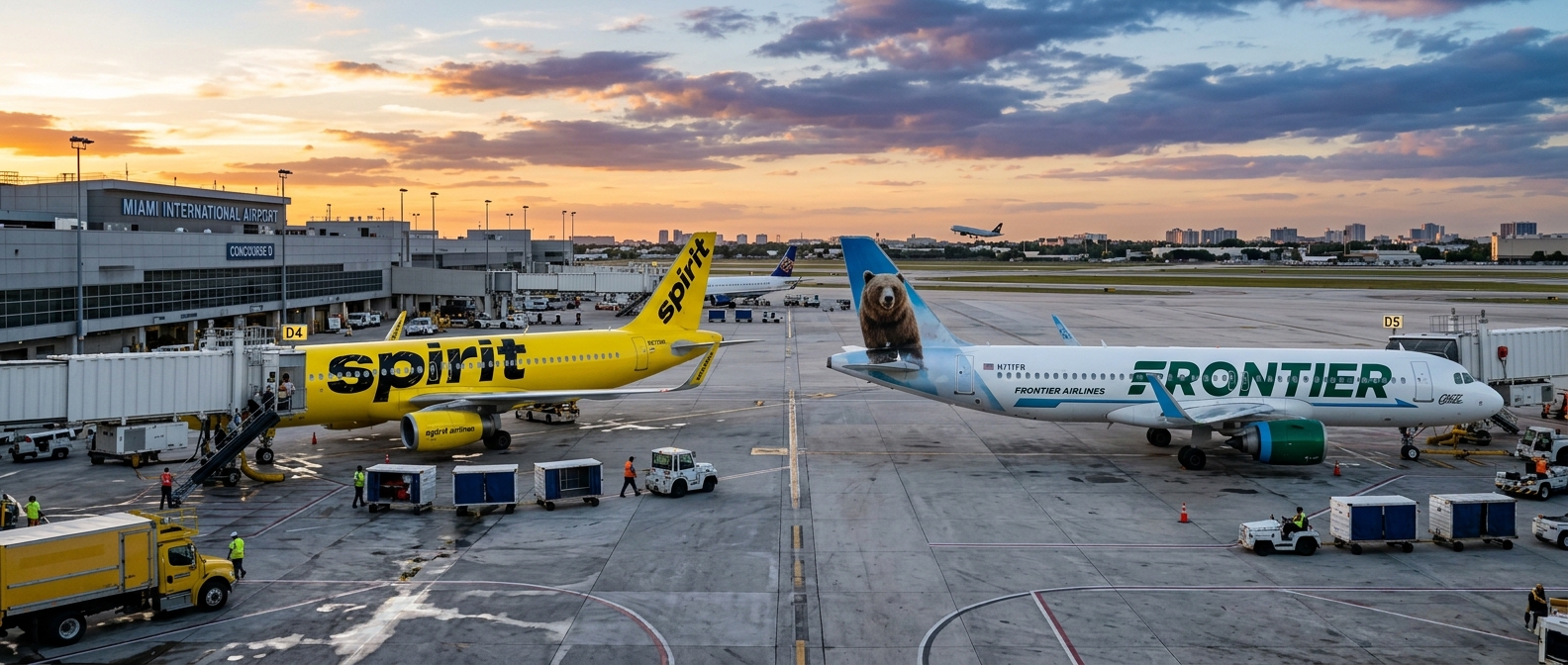
The Spirit-Frontier Merger 2.0: What Happens to Your Free Spirit Points on November 12th
With renewed merger talks reaching a critical phase, travelers need to know if their ultra-low-cost carrier miles will survive the transition.
The Spirit-Frontier Merger 2.0: What Happens to Your Free Spirit Points on November 12th
The golden era of the "Yellow Plane" might be fading into a shade of "Frontier Green" faster than most travelers anticipated. Following the breadcrumbs first dropped by the Wall Street Journal and Reuters back in October 2024—when Spirit Airlines restarted merger talks with Frontier as a desperate pivot during debt restructuring—we have finally reached the endgame.
On November 12th, the technical integration of the two most polarizing loyalty programs in the sky begins. If you’ve been hoarding Free Spirit points like a digital dragon, you have less than a month to decide whether to burn them, bank them, or pray the conversion math works in your favor. Here is the ground truth on how to handle your miles before the systems merge.
The "Snapshot" Date: Why November 12th Matters
November 12th isn't just a random Tuesday. It is the scheduled "Data Snapshot" for the Spirit-Frontier integration. On this day, the "Free Spirit" and "Frontier Miles" databases will effectively freeze to create a unified ledger.
If you are mid-flight or have a pending points transaction on that date, expect a "blackout period" where your balance might look like zero for 48 to 72 hours. Don't panic. But do take a screenshot of your current balance and your "Status Quest" progress on the night of November 11th. In every major airline merger—from United/Continental to the recent Alaska/Hawaiian tie-up—IT glitches have swallowed miles whole. A screenshot is your only receipt when the customer service bot tells you that your 40,000 points never existed.
The Conversion Math: Will Your Points Devalue?
The most pressing question in my inbox is usually: “Is a Spirit point worth a Frontier mile?”
The short answer is: likely not 1:1. Historically, Frontier Miles have been slightly harder to earn through spend but arguably more valuable on specific routes out of Denver (DEN) or Orlando (MCO). Internal memos suggest a weighted conversion ratio. If the rumors of a 1:0.8 conversion hold true, your 10,000 Free Spirit points will become 8,000 Frontier Miles.
If you have a specific redemption in mind—say, a quick hop from Fort Lauderdale (FLL) to Montego Bay (MBJ)—book it now. Existing Spirit bookings made with points before November 12th will be honored under the old terms, even if the flight isn't until 2027. If you wait until the systems merge, the "dynamic pricing" of the new combined entity will almost certainly inflate the cost of that seat.
The "Status Leapfrog": A Surprising Strategic Play
Here is a tactic most people miss: The Status Leapfrog.
Right now, it is objectively easier to earn "Gold" status with Spirit than it is to hit the equivalent "Diamond" tier with Frontier. Spirit has been aggressive with status match promos and high-multiplier earning rates on their co-branded credit cards to keep people from jumping ship during the bankruptcy rumors.
If you can grind out the last few thousand status-qualifying points on Spirit before the November 12th cutoff, you will likely be grandfathered into the Frontier equivalent. For the frequent traveler, this means "The Works" (Frontier’s bundle that includes bags and seat selection) could become a free perk for you next year. It is significantly cheaper to buy a few "mileage run" tickets on Spirit today than it will be to earn that same status in a combined, more competitive program next year.
Route Optimization (The "Hidden" Cancellation Risk)
When two airlines become one, they don't keep two planes flying the same route at the same time. They "optimize." For you, that means "cancellation."
If you are booked on a Spirit flight between major hubs like Las Vegas (LAS) and Orlando (MCO) for late November or December, keep a very close eye on your itinerary. Frontier is notorious for aggressive schedule padding. If your flight time shifts by more than two hours due to the merger integration, you are legally entitled to a full cash refund—even on a "non-refundable" ticket.
If you find yourself stuck in a terminal because a merger-related IT glitch grounded your plane, don't just settle for a $10 meal voucher. Check if you're eligible for Flight Compensation before you even leave the gate. Mergers are the primary breeding ground for "operational issues" that airlines try to blame on weather, but often stem from crew scheduling software failing to talk to a new database.
What Happens to the "Big Front Seat"?
Spirit’s "Big Front Seat" is one of the best kept secrets in domestic travel—a domestic first-class seat without the first-class price or service. Frontier, conversely, focuses on "Stretch" seating, which is just an economy seat with more legroom.
The combined airline has signaled they will keep the "Big Front Seat" hardware on existing Spirit airframes (the A320 and A321 fleets), but the branding will change. Post-November 12th, these seats will likely become "Premium Frontier Plus" or something equally corporate. The pricing will likely move from a flat upgrade fee to a points-based auction system. If you want the old-school $50 upgrade experience, your window is closing.
Practical Steps to Take Today
- Empty the Spirit Credit Card: If you have the Spirit co-branded Mastercard, look at your "Points + Cash" options. These cards often see "term changes" during mergers that make the annual fee less justifiable.
- Audit Your Expiration Dates: Free Spirit points used to expire in 12 months without activity. Frontier Miles have a similar 12-month window. Use the PingWing app to track your upcoming flights and ensure you have at least one "activity" (even a $5 magazine purchase through a portal) to keep your balance alive through the transition.
- Book the "Ghost Routes": Spirit flies to several Caribbean destinations that Frontier currently avoids. These routes are the most likely to be cut or have their frequency reduced once the accountants take over. If you've wanted to visit St. Maarten (SXM) on the cheap, book it for early next year now.
The Infrastructure of the New Airline
Expect the physical footprint to change. Spirit's massive presence at the Spirit Airlines Headquarters will remain a tech hub, but the operational "brain" is shifting toward Denver.
For travelers, this means the "Frontier-ization" of the airport experience. Expect more self-service bag drops and more aggressive gate agents measuring your "personal item." If you haven't bought a "merger-proof" personal item bag yet—one that fits the 18" x 14" x 8" dimensions of both carriers—now is the time.
Don't Let Your Miles Become "Vaporware"
The reality of airline mergers is that the customer rarely wins in the first six months. There will be lost bags, "ghost" flights that appear in search results but don't exist, and points balances that seem to fluctuate wildly.
The most important thing you can do is stay mobile and stay informed. If you're heading out on a trip during this transition period, make sure your connectivity is sorted before you land in the middle of a merger-induced delay. Grabbing a United States eSIM ensures you aren't fighting for the overtaxed airport Wi-Fi when you need to rebook a cancelled leg.
November 12th is the line in the sand. On one side, you have the chaotic, yellow, "Bare Fare" world we’ve known for years. On the other, a new ultra-low-cost giant that will either be a miracle for budget travelers or a masterclass in hidden fees. Either way, make sure your points are accounted for before the clock strikes midnight on the 11th. I’ve seen enough "database migrations" to know that "trust us" is not a travel strategy. Take the screenshot. Book the flight. Get your value while the yellow paint is still fresh.