
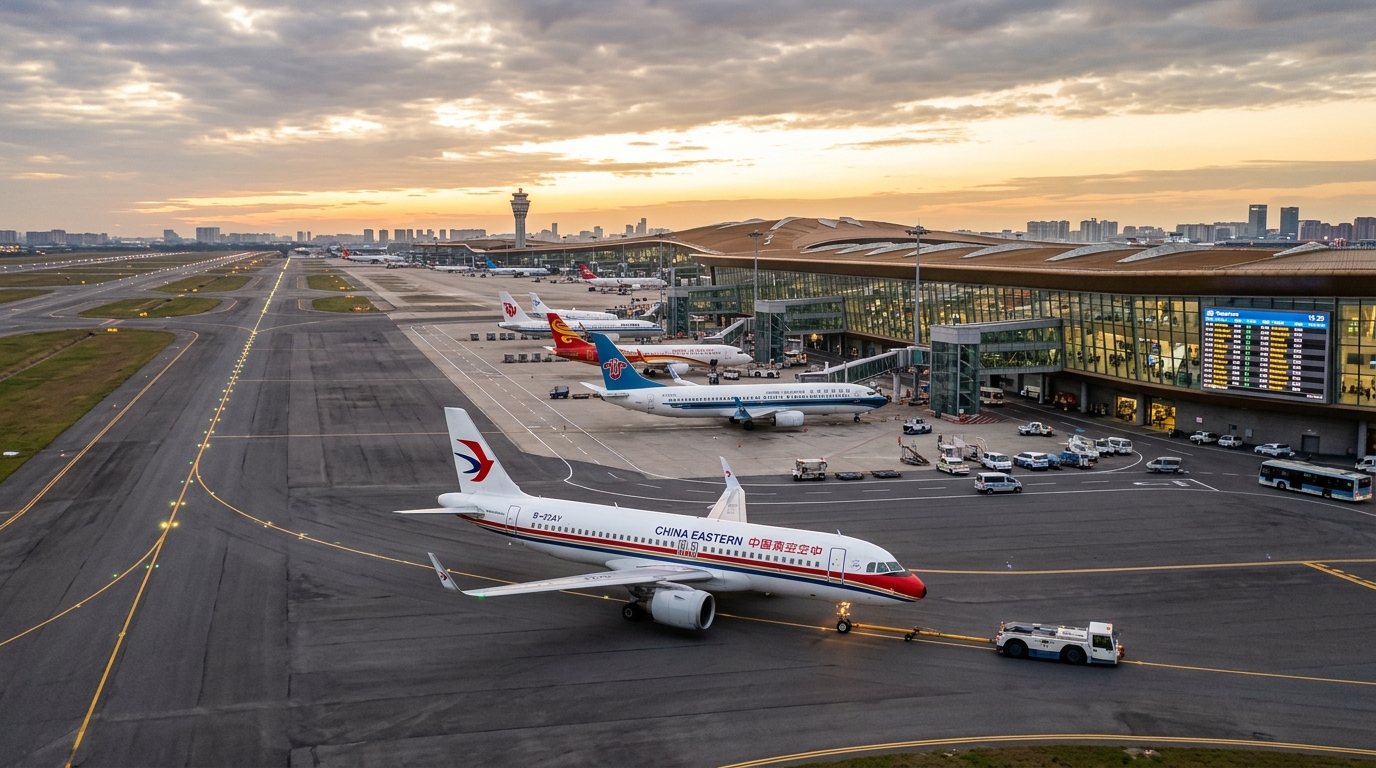
The October 25th Schedule Flip: 400 New Domestic China Routes Start Today
Today marks the official launch of the CAAC Winter-Spring flight season, meaning your saved flight times and routes just changed.
The October 25th Schedule Flip: 400 New Domestic China Routes Start Today
At midnight last night, the architecture of the Chinese sky changed. The Civil Aviation Administration of China (CAAC) officially transitioned to the 2026/27 Winter-Spring flight season today, October 25, 2026, triggering a massive reshuffle of domestic and international slots.
If you have a flight booked within China for this week, stop reading for ten seconds and check your airline app. There is a high probability your departure time has shifted, your gate has moved, or your flight number has been retired entirely in favor of a new seasonal schedule.
This isn't just a routine update. We are looking at over 400 brand-new domestic routes launching today, alongside a significant pivot toward "Ice and Snow" tourism in the north and tropical "escape" routes to the south. Here is what you need to know to navigate the flip without losing your mind—or your connection.
The 30-Minute Trap
The most dangerous part of the October 25th shift isn't the canceled flights; it’s the flights that still exist but have moved by 20 to 40 minutes. In the world of tight connections at massive hubs like Beijing Daxing (PKX) or Shanghai Pudong (PVG), 30 minutes is the difference between making your flight and watching it push back from the lounge window.
Airlines often "optimize" their turn times during the winter season to account for de-icing procedures in northern cities like Harbin (HRB) or Changchun (CGQ). This means your 90-minute layover in Beijing might have just shrunk to 55 minutes. Check your PNR (Passenger Name Record) now. If the airline changed your schedule and the new connection is below the "Minimum Connection Time" (MCT), you are entitled to a rebooking on a more sensible routing.
If a schedule change results in a significant delay or a missed connection due to these systemic shifts, you might be eligible for help. While Chinese domestic regulations differ from EU rules, international legs connecting through China are often covered by AirHelp's flight compensation services.
Where the New 400 Routes are Heading
The CAAC's winter schedule is a direct reflection of where the money is moving. This year, the focus is aggressively shifted toward the "Ice and Snow" economy.
- The Harbin Surge: Following the massive success of previous winter seasons, Harbin (HRB) is seeing a double-digit percentage increase in daily slots. New direct routes from tier-2 southern cities like Fuzhou (FOC) and Kunming (KMG) mean you no longer have to hub through Beijing to get to the [Harbin Ice and Snow World]( ).
- The Western Expansion: Chengdu’s dual-hub system (CTU and TFU) is finally reaching its designed capacity. Expect a flurry of new "Silk Road" routes connecting Chengdu Tianfu (TFU) to smaller outposts in Xinjiang and Gansu.
- Tropical Resilience: Hainan remains the winter king. Sanya (SYX) and Haikou (HAK) have added dozens of "red-eye" slots to accommodate the demand from northern "snowbirds" fleeing the cold.
The Counterintuitive Tip: The "Ghost" Flight Bargain
Here is something most travelers miss during the October schedule flip: The Load Factor Gap.
When an airline launches one of these 400 new routes today, their historical data for that specific leg is zero. Their algorithms often default to lower "introductory" pricing to ensure the planes don't fly empty while the route gains visibility in search engines. For the next 14 days, you can often find "ghost flights"—newly added frequencies on routes like Shenzhen (SZX) to Shenyang (SHE)—priced significantly lower than the established morning flights.
If you are flexible, search for the mid-afternoon departures. These are frequently the "new" slots added in the Winter-Spring reshuffle, and they are currently the best value in the Chinese domestic market.
Staying Connected in the New Season
Navigating Chinese airports requires more than just a boarding pass; it requires a functioning smartphone with local data and the ability to bypass the Great Firewall. If you are landing in China today to catch one of these new routes, don't rely on the infamously spotty airport Wi-Fi that requires a Chinese SMS code to activate.
I always recommend grabbing a China-specific eSIM before you touch down. It bypasses the need for a local SIM card and, crucially, often provides a cleaner roaming data path that makes accessing your usual apps much easier. Combine this with a reliable VPN to ensure you can actually check your maps and flight trackers without hitting a digital wall at your hotel in the [Futian District]( ).
The Regional Jet Revival
Keep an eye on the aircraft type when you re-check your bookings today. The 2026/27 winter schedule sees a massive uptick in the use of the COMAC ARJ21 and C919.
Chinese carriers are increasingly using the smaller ARJ21 for these new "thin" routes between tier-3 cities. If you’re used to the wide-body comfort of an A350 between major hubs, the jump to a regional jet can be a shock. They are louder, the overhead bins are smaller, and the seating is 2-3. If you’re a frequent flyer who values space, check the "Equipment" tab in your flight tracker. If it says ARJ21, pack a smaller carry-on.
Why Today is the "Reset" for Your Apps
Because the CAAC schedule change is so comprehensive, many third-party flight tracking apps may show "ghost" data for 24-48 hours as they reconcile the new slot times with actual transponder data.
This is the day to trust the tail number, not just the flight number. Airlines often swap airframes during the season change. A flight number that usually uses a Boeing 787 might suddenly be downgraded to a 737-800 starting today. If you’ve paid for a "Premium Economy" seat that only exists on the 787, you need to verify your seat assignment immediately.
Beyond the Domestic: The International Ripple
While the 400 routes are domestic-focused, the Winter-Spring flip also marks the return of several long-haul frequencies. Expect to see increased capacity from London (LHR), Frankfurt (FRA), and Singapore (SIN) into China’s secondary hubs.
If you are planning an international trip involving a Chinese connection, remember that the "minimum connection time" at Beijing Capital (PEK) is notoriously optimistic. With the new winter schedule, ground handling at PEK and PVG often slows down due to weather. Give yourself at least three hours. It’s better to spend an hour in a lounge near the [Bund]( ) than to spend ten hours arguing with a transfer desk.
The October flip is a reminder of how fast the Chinese aviation market moves. It’s a market that doesn’t just grow; it re-invents its entire schedule twice a year. Today, the map looks different than it did yesterday.
Bookmark your route, refresh your tracker, and don't assume the flight you booked in August still leaves at 9:00 AM. In the 2026 winter season, the only thing that's permanent is the change itself. Or, more likely, a 20-minute delay for de-icing in Urumqi.