
The Bali Levy 2.0: Why You Must Scan Your QR Code Before Reaching the Immigration Desk
Indonesia has just installed automated enforcement gates at Denpasar Airport to catch travelers who haven't paid the mandatory tourist tax before landing.
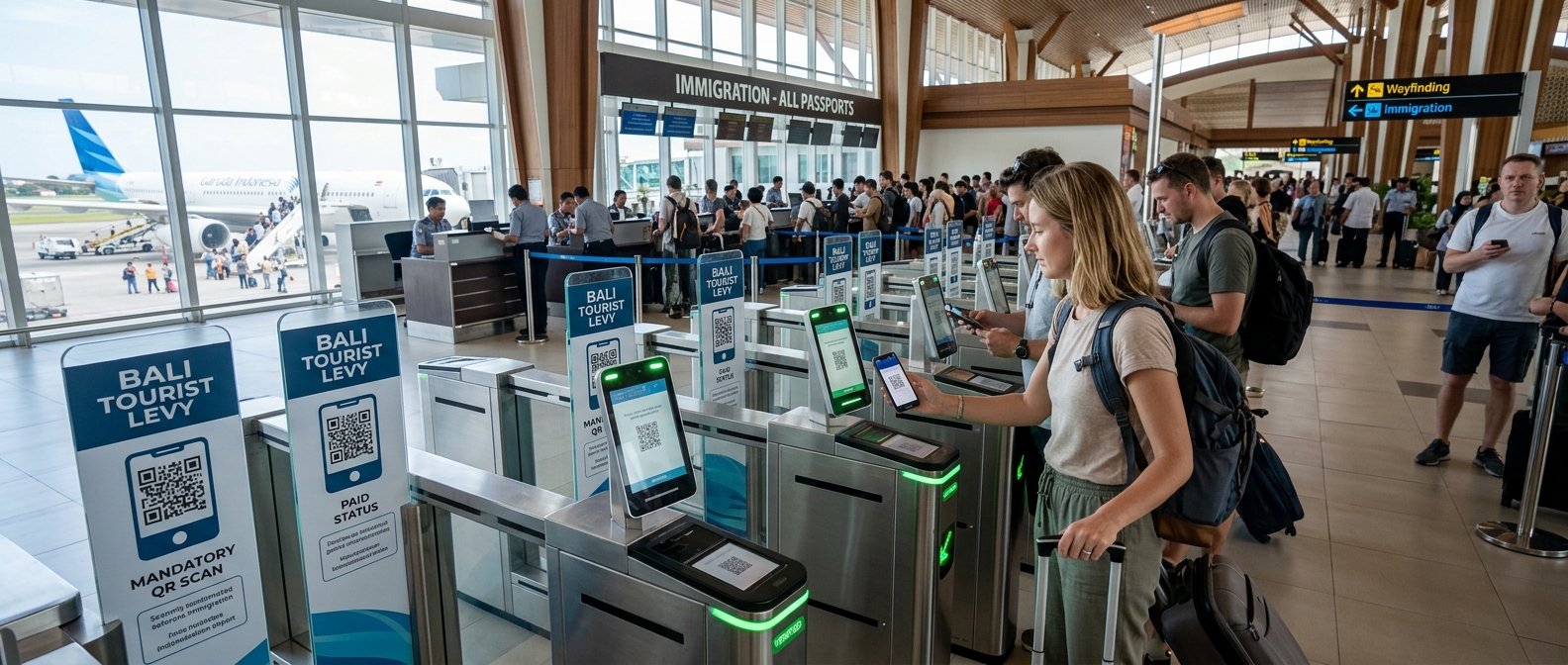
On October 12, 2026, the arrival hall at Ngurah Rai International Airport (DPS) underwent a silent but high-tech transformation. Authorities officially activated a row of automated digital checkpoints in the primary arrival concourse, effectively turning the "mandatory" Bali tourist levy from a polite request into a hard physical barrier.
If you land in Denpasar without your IDR 150,000 (roughly $10 USD) payment already processed, you aren't just flirting with a fine—you are looking at a literal bottleneck that could add an hour to your transit time. The days of "I’ll pay it at the hotel" or "Maybe they won't ask" are officially over. These new gates require a valid QR code scan before you are even permitted to approach the immigration desks.
Here is the reality of Bali’s "Levy 2.0" and how to navigate it without losing your mind in the humidity of the arrival terminal.
The New Digital Gatekeepers
The enforcement gates are positioned right after you exit the jet bridge and follow the corridors toward the main hall. They look remarkably like the automated e-gates used for passport control in Heathrow (LHR) or Singapore Changi (SIN). You approach, scan the QR code issued by the "Love Bali" system, and the glass barriers slide open.
If the light turns red? You are directed to a "reconciliation desk."
This is where the nightmare begins. The reconciliation desk is essentially a purgatory for the unprepared. You will find yourself standing behind dozens of other travelers who also forgot to pay, all trying to use the airport’s notoriously fickle public Wi-Fi to process payments on their phones. On a heavy arrival afternoon—when the big birds from Emirates and China Southern land back-to-back—this line moves with the speed of cooling lava.
Don't Trust the Airport Wi-Fi
The most common mistake travelers make is assuming they can just "pull up the email" when they land. Ngurah Rai’s Wi-Fi is better than it used to be, but it still chokes when three hundred people simultaneously try to download a PDF receipt.
The smarter move is to have your connectivity sorted before the wheels touch the tarmac. If you’re relying on a local connection to access your payment proof, ensure you have an Indonesia eSIM activated the moment you land. Having 4G or 5G bars while everyone else is staring at a spinning loading icon is the ultimate airport power move. It allows you to pull up your "Love Bali" QR code instantly and breeze through the automated gates while the rest of your flight is stuck in the "No Connection" huddle.
The Surprising "Group QR" Glitch
Here is something most travel blogs won't tell you: the system currently struggles with group payments. While the Love Bali portal allows you to pay for a family of four in one transaction, it often generates a single QR code for the entire group.
In theory, you scan it four times. In practice, the new automated gates at DPS sometimes "lock out" after the second scan, thinking it’s a duplicate entry.
The Fix: If you are traveling in a group, process your payments individually. It’s a minor annoyance during the application phase, but having four distinct QR codes on four different phones (or four separate screenshots on one phone) ensures that the gate sensors don't flag you for a "double scan" error. If you must do a group payment, make sure the person holding the phone is the last one to go through, handing the phone back through the gate gap to the next person. It’s clumsy. Just pay individually.
The "Levy 2.0" Workflow: Step-by-Step
To avoid the October 2026 enforcement traps, follow this exact sequence:
- Pay 48 Hours Out: Use the official Love Bali website or app. Do not use third-party "expeditor" sites that charge a $5 convenience fee. They are a scam.
- Screenshot the QR: Do not rely on the PDF living in your email inbox. Take a high-resolution screenshot and "Favorite" it in your photo gallery.
- Check Your Exemption: If you are on a KITAS (stay permit) or a diplomatic visa, you are exempt. However, you must register your exemption on the portal at least five days before arrival. The automated gates will not recognize your residency status by looking at your passport; they only care about the QR code.
- The Physical Backup: If you’re a "belt and braces" traveler, print the QR code. The scanners at the new gates are sensitive to screen glare, especially if you have one of those privacy screen protectors that darkens the display at an angle. A piece of paper never has a low battery or a glare issue.
Life Beyond the Gates
Once you’ve cleared the levy gates and passed through immigration, the usual Bali chaos resumes. The taxi scrum at the exit is still there, though it’s slightly more organized than it was five years ago.
If you’re heading straight to the clifftops of the Bukit Peninsula for a sunset session at , do yourself a favor and pre-book your transport. Trying to negotiate a fair rate with a "freelance" driver while jet-lagged is a losing game. You can easily arrange airport transfers in advance to have a driver waiting with a sign, which is a godsend when you just want to get to your villa and jump in the pool.
Why Is This Happening Now?
The timing of this October 2026 enforcement push isn't accidental. The Balinese government has been vocal about shifting toward "quality tourism." The levy was introduced in early 2024, but for the first two years, enforcement was spotty—mostly random checks at popular sites like or the Uluwatu Temple.
By installing these gates at the airport, the provincial government is ensuring a 100% capture rate. The funds are earmarked for waste management and cultural preservation—two things Bali desperately needs as it grapples with its own popularity. Whether the money actually makes it to the coral reefs and trash-processing centers is a topic of heated debate among locals, but for you, the traveler, the "why" matters less than the "how."
The "Old Bali" Trap
A final word of caution: don't listen to frequent visitors who "know a guy" or who haven't been back since 2023. They will tell you the tax is optional or that nobody checks. That advice is now obsolete. The physical infrastructure at the airport has changed the game.
I’ve seen travelers get genuinely distressed at the new gates, not because they couldn't afford the $10, but because the technical friction of paying it on the spot—while tired, hot, and disconnected—is a miserable way to start a vacation.
Bali is still the Island of the Gods, but those gods now expect a digital tribute before they let you into the temple. Scan the code, beat the gates, and get to the beach. The Bintang tastes better when you haven't spent your first hour in the country arguing with a glass barrier.
Don't let a bureaucratic QR code be the thing that ruins your first impression of the island. If you’re worried about other travel hiccups, like the sudden "medical tourism" insurance requirements that occasionally pop up in Southeast Asia, it’s always wise to have a robust travel insurance policy that covers the weird stuff—not just lost bags, but the sudden administrative shifts that can derail a trip.
Welcome to Bali 2.0. It’s more efficient, more expensive, and just as beautiful as it ever was—provided you can get past the gate.